
This historical portrait represents Lazzaro Spallanzani (1729–1799), an Italian priest, biologist, and physiologist who made fundamental contributions to the experimental study of bodily functions and animal reproduction. His most critical legacy in medical science, however, lies in his rigorous experiments with nutrient broth, which aimed to disprove the prevailing theory of spontaneous generation. By demonstrating that microorganisms do not arise from inorganic matter but are introduced from the environment, Spallanzani provided the essential scientific bridge between early microscopy and the eventual development of the germ theory of disease.
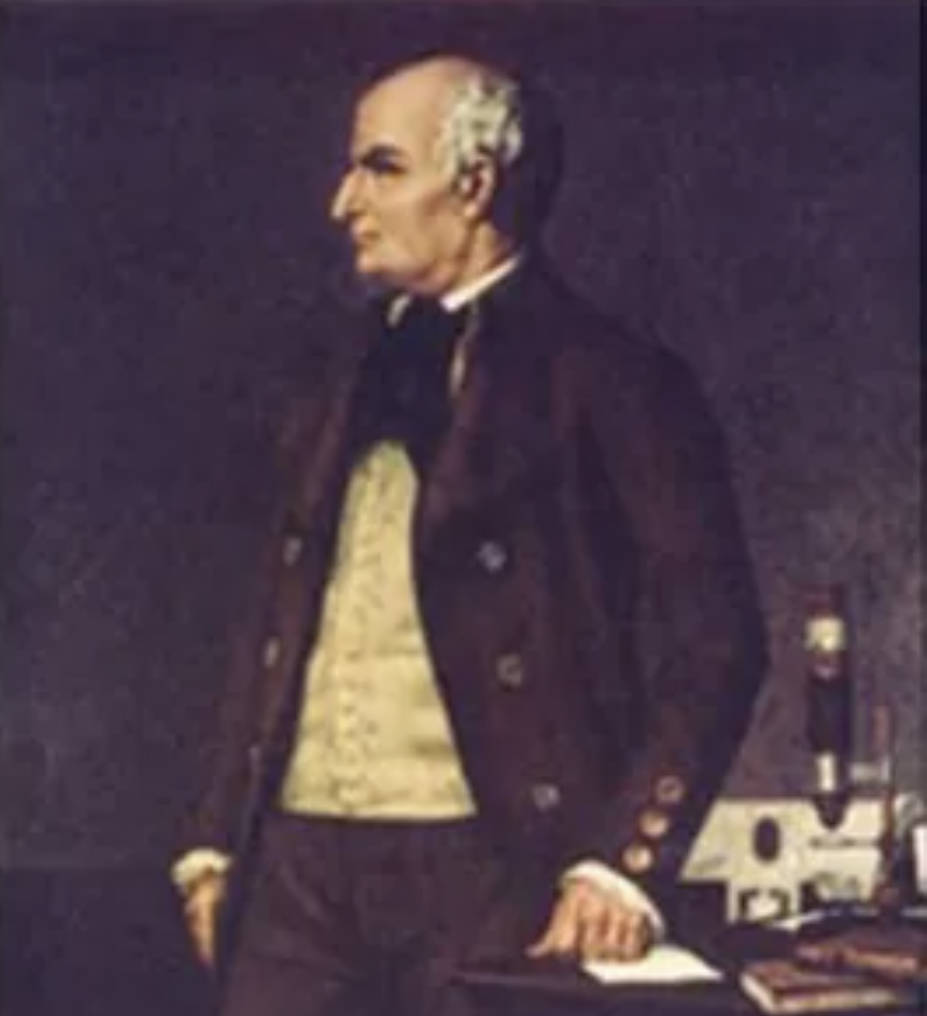
Image Overview
The image is a classic portrait of Lazzaro Spallanzani, typically depicted in the scholarly attire of the late 18th century. He is shown in a profile or semi-profile view, reflecting the intellectual gravitas associated with the Enlightenment-era scientists. In many such depictions, he is surrounded by the tools of his trade—books, manuscripts, or glass vessels—symbolizing his transition from theoretical philosophy to empirical, laboratory-based biology. This image captures the man who first mastered the art of biological isolation, a technique that would later become the standard for sterile procedures in modern medicine.
Historical Context: The Needham-Spallanzani Debate
During the mid-18th century, the scientific community was divided over the origin of microscopic life. John Needham, an English clergyman, had conducted experiments where he boiled mutton broth and sealed it with corks, only to find that microbes appeared days later. Needham argued that a “vegetative force” or “vital force” within the organic matter spontaneously generated life when heated.
Spallanzani was skeptical of Needham’s findings, suspecting that the broth had either not been boiled long enough to kill all existing microbes or that the cork seals were not truly airtight. In 1768, Spallanzani conducted a series of refined experiments. He boiled his infusions for a full hour and hermetically sealed the glass flasks by fusing the necks shut with a flame. His results were definitive: no microbes appeared in the sealed, boiled flasks. This was the first major evidence for biogenesis—the principle that living organisms only arise from other living organisms.
Scientific Significance and Methodology
Spallanzani’s work was revolutionary because of its emphasis on controlled variables. He recognized that air itself might contain the “seeds” of microbes, a concept that predated the formal understanding of airborne pathogens. His methodology established several key principles used in modern medical research:
- Sterilization through Heat: He proved that sufficient heat could neutralize the biological agents responsible for spoilage and infection.
- Isolation and Sealing: He demonstrated that the environment is a constant source of contamination, and that maintaining sterility requires a physical, impermeable barrier.
- Observation and Replicability: By systematically varying the boiling times and the types of seals, he applied a level of rigor that was uncommon in the biological sciences of his day.
While his critics argued that his excessive boiling destroyed the “vital force” in the air, Spallanzani’s persistence in documenting his results laid the groundwork for the next century of discoveries. He effectively shifted the focus of biology from speculative metaphysics to observable, microscopic reality.
Legacy in Microbiology and Clinical Medicine
The direct lineage from Lazzaro Spallanzani to modern healthcare is clear. His experiments with sealing and heating were the precursors to pasteurization and the development of the autoclave. In the 19th century, Louis Pasteur would use Spallanzani’s methods as a starting point for his own swan-neck flask experiments, which eventually ended the debate on spontaneous generation once and for all.
In a clinical sense, Spallanzani is also recognized for his work on digestion, where he proved that digestion is a chemical process involving gastric juice rather than just a mechanical grinding of food. His multi-faceted approach to the body—viewing it as a system governed by physical and chemical laws—helped move medicine away from the era of the “four humors” and toward a science-based understanding of human physiology.
Key Learning Points for Medical Learners
For healthcare professionals and students, Spallanzani’s career offers several practical insights into the evolution of medical thought:
- Foundations of Sterility: The basic mechanics of medical sterilization (heat + time + isolation) were first codified in Spallanzani’s broth experiments.
- Biogenesis over Spontaneous Generation: Understanding that infection is an invasion of external organisms, rather than an internal “spontaneous” event, is the foundation of all antibiotic and antiseptic therapies.
- Experimental Rigor: Spallanzani’s success over Needham highlights how small flaws in experimental design (like poor seals or insufficient heating) can lead to profoundly incorrect medical conclusions.
In summary, Lazzaro Spallanzani represents the critical historical moment when the biological sciences became experimental. His portrait serves as a reminder that the sterile environments of today’s operating rooms and laboratories are built upon his 18th-century insistence that life does not appear from nowhere, but must be carefully kept out to ensure safety and health.
Medical Learning Tips
- Identify Spallanzani as the primary 18th-century challenger to the theory of spontaneous generation through heat and airtight sealing.
- Contrast Spallanzani’s hermetic glass seals with Needham's porous cork seals to understand why experimental results varied.
- Recognize that Spallanzani’s work on gastric juices also significantly advanced the understanding of human digestive physiology.


