
The trajectory of human civilization has been fundamentally altered not just by wars or political shifts, but by our evolving understanding of the microscopic world. For the vast majority of human existence, the causes of illness remained a terrifying mystery, often attributed to divine punishment, planetary alignments, or invisible ‘miasmas’ rising from decaying matter. The transition from these ancient superstitions to the rigorous, evidence-based science of the modern era is a core pillar of Medical History. This journey was not a linear progression but a hard-fought battle led by visionary thinkers who dared to look closer, question the status quo, and apply the scientific method to the invisible killers that plagued humanity. From the first glimpse of a cell to the definitive identification of bacterial pathogens, each milestone in this timeline represents a paradigm shift that has saved billions of lives. By examining the landmarks of medical discovery, we gain a deeper appreciation for the foundation of modern healthcare and the persistent intellectual curiosity required to solve the biological puzzles of our species.
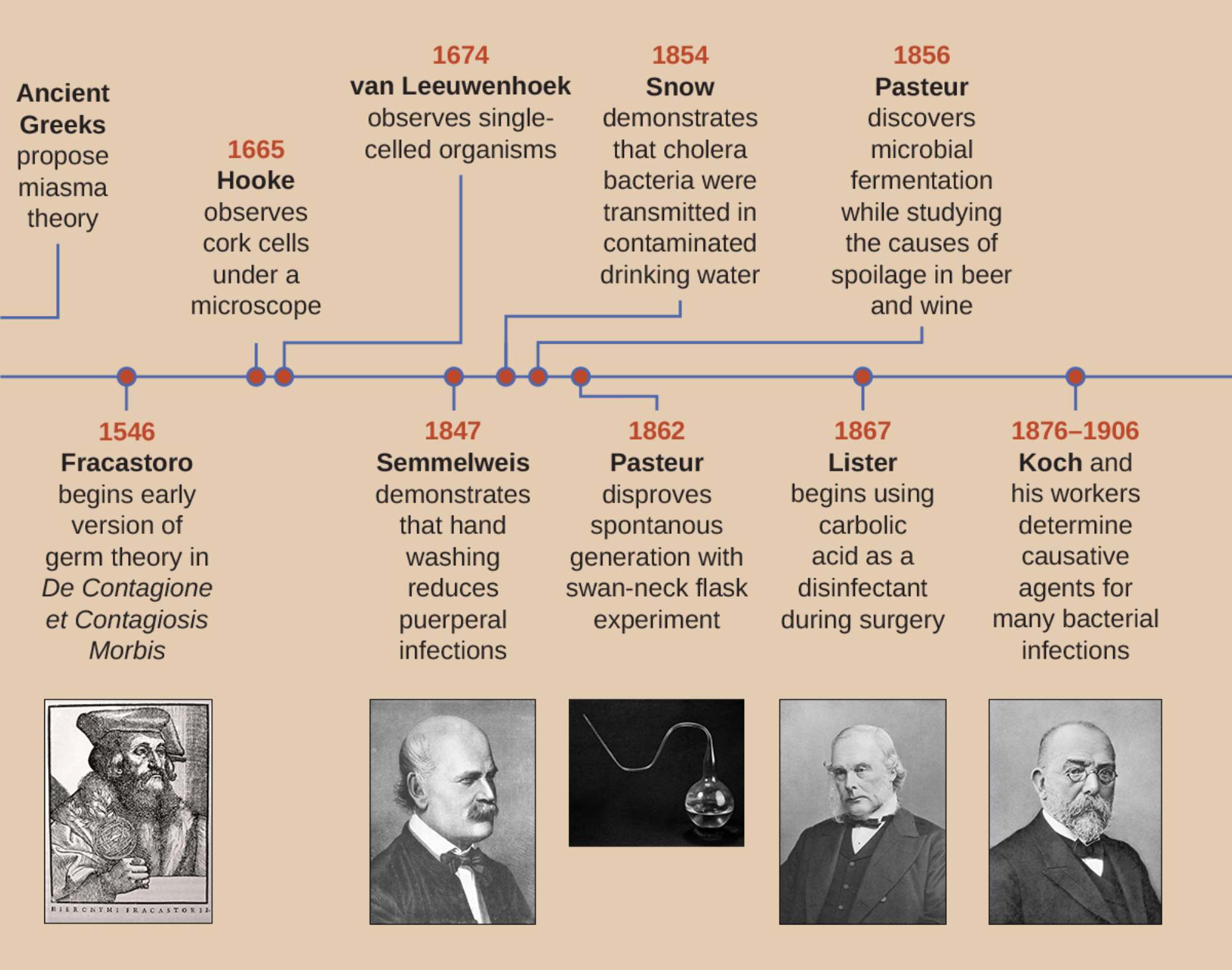
Ancient Greeks: They proposed the miasma theory, which suggested that diseases like the plague and cholera were caused by ‘bad air’ or noxious vapors. This belief persisted for nearly two thousand years, often leading to ineffective public health measures centered on masking odors rather than cleaning water or air.
1546 Fracastoro: Girolamo Fracastoro wrote ‘De Contagione et Contagiosis Morbis,’ which introduced an early, theoretical version of germ theory. He hypothesized that ‘seedlets’ of contagion could be transmitted between people, though he lacked the technology to prove their physical existence.
1665 Hooke: Robert Hooke utilized a primitive compound microscope to examine a thin slice of cork and discovered small, repeating units he called ‘cells.’ While he was observing dead plant tissue, his work introduced the concept of biological building blocks to the scientific world.
1674 van Leeuwenhoek: Antonie van Leeuwenhoek was the first to observe living single-celled organisms, which he termed ‘animalcules,’ through high-powered single lenses he ground himself. This discovery revealed a hidden world of life, although the link between these microbes and human disease remained undiscovered for another century.
1847 Semmelweis: Ignaz Semmelweis identified that hand washing with chlorinated lime solutions drastically reduced maternal mortality from puerperal fever in hospitals. Despite his statistical proof, he was largely ridiculed by his peers, demonstrating the immense social resistance to early hygiene reforms.
1854 Snow: John Snow mapped a cholera outbreak in London and traced its source to a specific public water pump on Broad Street. His evidence-based approach successfully challenged the miasma theory and established the field of modern epidemiology.
1856 Pasteur (Fermentation): Louis Pasteur discovered that microbial fermentation was the process behind the spoilage of beer and wine. This research proved that microorganisms were active agents capable of causing physical and chemical changes in their environment, laying the groundwork for his later work on disease.
1862 Pasteur (Swan-neck flask): Through his famous swan-neck flask experiment, Pasteur definitively disproved the theory of spontaneous generation. He demonstrated that sterilized broth remained pure unless exposed to airborne dust, proving that life only arises from pre-existing life.
1867 Lister: Joseph Lister applied Pasteur’s findings to clinical practice by using carbolic acid to disinfect surgical wounds and instruments. This ‘antiseptic principle’ fundamentally changed the safety of surgery, turning it from a high-risk gamble into a life-saving medical specialty.
1876-1906 Koch and his workers: Robert Koch and his team developed a set of scientific criteria, known as Koch’s postulates, to identify the specific causative agents of infectious diseases. Their work identified the bacteria responsible for anthrax, tuberculosis, and cholera, ushering in the golden age of microbiology.
Ancient Foundations and the Miasma Myth
To understand the revolutionary nature of Germ Theory, one must first understand the miasma theory that it replaced. For centuries, the brightest minds in medicine believed that diseases were the result of environmental ‘rot.’ If a swamp smelled foul, it was assumed that the smell itself carried the disease. This led to peculiar medical practices, such as doctors carrying bouquets of flowers or wearing ‘plague masks’ filled with herbs to ward off the bad air. While these measures were ineffective at stopping the spread of bacteria or viruses, they reflected a primitive understanding that something in the environment was responsible for sickness.
The transition away from miasma was slow because the theory seemed to align with common sense. People noticed that areas with poor sanitation and foul smells often had higher rates of disease. However, without the ability to see microscopic pathogens, they confused the symptom (the smell of rot) with the cause (the bacteria causing the rot). It would take the combined efforts of early microscopists and innovative clinicians to move Medical History past these ancient misconceptions and toward a microscopic reality.
The Optical Revolution: From Cells to Animalcules
The mid-17th century marked the beginning of a technological leap that would eventually destroy the miasma theory. When Robert Hooke first published his drawings of ‘cells’ in 1665, he opened the door to a new way of looking at the body. No longer was a human just a collection of humors and fluids; it was a complex structure built of billions of individual units. Although Hooke’s cells were empty, dead structures, the mere idea that life had a microscopic architecture was a necessary prerequisite for understanding infection.
A few years later, Antonie van Leeuwenhoek took this a step further by observing living microbes in drops of water and scrapings from teeth. These ‘animalcules’ were the first bacteria and protozoa ever seen by a human being. Leeuwenhoek’s lenses were so superior to those of his contemporaries that no one else could replicate his findings for years, leading many to doubt his claims. This period highlights a recurring theme in science: the truth often exists right before our eyes, but we require the right tools and the willingness to believe what those tools show us before progress can be made.
The Hungarian Savior and the Birth of Hygiene
By the mid-19th century, the pressure for reform was mounting, even as the establishment resisted. Ignaz Semmelweis, working in a Vienna maternity hospital, noticed a terrifying discrepancy in death rates between two clinics. In the clinic where medical students performed autopsies before delivering babies, mothers were dying at ten times the rate of those in the clinic where midwives worked. Semmelweis deduced that ‘cadaverous particles’ were being carried on the hands of the students, and he implemented a strict hand-washing protocol.
Despite reducing the death rate from nearly 18% to less than 2%, Semmelweis was professionally ostracized. His colleagues were insulted by the suggestion that they, the healers, were actually carrying death to their patients. This tragedy serves as a sober reminder in the annals of science that data alone is often not enough to change the world; one must also overcome the social and professional ego of the status quo. Semmelweis’s work was the first practical application of what would become the ‘antiseptic principle,’ even though he could not yet identify the specific microbes involved.
Snow, Pasteur, and the Death of Spontaneous Generation
In 1854, John Snow provided the next major piece of the puzzle through Epidemiology. By mapping the victims of a London cholera outbreak, he proved that the disease followed water lines, not air currents. While Snow didn’t see the cholera bacteria, he used logic to prove it was a physical contaminant in the drinking water. Simultaneously, Louis Pasteur was performing experiments in France that would provide the biological explanation for Snow’s observations.
Pasteur’s swan-neck flask experiment is perhaps the most famous single experiment in the history of biology. By showing that life did not ‘spontaneously’ appear in a sterile environment, he established the law of Biogenesis. This proved that if a patient got sick, something living must have entered their body from the outside. Pasteur’s work on fermentation further showed that these microbes were active chemical agents. Together, Snow and Pasteur provided the ‘what’ and the ‘how’ that allowed for the final formation of a unified theory of germs.
The Golden Age of Bacteriology and Lister’s Surgery
Once the existence and role of microbes were accepted, the final phase of this medical revolution began. Joseph Lister, reading Pasteur’s work, realized that if microbes caused spoilage in wine, they likely caused the ‘spoilage’ (infection) of human wounds. By introducing carbolic acid into the operating room, he successfully created an antiseptic environment. This single change transformed hospitals from ‘houses of death’ into centers of healing, paving the way for the complex surgeries that define modern medicine today.
The era concluded with the work of Robert Koch, who turned microbiology into an exact science. His ‘postulates’ provided a roadmap for scientists to prove that a specific microbe caused a specific disease. Koch’s identification of the tuberculosis bacterium finally gave a name and a face to one of humanity’s greatest killers. This period, from 1876 to 1906, was a golden age of discovery where the causative agents of many bacterial infections were determined one by one, leading directly to the development of the vaccines and antibiotics we rely on today.
Conclusion: The Enduring Impact of the Timeline
Looking back at the milestones of medical discovery, we see a story of triumph over invisibility. The transition from miasma to microbes was not just a scientific change; it was a revolution in how we value life and sanitation. Every modern medical practice, from the sterile packaging of a syringe to the rigorous testing of a new vaccine, is an echo of the work done by Fracastoro, Hooke, Semmelweis, Snow, Pasteur, Lister, and Koch. They provided the intellectual tools that allowed us to step out of the shadows of superstition and into the light of clinical reality. As we face new challenges like antibiotic resistance and emerging viruses, we must remember the lessons of this timeline: progress requires observation, courage in the face of skepticism, and a relentless commitment to the truth of the microscopic world. The history of medicine is a testament to what is possible when we stop fearing the unknown and start studying it with precision and purpose.


