
For nearly fifteen hundred years, the understanding of the human body was dominated by the teachings of Galen, a Greek physician whose theories suggested that blood was continuously created in the liver and consumed by the tissues. According to this ancient view, blood moved in a wave-like, ebb-and-flow motion through the veins and arteries, rather than traveling in a closed loop. The intellectual breakthrough that dismantled this dogma and founded modern physiology occurred in 1628 with the publication of Exercitatio Anatomica de Motu Cordis et Sanguinis in Animalibus by the English physician William Harvey. Harvey’s work was revolutionary because it relied on rigorous experimentation, mathematical calculation, and direct anatomical observation rather than philosophical speculation. The iconic illustration from his treatise, showing the veins of the forearm, served as the definitive proof of Blood Circulation. By demonstrating that valves in the veins only permit blood to flow toward the heart, Harvey fundamentally changed our conception of the heart as a mechanical pump and the vascular system as a unified circuit. This discovery remains the most significant event in the history of medicine, providing the essential foundation for all subsequent advancements in cardiology, hematology, and surgery.
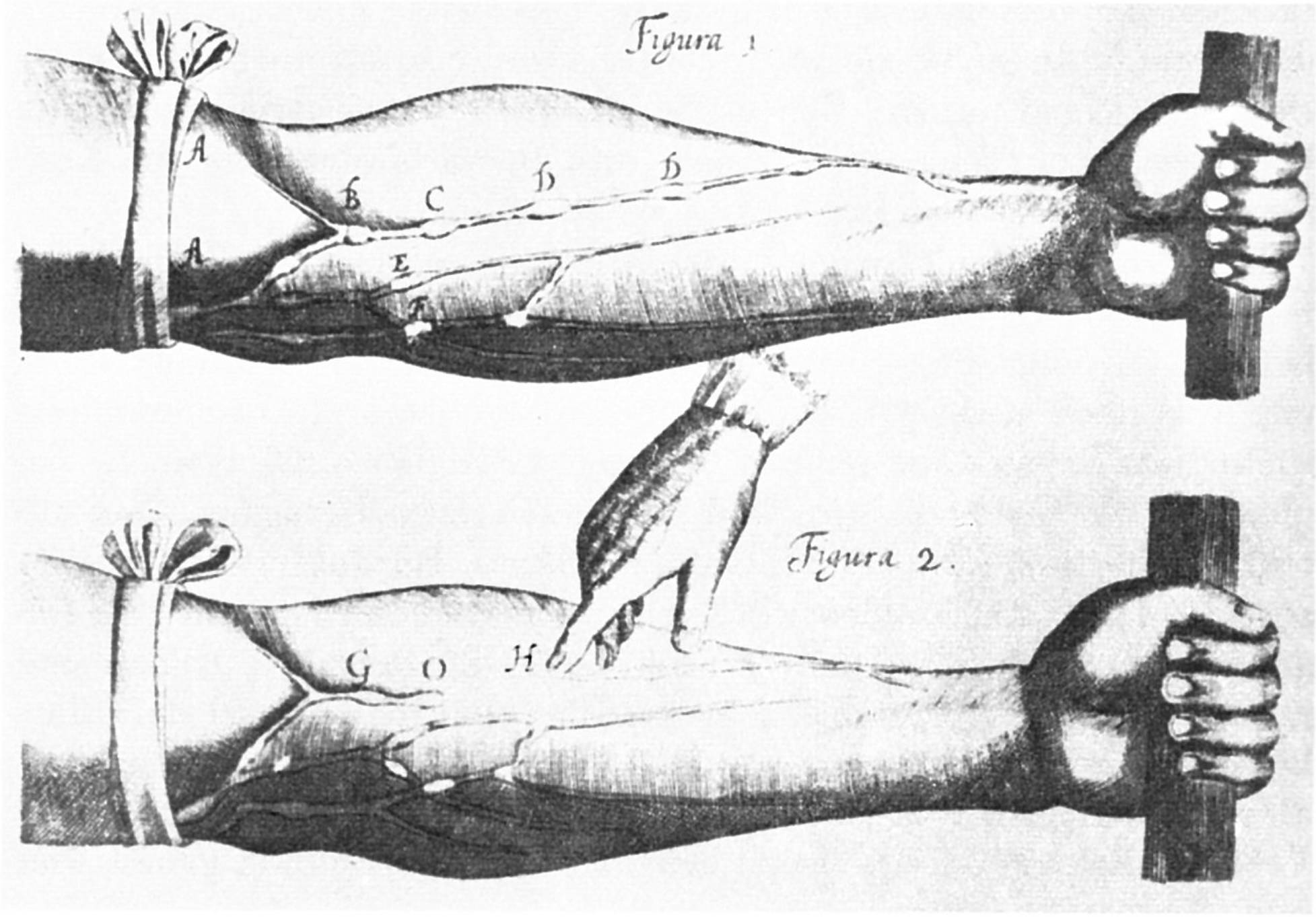
A: This label identifies the ligature or tourniquet applied tightly to the upper arm of the subject. Its purpose is to impede the return of venous blood to the heart, causing the superficial veins of the forearm to become distended and clearly visible for the experiment.
B: This point indicates a specific location on a distended vein where blood has accumulated due to the pressure of the ligature. It demonstrates the capacity of the venous system to act as a reservoir for blood returning from the extremities.
C: This mark identifies the site of a venous valve, which appears as a small node or swelling along the length of the vessel. Harvey noted these ‘knots’ as the primary mechanisms ensuring that blood cannot be pushed backward toward the hand.
D: Similar to point C, this indicates another valve positioned further down the vessel. The presence of multiple valves along the same vein confirmed that the one-way flow mechanism was a consistent anatomical feature rather than an isolated anomaly.
E: This label points to a junction where a tributary vein enters a larger venous trunk. It illustrates the convergence of the peripheral venous network as it directs blood back toward the central circulation.
F: This indicates a lower branch of the venous system in the forearm, showing the complexity of the superficial vasculature. These branches work in unison to collect deoxygenated blood from the skin and underlying muscles.
G: In the lower figure (Figura 2), this label marks a segment of the vein that has been emptied of blood by a stroking motion of the finger. It demonstrates the experimental manipulation used to prove that blood does not flow back from the heart into the arm.
H: This indicates the position of a finger pressing down on the vein to block any blood from entering a specific segment from below. By holding this point, Harvey could show that the emptied portion of the vein would remain collapsed despite the pressure above it.
O: This label designates the emptied, collapsed segment of the vein located between a valve and the point of pressure. This visual evidence proved that the ‘knots’ (valves) were impenetrable barriers to backward-flowing blood, providing the smoking gun for the theory of circulation.
The Galenic Deadlock: Medicine Before Harvey
Before the seventeenth century, medical practice was largely a matter of interpreting ancient texts rather than performing new research. Galen had taught that there were two separate types of blood: venous blood, which originated in the liver and provided nourishment, and arterial blood, which was infused with ‘vital spirits’ in the heart. It was believed that the tissues simply ‘drank’ this blood, and therefore the liver had to constantly manufacture new blood from the food we ate. This model was highly inefficient and made little sense from a volume perspective, yet it remained unchallenged because of the immense authority granted to classical scholars.
The primary flaw in the Galenic system was its inability to explain the role of the Venous Valves. While other anatomists, such as Hieronymus Fabricius (who was Harvey’s teacher), had identified these valves, they believed the valves were merely there to slow down the blood so the tissues had more time to absorb nutrients. They could not conceive of a closed-loop system because they lacked the concept of the heart as a muscular pump. It was Harvey’s unique perspective—viewing the body through the lens of early mechanical engineering—that allowed him to see the heart not as a source of heat or spirits, but as a pump that moved a finite amount of fluid through a continuous circuit.
The Quantitative Argument for Circulation
One of the most compelling parts of Harvey’s Exercitatio Anatomica was not anatomical, but mathematical. Harvey calculated the amount of blood the heart pumped with every beat. He estimated that if the heart pushed out just two ounces of blood per stroke, and beat roughly 72 times per minute, it would pump over 500 pounds of blood in a single hour. This was far more than the weight of a human being and far more than could possibly be produced by the liver from the food consumed in a day.
This simple calculation proved that the ‘consumption’ theory was physically impossible. The only logical explanation was that the blood was not being used up, but was instead returning to the heart to be recycled. This was a massive shift in scientific thinking. It moved biology away from qualitative descriptions (‘spirits’ and ‘humors’) and into the realm of quantitative data. By showing that the volume of blood remained constant and was simply in motion, Harvey provided the first truly scientific law of biology.
The Experiment: Proving One-Way Flow
The illustration provided in this article depicts the most famous part of Harvey’s proof. By using a ligature on a living subject’s arm, he could make the valves in the veins visible as small bumps. Harvey showed that if you press a finger on a vein and slide it toward the heart, the blood moves easily. However, if you try to push the blood in the opposite direction—away from the heart—it stops at the next valve (the ‘knots’ labeled C and D). The vein between the valve and your finger remains empty, as shown by the label ‘O’.
This experiment was simple, elegant, and entirely reproducible. It proved that the valves in the veins were not just speed bumps; they were check-valves. This meant that the venous system was essentially a one-way street leading back to the heart. When combined with his observations that arteries always carry blood away from the heart, the circle was complete. Although Harvey could not see the microscopic capillaries that connected arteries to veins (as the microscope had not yet been perfected), he correctly deduced their existence, predicting a ‘hidden’ connection that would later be discovered by Marcello Malpighi.
The Mechanical Heart and Vascular Dynamics
Harvey’s discovery redefined the heart as the central motor of the body. He described the heartbeat in two phases: systole (contraction) and diastole (relaxation). He observed that during systole, the heart becomes hard and smaller, much like a muscle in the arm, and ejects blood into the arteries. This mechanical view of the heart was a radical departure from the idea of the heart as a furnace. It allowed physicians to begin thinking about blood pressure, resistance, and the physical force required to sustain life.
Furthermore, Harvey’s work helped clarify the difference between pulmonary and systemic circulation. He realized that the right side of the heart pumps blood to the lungs to be refreshed, while the left side pumps that same blood to the rest of the body. This dual-circuit system is the basis for all modern cardiovascular medicine. Understanding this flow is what eventually led to the development of stethoscopes, EKG machines, and heart-lung bypass technology. Without the foundational knowledge that blood moves in a specific, predictable path, none of these life-saving technologies could have been conceived.
Resistance, Controversy, and Eventual Triumph
Despite the brilliance of his evidence, Harvey faced significant backlash from the medical establishment. Many physicians of the time were ‘Galenists’ who viewed any challenge to ancient authority as a form of heresy. Critics argued that if blood circulated, then traditional treatments like bloodletting—which was the standard of care for almost every ailment—might be useless or even harmful. Harvey’s practice as a physician actually suffered for a time after his publication because people thought he was ‘crack-brained.’
However, the truth of Harvey’s observations was undeniable. As more anatomists performed the forearm experiment for themselves, the old theories began to crumble. By the end of Harvey’s life, his theory of circulation was accepted throughout Europe. His success was a triumph for the ‘New Science’ of the seventeenth century, which valued the evidence of the senses and the power of logic over the weight of tradition. He proved that the human body was a machine that followed the laws of physics, a concept that remains the core of medical education today.
The Legacy of Harvey in Modern Medicine
The implications of Harvey’s discovery are present in almost every interaction a modern patient has with a doctor. When a nurse places a tourniquet on your arm to draw blood, they are using the exact same anatomical principles illustrated in Harvey’s 1628 diagram. When a cardiologist calculates an ‘ejection fraction’ during an echocardiogram, they are performing a modern version of the quantitative calculations Harvey first used to disprove Galen. The entire field of pharmacology relies on the fact that a drug injected into a vein will be circulated throughout the entire body via the heart.
- Intravenous Therapy: The ability to deliver fluids and medications directly into the bloodstream is only possible because we know blood circulates.
- Emergency Medicine: Techniques like CPR are based entirely on the mechanical need to manually circulate blood when the heart fails.
- Surgical Planning: Knowledge of vascular pathways allows surgeons to bypass blocked vessels and repair heart valves.
- Transfusion Medicine: Understanding the volume and flow of blood is critical for safe blood transfusions and fluid management in trauma.
Conclusion: A Continuous Flow of Knowledge
The image from Harvey’s Exercitatio is more than a diagram of an arm; it is the birth certificate of modern science. It represents the moment when humanity stopped guessing about the internal workings of the body and started measuring them. By proving that the heart is a pump and that blood moves in a closed loop, William Harvey provided the map that all subsequent medical explorers have used to navigate the human body. His commitment to ‘searching out the secrets of nature’ through experiment rather than book-learning set the standard for the scientific method. Today, as we explore the complexities of the micro-vasculature and the genetics of heart disease, we are still following the path that Harvey laid out four centuries ago. The circulation of blood is the most fundamental ‘fact’ of our existence, a tireless rhythmic process that sustains every thought, every breath, and every heartbeat. We owe our understanding of this life-giving flow to the curious physician who looked at the knots in a distended vein and saw the truth of how we live.
Blood Circulation, William Harvey, Exercitatio Anatomica, Venous Valves, Medical History, Cardiovascular Physiology, Heart Anatomy, Anatomy of the Arm, History of Science, Vascular System


