
Explore the intricate journey of food through your body with our detailed guide to the human digestive system. From ingestion to defecation, learn about the vital processes of propulsion, mechanical and chemical digestion, and nutrient absorption that keep you healthy.
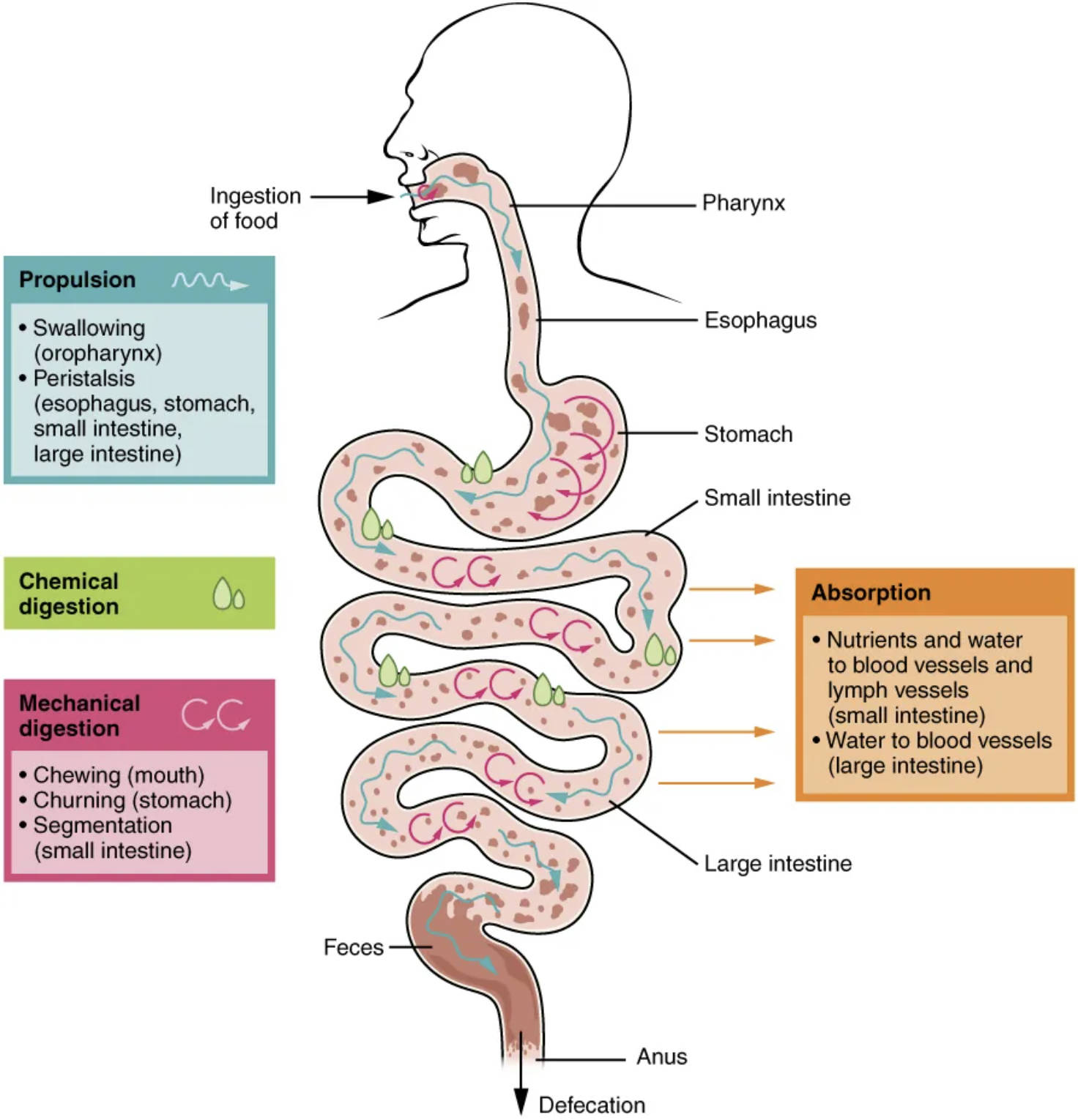
Pharynx: The pharynx, commonly known as the throat, is a crucial passageway for both food and air. It plays a significant role in swallowing, directing the ingested food from the mouth to the esophagus while preventing it from entering the trachea.
Esophagus: The esophagus is a muscular tube that connects the pharynx to the stomach. Its primary function is to transport food through a series of wave-like muscle contractions called peristalsis.
Stomach: The stomach is a J-shaped organ located in the upper abdomen, responsible for the initial breakdown of food. It churns and mixes food with gastric juices containing enzymes and hydrochloric acid, converting it into a semi-liquid mixture called chyme.
Small intestine: The small intestine is a long, coiled tube where most chemical digestion and nutrient absorption occur. It is divided into three parts: the duodenum, jejunum, and ileum, and its inner surface is lined with villi and microvilli to maximize absorption.
Large intestine: The large intestine, also known as the colon, primarily absorbs water and electrolytes from the remaining indigestible food matter. It also compacts waste into feces for elimination from the body.
Anus: The anus is the external opening at the end of the digestive tract, controlled by sphincters. It is responsible for the controlled expulsion of feces from the body during defecation.
Our digestive system is a marvel of biological engineering, meticulously designed to process the food we eat and extract essential nutrients while eliminating waste. This complex network of organs works in harmony to ensure our bodies receive the energy and building blocks necessary for survival and proper functioning. Understanding its processes is key to appreciating overall health and well-being.
The journey of food through the human body involves several distinct yet interconnected stages, beginning the moment we take a bite. These processes ensure that food is properly broken down, its nutrients absorbed, and waste efficiently removed.
- Ingestion: The act of taking food into the mouth.
- Propulsion: The movement of food through the digestive tract.
- Mechanical Digestion: Physical breakdown of food into smaller pieces.
- Chemical Digestion: Enzymatic breakdown of complex molecules into simpler ones.
- Absorption: The passage of nutrients into the bloodstream or lymph.
- Defecation: The elimination of indigestible waste from the body.
The Stages of Digestion: A Detailed Look
The digestive process commences with ingestion, where food is taken into the oral cavity. Here, mechanical digestion begins with chewing (mastication), while salivary amylase initiates the chemical breakdown of carbohydrates. Once food is adequately processed in the mouth, it undergoes propulsion through swallowing, moving from the pharynx into the esophagus. Peristalsis, a rhythmic contraction of smooth muscles, then propels the food bolus down the esophagus to the stomach.
In the stomach, food undergoes vigorous mechanical digestion through churning, mixing with highly acidic gastric juices. These juices, containing hydrochloric acid and pepsin, initiate chemical digestion of proteins. The stomach’s environment is crucial for denaturing proteins and killing most ingested microorganisms. The partially digested food, now a semi-liquid chyme, is then slowly released into the small intestine.
The small intestine is the primary site for extensive chemical digestion and nutrient absorption. Here, enzymes from the pancreas and the intestinal wall further break down carbohydrates, proteins, and fats into their simplest forms. The vast surface area provided by villi and microvilli facilitates the efficient absorption of these nutrients, including vitamins and minerals, into the bloodstream and lymphatic system. Finally, any remaining undigested material and water move into the large intestine. The large intestine focuses on absorbing water and electrolytes, solidifying the waste material into feces. This waste is then stored until it is eliminated from the body through the process of defecation via the anus.
Understanding these intricate processes highlights the sophisticated design of the human body, ensuring optimal nutrient extraction and waste management.


