
This portrait depicts Dr. Jan Janský (1873–1921), a Czech serologist, neurologist, and psychiatrist whose contributions to hematology were foundational to modern transfusion medicine. While Landsteiner is often credited with the discovery of blood groups, Janský independently discovered the existence of four distinct blood types, providing a more comprehensive classification than early initial studies. Understanding Janský’s work is essential for medical students and clinicians as it highlights the evolution of blood typing and the transition from experimental serology to safe clinical practice.
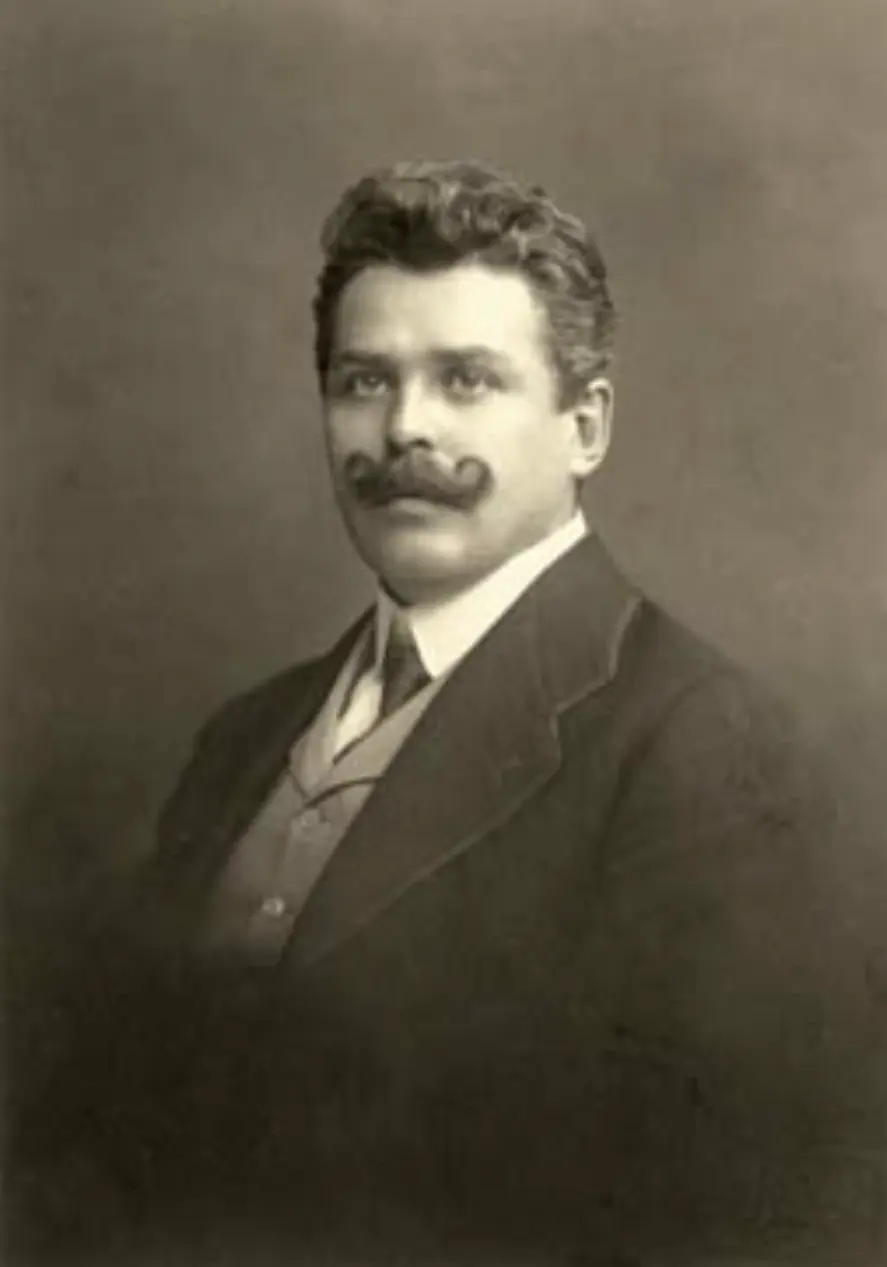
Jan Janský is credited with the first classification of blood into four types (A, B, AB, and O)
Image Overview
The image shows a classic early 20th-century professional portrait of Dr. Jan Janský. He is seen in formal academic or clinical attire, including a dark suit, vest, and tie, reflecting the status of medical professionals in the Austro-Hungarian era. His appearance, characterized by a prominent mustache and a focused gaze, is typical of the academic elite of the period. This visual representation serves as a historical record of the man who bridged the gap between psychiatric research and hematological discovery.
Historical Context and Discovery
Dr. Jan Janský was a professor at Charles University in Prague and worked primarily as a psychiatrist. His discovery of blood groups was actually a byproduct of his efforts to find a correlation between mental illness and blood properties. In 1907, he published a study titled “Hematologická studie u psychotiků” (Hematological study of psychotics), based on a sample of 3,100 psychiatric patients.
While Karl Landsteiner had identified groups A, B, and O in 1901, Janský independently recognized that human blood could be categorized into four groups. He labeled them with Roman numerals: I, II, III, and IV. His classification was significant because it was the first to consistently include the AB blood group (his Group IV), which Landsteiner’s original work had largely overlooked. Around the same time, William Lorenzo Moss also developed a four-group system, but his numbering was different, leading to significant confusion in the medical community for decades.
The Janský Classification System
The Janský system was widely adopted in the early 20th century, particularly in Russia, Eastern Europe, and for a period, the United States. To understand the historical medical records of the era, clinicians must be aware of how Janský’s Roman numerals map to the modern ABO system:
- Group I: Corresponds to the modern Type O.
- Group II: Corresponds to the modern Type A.
- Group III: Corresponds to the modern Type B.
- Group IV: Corresponds to the modern Type AB.
Note that the Moss system, which was also popular, inverted Groups I and IV (making Type AB Group I and Type O Group IV). This nomenclature conflict was a major impetus for the eventual international standardization of the ABO system in the 1920s and 30s to prevent fatal transfusion errors caused by numerical confusion.
Clinical and Educational Importance
From a clinical perspective, Janský’s work emphasized the concept of agglutination. He observed that certain blood sera caused the clumping of erythrocytes from other individuals, while others did not. This observation is the fundamental principle behind cross-matching and bedside blood typing used today.
For medical learners, Dr. Janský represents the importance of rigorous clinical observation and the interdisciplinary nature of medicine. His background in neurology and psychiatry did not limit his contribution to hematology; instead, his large-scale screening of psychiatric patients provided the statistical power necessary to identify the rarer AB blood type accurately.
Legacy in Modern Medicine
Although the ABO nomenclature is now universal, Janský’s legacy remains preserved in various ways. In the Czech Republic and Slovakia, the “Janský Medal” is awarded to voluntary blood donors to honor their contribution to saving lives. His work serves as a reminder of the era of serological discovery when the biological basis for individual physiological differences was first being mapped out at the molecular level.
Understanding the history of blood typing helps healthcare professionals appreciate the safety protocols currently in place. Modern transfusion medicine relies on the precise identification of antigens and antibodies, a science that Janský helped initiate through his meticulous classification of human blood types.
Key Learning Points for Medical Students
- The four-group system was established independently by Janský and Moss following Landsteiner’s initial discovery of three groups.
- Historical nomenclature used Roman numerals (I-IV), which requires careful translation when reviewing older medical literature or forensic records.
- The ABO system eventually replaced numerical systems to eliminate the risk of lethal errors between the Janský and Moss classifications.
- Janský’s Group IV (Type AB) is the universal plasma donor and the universal recipient of packed red blood cells.
Medical Learning Tips
- Always remember that Janský's Group I corresponds to Type O and Group IV to Type AB.
- The ABO system was standardized internationally to resolve confusion between the Janský and Moss numerical systems.
- Janský’s research originated in psychiatry, proving that significant medical breakthroughs can come from unrelated clinical fields.


Anatomy note website is your first choice!