
Parasitic infections remain a significant global health challenge, affecting millions of people particularly in regions with limited sanitation and close proximity to livestock. Among the most well-known of these parasites are members of the genus Taenia, commonly referred to as tapeworms. These flatworms have evolved a highly specialized biological strategy that requires two different hosts to complete their development: an intermediate host, such as cattle or pigs, and a definitive host, which is almost exclusively human. The Life Cycle of a Tapeworm is a remarkable example of evolutionary adaptation, involving several distinct stages including eggs, larvae (oncospheres), and mature adults capable of reaching several meters in length. Understanding this cycle is not only a fascinating exercise in biology but also a clinical necessity, as certain stages of the infection can lead to severe neurological complications if left untreated. By tracing the path of the parasite from the environment into the food chain and eventually into the human digestive system, we can better appreciate the importance of food safety standards and the public health initiatives designed to eradicate these resilient organisms.
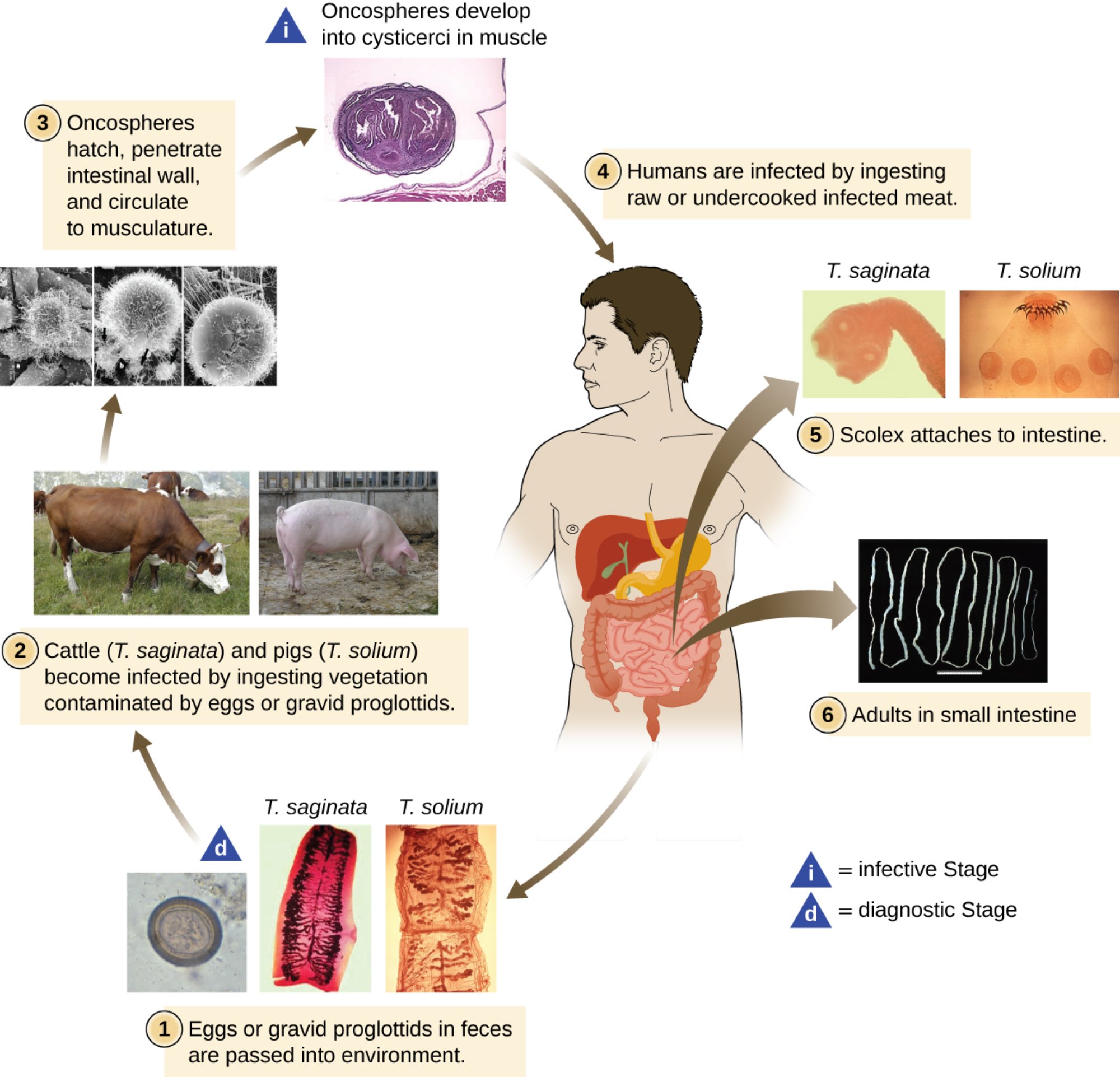
Eggs or gravid proglottids in feces: This is the primary diagnostic stage where the infected human host sheds mature segments of the worm or individual eggs into the environment through bowel movements. These eggs are extremely hardy and can persist in soil, water, or on vegetation for many months, waiting to be consumed by a suitable animal host.
Cattle (T. saginata) and pigs (T. solium) infection: Intermediate hosts acquire the parasite by ingesting vegetation that has been contaminated with human waste containing eggs. In this phase of the cycle, the animal acts as a biological vessel where the parasite undergoes its first major developmental transformation.
Oncospheres hatch and migrate: Upon entering the animal’s digestive tract, the eggs hatch into a larval form known as oncospheres, which are equipped with microscopic hooks. These larvae penetrate the intestinal wall and enter the circulatory system, eventually settling into the animal\’s skeletal muscle and other tissues.
Oncospheres develop into cysticerci in muscle: Within the animal\’s musculature, the larvae transform into a resting stage called cysticerci, often referred to as ‘bladder worms.’ This is the infective stage for humans; the larvae can remain viable in the meat for long periods unless destroyed by high heat or deep freezing.
Human infection by ingesting meat: Humans enter the cycle by consuming raw or undercooked beef or pork that contains these larval cysts. Once the meat is digested, the larvae are released into the human small intestine, where they are stimulated by bile and stomach acids to ‘evaginate’ or turn inside out.
Scolex attaches to intestine: The scolex, or the head of the tapeworm, uses its specialized suckers or hooks to anchor itself firmly to the mucosal lining of the upper small intestine. This attachment is permanent and allows the worm to begin the process of strobilation, or the creation of new body segments.
Adults in small intestine: The mature tapeworm resides in the lumen of the small intestine, absorbing nutrients through its skin as it lacks a digestive tract of its own. It can survive for years, constantly growing and releasing egg-filled proglottids into the feces to begin the cycle anew.
The Dual Host Strategy: Cattle and Pigs
The success of the Taenia species is dependent on the intersection of human and animal biology. Taenia saginata, known as the beef tapeworm, utilizes cattle as its intermediate host, while Taenia solium, the pork tapeworm, utilizes pigs. These animals are referred to as intermediate hosts because they facilitate the asexual phase of the parasite\’s development. When these animals graze on contaminated land, they unknowingly take in thousands of eggs. The transition from an egg to a cysticercus in the muscle is a form of Zoonosis that bridges the gap between the environment and the human kitchen.
The biological impact on the animal host is generally minimal, as the cysts usually reside in the muscle without causing immediate illness. This is an evolutionary advantage, as it ensures the animal survives long enough to be slaughtered and consumed by the definitive host. However, for the human consumer, the presence of these cysts in meat represents a significant health risk. In many parts of the world, rigorous meat inspection protocols involve checking for these visible cysts in the tongue, heart, and diaphragm of slaughtered livestock to prevent them from entering the food supply.
The Intestinal Phase: Anatomy and Growth of the Adult
Once the scolex has anchored itself within the human small intestine, the parasite begins a rapid growth phase. The body of the tapeworm, known as the strobila, consists of hundreds or even thousands of segments called proglottids. Each proglottid is a complete reproductive unit, containing both male and female organs. This hermaphroditic nature allows the worm to self-fertilize, ensuring a high reproductive output without the need for a second worm. In the case of *T. saginata*, the adult can reach lengths of up to 10 meters, making it one of the largest parasites to inhabit the human body.
As the worm matures, the segments furthest from the head become ‘gravid,’ or filled with eggs. These segments eventually detach and pass out of the body. Interestingly, the segments of the beef tapeworm are often motile and can crawl out of the anus independently of a bowel movement, a symptom that frequently leads patients to seek medical attention. The intestinal infection itself, known as Taeniasis, is often asymptomatic, although some patients may experience abdominal pain, weight loss, or digestive disturbances as the worm competes for nutrients.
The Dangers of Neurocysticercosis
While an intestinal infection is unpleasant, a far more dangerous condition can occur specifically with the pork tapeworm, *Taenia solium*. If a human accidentally ingests the eggs of *T. solium* (rather than the cysts in meat), the human becomes an accidental intermediate host. Just as they would in a pig, the eggs hatch into oncospheres, migrate through the blood, and form cysts in various tissues. When these cysts form in the central nervous system, the condition is known as Cysticercosis, specifically neurocysticercosis.
Neurocysticercosis is a leading cause of adult-onset seizures and epilepsy globally. The presence of these larvae in the brain triggers a significant inflammatory response from the immune system, leading to headaches, confusion, and in severe cases, death. This illustrates a critical point in the Life Cycle of a Tapeworm: while the definitive host is supposed to harbor the adult worm, becoming the ‘intermediate’ host for the larval stage is a pathological dead-end that results in severe tissue damage. This is why hand hygiene and the prevention of fecal-oral transmission are just as important as cooking meat thoroughly.
Medical Management and Pharmacological Treatment
Diagnosing a tapeworm infection typically involves a microscopic examination of stool samples to identify the characteristic eggs or proglottids. In cases of suspected cysticercosis, imaging techniques such as CT or MRI scans are used to visualize the cysts within the brain or muscle tissue. Once the infection is confirmed, the medical approach focuses on the complete eradication of the parasite, including the scolex, to prevent the worm from simply regrowing.
- Praziquantel Therapy: The drug of choice for most tapeworm infections is Praziquantel, which works by increasing the permeability of the parasite’s cell membranes to calcium. This causes the worm to undergo a sudden, massive contraction and paralysis, allowing the body to flush it out.
- Albendazole: This medication is often used in conjunction with steroids to treat cysticercosis, as it can penetrate the blood-brain barrier to kill the larvae within the brain.
- Surgical Intervention: In rare cases where a cyst is causing dangerous pressure in the brain or eyes, surgery may be required to remove the parasite manually.
- Supportive Care: Anticonvulsants are frequently prescribed to manage the seizures associated with neurocysticercosis while the infection is being treated.
Prevention and Public Health Strategies
Interrupting the Life Cycle of a Tapeworm requires a coordinated effort between veterinary medicine, agriculture, and public health. The most effective way to prevent infection is to ensure that meat is cooked to an internal temperature of at least 63°C (145°F) for whole cuts or 71°C (160°F) for ground meat. Freezing meat at -20°C for several days is also an effective method for killing any hidden cysticerci. On a larger scale, improving sanitation systems to prevent human waste from contaminating livestock grazing areas is the only way to permanently break the environmental cycle.
Public education also plays a vital role. In endemic regions, teaching communities about the dangers of using untreated human waste as fertilizer and the importance of thorough hand-washing can significantly reduce the incidence of both taeniasis and cysticercosis. Furthermore, the development of vaccines for pigs is an emerging area of research that aims to prevent the larvae from ever forming in the intermediate host, effectively removing the source of human infection before it reaches the market. By targeting every stage of the cycle—from the egg in the soil to the cyst in the pig and the adult in the human—we can hope to one day eliminate these parasites from the human experience.
Conclusion: A Path Toward Eradication
The Life Cycle of a Tapeworm is a complex biological journey that highlights the delicate balance between hosts and their environment. From the resilient eggs shed in human waste to the microscopic larvae that migrate through livestock, each stage of the cycle provides an opportunity for transmission or intervention. While modern medicine provides effective treatments like Praziquantel, the ultimate solution lies in the fundamental pillars of public health: clean water, safe sanitation, and rigorous food safety. By understanding the anatomy and behavior of these ancient parasites, we can better protect ourselves and our communities from the silent threat they pose. As we continue to refine our diagnostic and preventative tools, the goal of eradicating tapeworm infections becomes not just a scientific possibility, but a moral imperative for global health. The story of the tapeworm is a reminder of our intimate connection to the animals we raise and the environment we share, emphasizing that the health of one is inextricably linked to the health of all.
Life Cycle of a Tapeworm, Taeniasis, Cysticercosis, Taenia solium, Taenia saginata, Parasitology, Praziquantel, Zoonosis, Neurocysticercosis, Helminthology


