
In the mid-19th century, the medical and scientific worlds were locked in a fierce debate over the origin of life and the causes of disease. For centuries, the prevailing belief was that microscopic organisms could arise from non-living matter through a process called Spontaneous Generation. It was thought that if organic material was left to decay, the “vital force” inherent in the air would magically produce mold, bacteria, or maggots. This theory was not merely a philosophical curiosity; it was a significant barrier to medical progress, as it suggested that infection and sepsis were unavoidable consequences of biology rather than preventable events. The turning point came through the ingenious design of a simple glass vessel: the swan-neck flask. Designed by Louis Pasteur in the 1860s, this device allowed for a controlled experiment that would eventually shatter ancient myths and lay the cornerstone for all modern antiseptic techniques, surgery, and immunology. By proving that life only arises from pre-existing life, Pasteur redirected the course of human history toward a future where microbial pathogens could be identified, studied, and defeated.
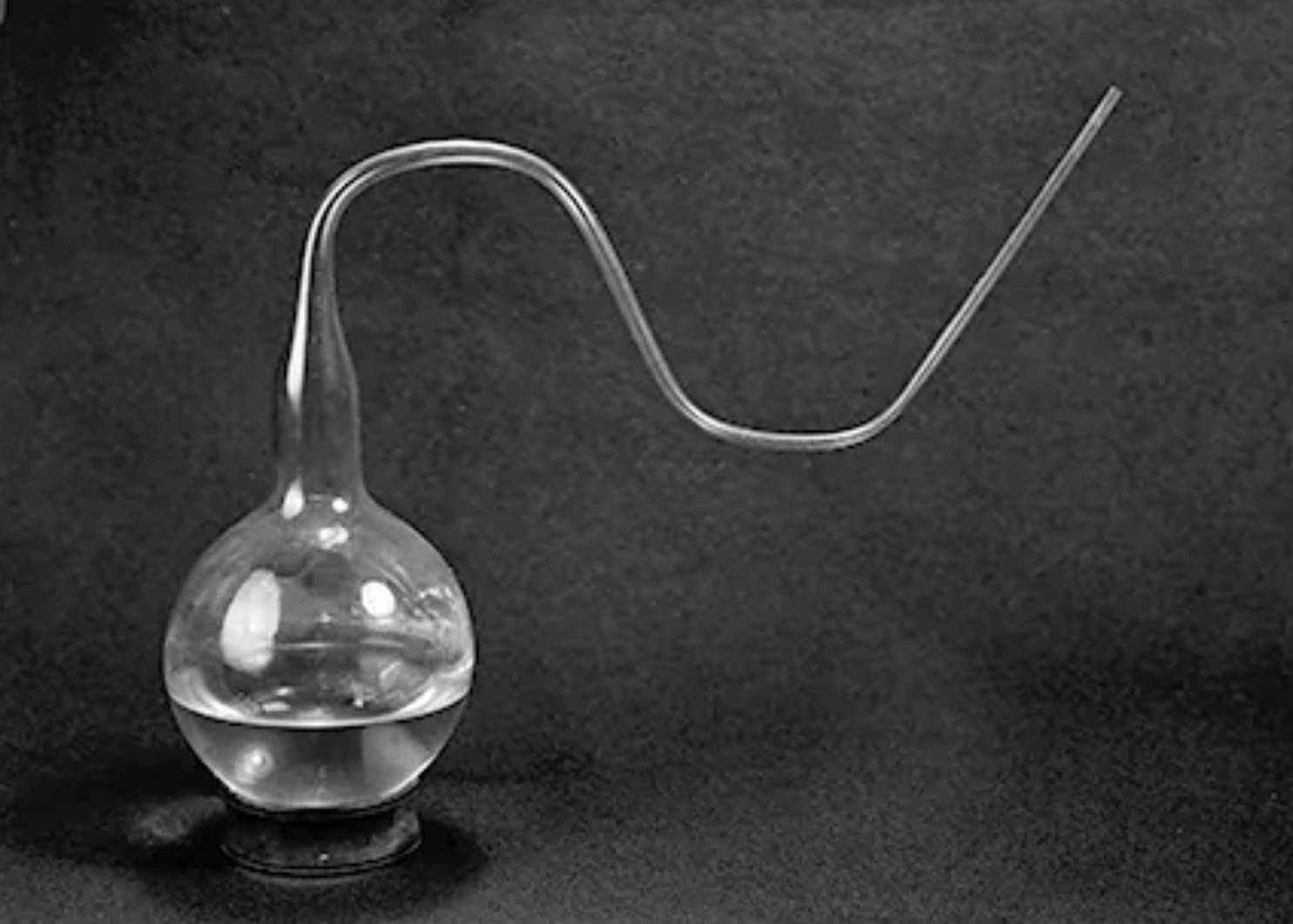
Glass Bulb: This rounded reservoir at the base of the flask is designed to hold a nutrient-rich broth, which serves as a cultivation medium for microorganisms. During the experiment, the broth is boiled within this bulb to ensure that any living matter already present is completely sterilized.
Swan-Neck curve: The distinctive S-shaped glass tube allows air to pass freely into the flask while acting as a physical trap for gravity-bound particles. Dust and airborne microbes are caught in the lower curve of the neck, preventing them from reaching the sterile broth in the bulb.
Open End: The distal tip of the tube remains completely open to the outside atmosphere, ensuring that the “vital force” of air could still enter the flask. This feature was critical in proving that air alone does not cause the spontaneous appearance of life.
Nutrient Broth: The liquid seen at the bottom of the flask provides the essential water and organic compounds needed for bacterial growth. In Pasteur’s original experiments, this liquid remained clear and sterile for years as long as the swan-neck remained upright and intact.
The Historical Context of Pasteur’s Experiment
To understand the profound impact of the swan-neck flask, one must appreciate the scientific climate of the 1850s. The French Academy of Sciences offered a prize to anyone who could shed light on the mystery of how microorganisms were formed. At the time, supporters of the “vitalist” theory argued that air contained a mystical property that catalyzed life. Previous experiments by scientists like Lazzaro Spallanzani had attempted to disprove this by boiling broth in sealed containers, but critics argued that the act of sealing the jars excluded the very oxygen necessary for life to “spontaneously” occur. The challenge was to create an environment that was exposed to the air but protected from contamination.
Pasteur’s breakthrough was the realization that it was not the air itself that carried life, but the invisible particles—dust, spores, and bacteria—suspended within it. By heating the neck of a standard glass flask and pulling it into a long, curved S-shape, he created a bypass that allowed gases to diffuse but used the laws of physics to filter out solids. As air moved into the flask, gravity caused the relatively heavy dust particles to settle in the lowest point of the curve. This simple elegant design meant that the broth remained in contact with oxygen but isolated from the biological components of the environment. This was the definitive proof for Biogenesis, the principle that living matter only comes from other living matter.
The Mechanics of Sterile Technique and Germ Theory
The swan-neck flask experiment provided the experimental foundation for what we now know as the Germ Theory of disease. Before this discovery, doctors often moved from performing autopsies to delivering babies without washing their hands, as they believed the resulting infections were a natural outcome of the “bad air” (miasma) or internal imbalances. Pasteur’s flasks proved that if you exclude the microscopic “germs” from a sterile environment, no decay or infection occurs. This realization was revolutionary for the medical field, as it implied that diseases were caused by specific, identifiable organisms that could be blocked, killed, or avoided.
The implications for surgery were immediate and transformative. Inspired by Pasteur’s findings, British surgeon Joseph Lister began using carbolic acid to sterilize surgical instruments and clean wounds. By treating the surgical environment like the interior of a swan-neck flask—keeping the “dust” of germs away from the “broth” of human tissue—Lister observed a dramatic drop in post-operative gangrene and death. The swan-neck flask essentially served as the world’s first model for an aseptic environment, teaching humanity that sterility is a state of being that can be maintained through physical and chemical barriers.
Evolution of Sterilization and Food Safety
The principles demonstrated by the swan-neck flask did not stop at the hospital doors; they redefined the global food industry. Pasteur applied his understanding of microbial growth to the wine and silk industries, eventually leading to the process of pasteurization. By heating liquids to a specific temperature for a set time, one could kill the majority of spoilage-causing bacteria without altering the chemical properties of the product. This was a direct application of the flask experiment: kill the existing life within the medium and prevent new life from entering.
Modern laboratories still rely on the logic of the swan-neck design. When scientists use vented caps on cell culture flasks or HEPA filters in laminar flow hoods, they are using advanced versions of Pasteur’s S-curve. The goal remains the same: allow the passage of air and gases while trapping microscopic contaminants. Furthermore, the development of the autoclave—a high-pressure steam sterilizer—was a direct technological evolution of the boiling process used in the swan-neck experiments. We owe the safety of our milk, the success of our vaccinations, and the reliability of our lab results to the foundational physics of this glass vessel.
Why the Swan-Neck Flask Still Matters Today
In an age of genomic sequencing and CRISPR technology, the swan-neck flask might seem like an artifact of a simpler time. However, its educational value remains unparalleled. It teaches the fundamental scientific method: isolating a single variable (microbial contact) while keeping all other factors (nutrients, temperature, and air exposure) constant. For medical students, the flask is a reminder that the most significant breakthroughs often come from simple, logical observations rather than complex machinery.
Moreover, the flask serves as a warning against scientific dogma. For thousands of years, the world’s greatest minds believed in spontaneous generation because it seemed to align with what they saw with their naked eyes. Pasteur’s flask proved that there is a world beyond our vision—the microcosm—that dictates the health and survival of our species. Every time a surgeon scrubs in, every time a nurse opens a sterile bandage, and every time a scientist works in a cleanroom, they are participating in a tradition that began with a single curved glass neck and a pot of boiling broth.
Legacy and Conclusion
The image of the swan-neck flask is more than a diagram of laboratory equipment; it is a symbol of the triumph of reason over superstition. By using the “unique swan-neck feature of the flasks,” Louis Pasteur provided the first empirical evidence that the microscopic world is the true driver of biological change and disease. This experiment did more than win a prize from the French Academy; it saved millions of lives by introducing the concept of sterility to the human consciousness. It transformed hospitals from places of certain infection into centers of healing and allowed for the birth of microbiology as a rigorous scientific discipline.
In conclusion, the swan-neck flask stands as one of the most important tools in medical history. It bridged the gap between ancient observational biology and modern experimental medicine. As we continue to battle new pathogens and refine our sterile techniques, we must look back at this simple S-shaped curve as the origin of our success. The flask reminds us that by understanding the nature of life at its smallest scale, we can master the health of the entire human body. Pasteur’s legacy is preserved in every sterile vial and every successful surgery, proving that a simple idea, when properly tested, can truly change the world.


