
The endocrine system is a complex network of glands and cells distributed throughout the body, playing a pivotal role in maintaining homeostasis through hormone secretion. This diagram highlights key components such as the hypothalamus, pituitary gland, pineal gland, thyroid gland, parathyroid glands, thymus, adrenal glands, pancreas, ovaries, and testes, offering a comprehensive view of their locations and functions. Exploring this image provides a deeper appreciation of how these structures coordinate essential physiological processes.
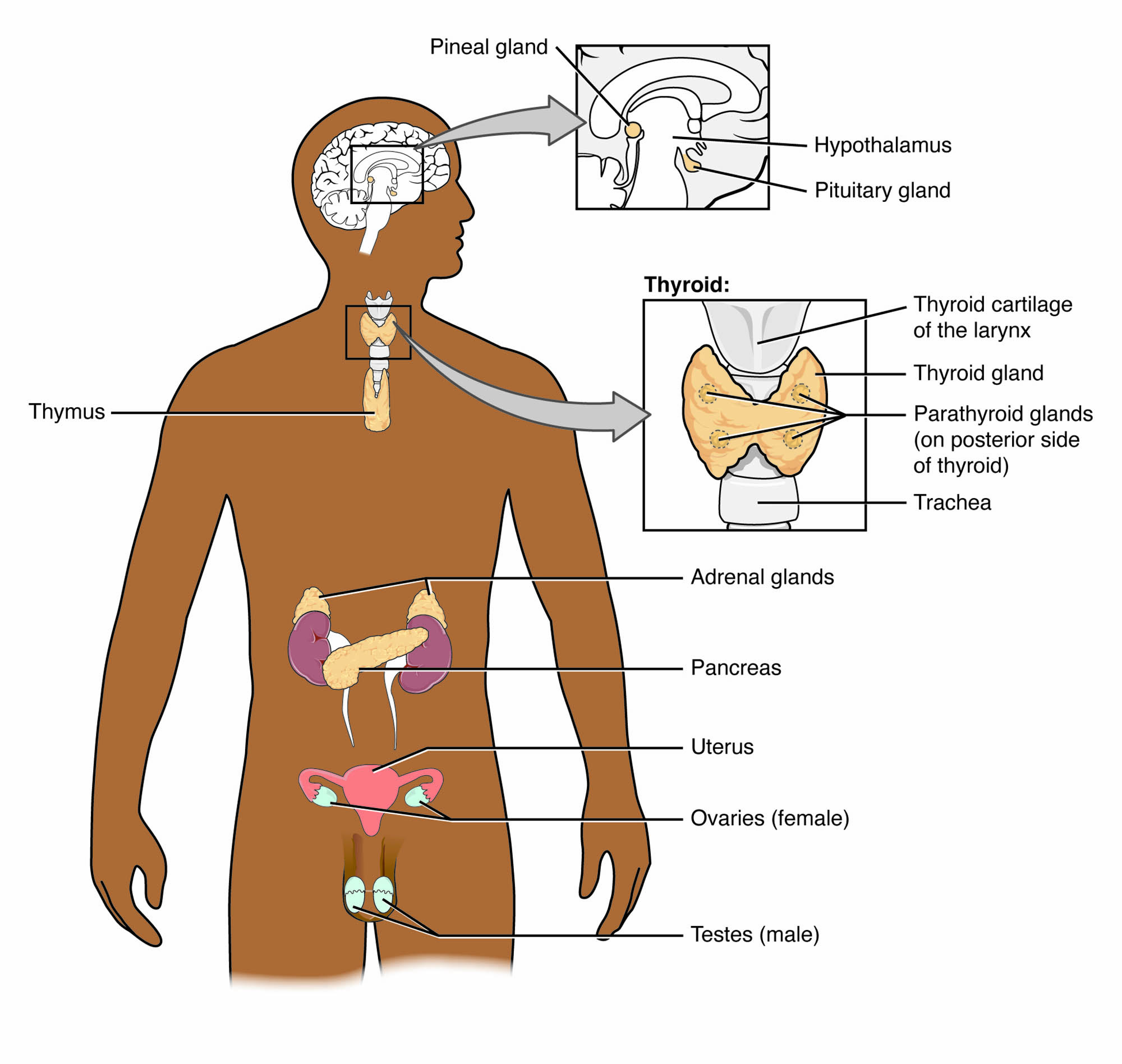
Labelled Parts Explanation
- Hypothalamus The hypothalamus, located below the thalamus in the brain, acts as a control center by releasing hormones that regulate the pituitary gland. It influences critical functions such as body temperature, hunger, and hormone production.
- Pituitary gland The pituitary gland, situated at the base of the brain, is known as the master gland, secreting hormones that control other endocrine glands and processes like growth and reproduction. It is divided into anterior and posterior lobes with distinct roles.
- Pineal gland The pineal gland, found near the center of the brain, produces melatonin to regulate sleep-wake cycles and circadian rhythms. It responds to light signals from the retina to adjust hormonal output.
- Thyroid gland The thyroid gland, located in the neck below the larynx, releases T3 (triiodothyronine) and T4 (thyroxine) to regulate metabolism and energy production. It also secretes calcitonin to help manage calcium levels.
- Parathyroid glands The parathyroid glands, four small structures embedded in the thyroid gland, produce parathyroid hormone (PTH) to increase blood calcium by stimulating bone resorption. They are essential for maintaining calcium and phosphate balance.
- Thymus The thymus, located in the upper chest behind the sternum, is active in early life, producing hormones like thymosin to support T-cell development in the immune system. It gradually shrinks with age but remains influential in immunity.
- Adrenal glands The adrenal glands, positioned atop each kidney, secrete cortisol for stress response and aldosterone for electrolyte balance, along with adrenaline for the “fight or flight” reaction. They play a key role in managing stress and metabolic demands.
- Pancreas The pancreas, located behind the stomach, serves as both an endocrine and exocrine gland, releasing insulin and glucagon to regulate blood glucose levels. Its endocrine function is critical for metabolic homeostasis.
- Ovaries The ovaries, situated in the female pelvic cavity, produce estrogen and progesterone to regulate the menstrual cycle and support pregnancy, while also contributing to secondary sexual characteristics. They are essential for female reproductive health.
- Testes The testes, located in the male scrotum, secrete testosterone to drive male sexual development and maintain reproductive functions, while also producing sperm. They are vital for male hormonal balance and fertility.
Anatomical Overview of the Endocrine System
The endocrine system consists of a series of glands and specialized cells scattered across the body, working together to secrete hormones that regulate various physiological functions. This diagram provides a clear layout of the hypothalamus, pituitary gland, pineal gland, thyroid gland, parathyroid glands, thymus, adrenal glands, pancreas, ovaries, and testes, each with a specific anatomical position.
- The hypothalamus and pituitary gland are centrally located in the brain, forming the control hub.
- The thyroid gland, parathyroid glands, and thymus are found in the neck and upper chest.
- The adrenal glands and pancreas reside in the abdominal region, managing stress and metabolism.
- The ovaries and testes are located in the pelvic area, regulating reproduction, while the pineal gland influences sleep in the brain.
This distribution ensures a coordinated hormonal network that maintains bodily equilibrium.
Role of the Hypothalamus and Pituitary Gland
The hypothalamus and pituitary gland serve as the endocrine system’s command center. Their interaction is crucial for hormonal regulation.
- The hypothalamus releases hormones like oxytocin and ADH to stimulate the pituitary gland.
- The pituitary gland secretes growth hormone, TSH, and FSH to control growth and other glands.
- These glands integrate nervous and hormonal signals.
- Dysfunction can lead to conditions like gigantism or hypothyroidism.
This axis is fundamental to endocrine control.
Function of the Thyroid, Parathyroid, and Thymus
The thyroid, parathyroid, and thymus glands regulate metabolism, calcium, and immunity. Their roles are interconnected.
- The thyroid gland produces T3 and T4 to boost metabolic rate and energy.
- The parathyroid glands release PTH to maintain calcium homeostasis via bone and kidney effects.
- The thymus supports immune development with thymosin in early life.
- Imbalances may cause goiter or hypocalcemia.
These glands ensure metabolic and immune stability.
Significance of the Adrenal Glands and Pancreas
The adrenal glands and pancreas address stress and glucose regulation. Their hormones are vital for survival.
- The adrenal glands produce cortisol for stress and aldosterone for blood pressure.
- The pancreas secretes insulin to lower blood sugar and glucagon to raise it.
- These glands respond to immediate and chronic needs.
- Disorders include Addison’s disease and diabetes.
This function supports metabolic resilience.
Role of the Ovaries, Testes, and Pineal Gland
The ovaries, testes, and pineal gland regulate reproduction and circadian rhythms. Their hormones shape development.
- The ovaries release estrogen and progesterone for female reproductive cycles.
- The testes secrete testosterone for male sexual characteristics.
- The pineal gland produces melatonin to regulate sleep patterns.
- These glands influence growth, fertility, and rest.
This diversity sustains life processes.
Physiological Importance of the Endocrine System
The endocrine system’s hormones coordinate bodily functions to maintain homeostasis. Its network adapts to change.
- The hypothalamus and pituitary gland link neural and hormonal control.
- The thyroid gland, parathyroid glands, and thymus regulate metabolism and immunity.
- The adrenal glands, pancreas, ovaries, testes, and pineal gland manage stress, glucose, reproduction, and sleep.
- This system ensures balanced physiological responses.
The glands’ synergy is essential for health.
Clinical Relevance of Endocrine Anatomy
Understanding endocrine anatomy aids in diagnosing glandular disorders. These structures are key clinical targets.
- Overactive thyroid gland can lead to hyperthyroidism, causing weight loss and anxiety.
- The adrenal glands’ failure results in adrenal insufficiency, with fatigue as a symptom.
- The pancreas’s insulin deficiency causes diabetes, affecting blood sugar.
- Imaging and hormone tests guide treatment.
This knowledge supports endocrine management.
Conclusion
The endocrine system diagram provides a detailed view of the hypothalamus, pituitary gland, pineal gland, thyroid gland, parathyroid glands, thymus, adrenal glands, pancreas, ovaries, and testes, illustrating their critical roles in hormone secretion and homeostasis. By exploring their anatomical distribution and functions, one gains insight into how this system regulates metabolism, reproduction, and other vital processes. This understanding serves as a foundation for studying endocrinology and addressing related health concerns, encouraging further exploration of the endocrine system’s intricate design and its essential contribution to overall well-being.


