
For centuries, the mystery of how life began was shrouded in philosophical debate rather than empirical evidence. One of the most common observations in the pre-modern world was the sudden appearance of small, worm-like creatures on rotting meat or decaying organic matter. Without the tools of modern microscopy or a formal scientific method, many early thinkers concluded that life could simply spring forth from non-living material under the right conditions. This concept, while seemingly logical at the time, was eventually challenged by rigorous experimentation. Understanding the mechanisms behind the formation of larvae is not just a lesson in history; it is a fundamental pillar of microbiology and forensic science that informs how we view infection, decomposition, and the very continuity of biological life.
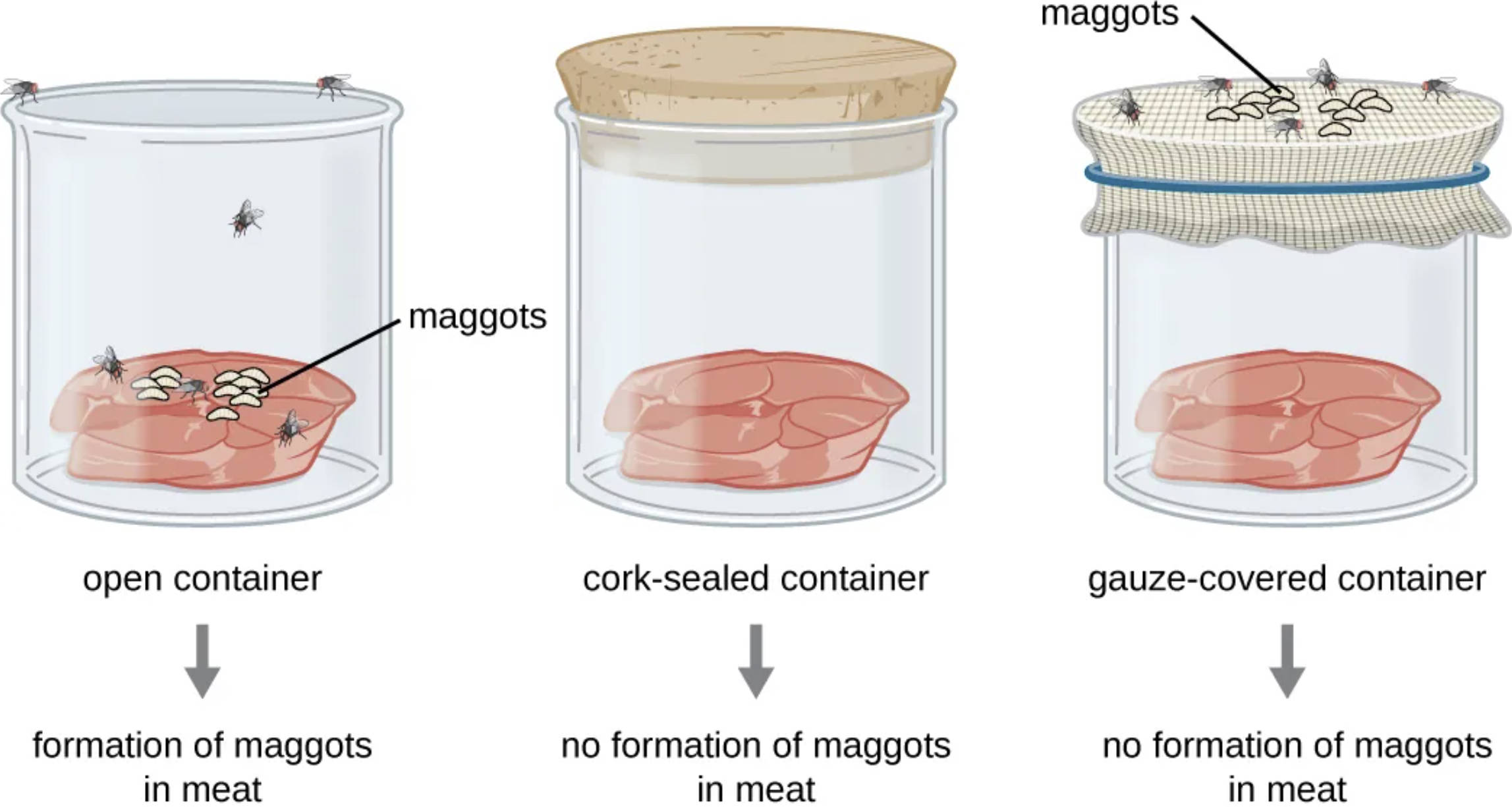
Open container: This part of the diagram represents a vessel left entirely exposed to the environment, allowing adult flies to land directly on the meat. As a result, maggots eventually form on and within the decaying meat because the flies were able to deposit their eggs there.
Cork-sealed container: This setup shows a jar that has been completely obstructed by a solid cork stopper, preventing both flies and air currents from reaching the meat. The experiment demonstrates that under these airtight conditions, no maggots form, as no external organisms can access the organic material.
Gauze-covered container: In this clever variation, the jar is covered with a porous mesh that allows the scent of the meat to escape but physically blocks flies from touching it. Maggots are seen forming on top of the gauze where the flies landed, but the meat itself remains free of larvae, proving that life requires a direct physical progenitor.
Maggots: These organisms are the larval stage of various fly species, characterized by their voracious appetite for necrotic or decaying tissue. The labels indicate their presence in specific scenarios, highlighting that their appearance is dependent on fly access rather than the meat itself.
The Historical Context of Spontaneous Generation
Before the mid-17th century, the dominant scientific theory regarding the origin of small organisms was spontaneous generation. This theory posited that living things could arise from non-living matter if it contained a “vital heat” or was exposed to certain environmental triggers. For instance, it was widely believed that old rags could produce mice, or that stagnant water could spontaneously create mosquitoes. This belief was not merely a folk tale; it was supported by prominent figures like Aristotle and remained the standard explanation for biological phenomena for nearly two millennia. The appearance of maggots on rotting meat was considered the definitive proof of this theory, as they seemed to emerge from the depths of the meat with no visible source.
However, as the Renaissance gave way to the Age of Enlightenment, a new generation of scientists began to demand more concrete evidence. They noticed that certain conditions, such as the exclusion of insects, seemed to halt the appearance of these organisms. This skepticism led to the development of controlled experiments, which are now the foundation of all medical and biological research. The move away from mystical explanations toward observable, repeatable evidence allowed for the eventual discovery of the microscopic world and the development of the germ theory of disease.
Francesco Redi’s Experimental Breakthrough
In 1668, an Italian physician and poet named Francesco Redi performed the landmark experiment depicted in the accompanying illustration. Redi was skeptical of the idea that maggots were a byproduct of meat putrefaction. His methodology was simple yet revolutionary: he used a series of jars containing various types of meat (such as snake, fish, and veal) and subjected them to different levels of exposure. By using an open jar, a sealed jar, and a jar covered with fine Neapolitan veil (gauze), he was able to isolate the variables responsible for the appearance of life. This was one of the first recorded instances of using a control group in a scientific experiment, a practice that remains essential in clinical trials today.
The results were conclusive. Maggots only appeared in the jars where flies could physically touch the meat. In the gauze-covered jars, flies were attracted to the smell and laid their eggs on the mesh, where maggots subsequently hatched. This proved that the meat was merely a food source and not the creator of the life forms. Redi’s work provided the first major blow to the theory of spontaneous generation, shifting the scientific paradigm toward the principle that all living things come from other living things, a concept known as biogenesis.
The Clinical and Forensic Implications of Maggot Formation
In the modern medical landscape, the study of how and when maggots form is highly specialized. In the field of forensic entomology, investigators use the presence and developmental stage of maggots to estimate the time of death in criminal cases. Because flies are often the first organisms to arrive at a scene, sometimes within minutes of a person’s passing, their lifecycle serves as a biological clock. By identifying the species of fly and the size of the larvae, experts can work backward to determine a precise window of time when the eggs were likely laid, providing critical evidence in legal proceedings.
Clinically, maggots have a complex relationship with human health. While they are often associated with filth and disease, they are also used in a therapeutic context known as Maggot Debridement Therapy (MDT). In this controlled medical procedure, sterile larvae are placed on non-healing wounds, such as diabetic foot ulcers. The maggots selectively consume only the dead, necrotic tissue while leaving healthy tissue intact. They also secrete enzymes that kill bacteria and promote healing. Conversely, when maggot infestation occurs unintentionally in a living host, the condition is referred to as myiasis, which can range from minor skin irritations to severe internal infections requiring surgical intervention.
Biological Lifecycles and Decomposition
The formation of maggots is just one stage in a complex ecological cycle of recycling nutrients. When an organism dies, it releases chemical signals like putrescine and cadaverine, which act as beacons for necrophagous insects. The primary colonizers are usually blowflies and flesh flies. Once an egg is deposited, it undergoes several stages, or instars, during which the larva grows rapidly by liquefying and absorbing organic matter. This process is essential for the ecosystem, as it breaks down complex proteins and fats, returning them to the soil and preventing the buildup of waste in the environment.
Understanding this lifecycle also informs modern food safety and sanitation practices. The reason we use airtight packaging and refrigeration is to prevent the very scenarios Redi illustrated over 300 years ago. By cooling the meat, we slow down the metabolic processes of bacteria and prevent the chemical signals that attract flies. By sealing the meat, we provide a physical barrier against egg deposition. These basic household habits are direct applications of biogenesis, ensuring that our food supply remains free of the larval infestations that were once considered an unavoidable part of the natural order.
From Redi to Pasteur: The Final Disproof
While Redi successfully proved that macroscopic organisms like maggots did not spontaneously generate, the debate continued for another two centuries regarding microscopic life. It wasn’t until the 1860s that Louis Pasteur conducted his famous swan-neck flask experiments, which finally laid the theory of spontaneous generation to rest for good. Pasteur showed that even bacteria and fungi in the air could not grow in a sterilized broth unless they had a path to enter the vessel. This established the germ theory, which revolutionized medicine by identifying microbes as the cause of infectious diseases.
The journey from observing maggots on meat to developing life-saving vaccines is a testament to the power of the scientific method. Every time a surgeon sterilizes their instruments or a scientist develops a new antibiotic, they are standing on the shoulders of researchers like Redi. By proving that life does not appear from nowhere, these pioneers paved the way for a deeper understanding of genetics, cellular biology, and the intricate web of life that sustains our planet. Today, we recognize that the tiny maggots in the jar are not signs of decay’s creative power, but rather a vital link in the continuous chain of biological existence.


