
Eukaryotic cells form the foundation of complex life on Earth, encompassing everything from single-celled protists to massive multicellular organisms like humans, plants, and fungi. The classification of eukaryotes into supergroups represents a major advancement in understanding evolutionary relationships based on molecular, morphological, and genomic data. This phylogenetic framework helps medical professionals, researchers, and students grasp how diverse eukaryotic pathogens, symbionts, and model organisms relate to one another, directly impacting fields like infectious disease, parasitology, and cell biology.
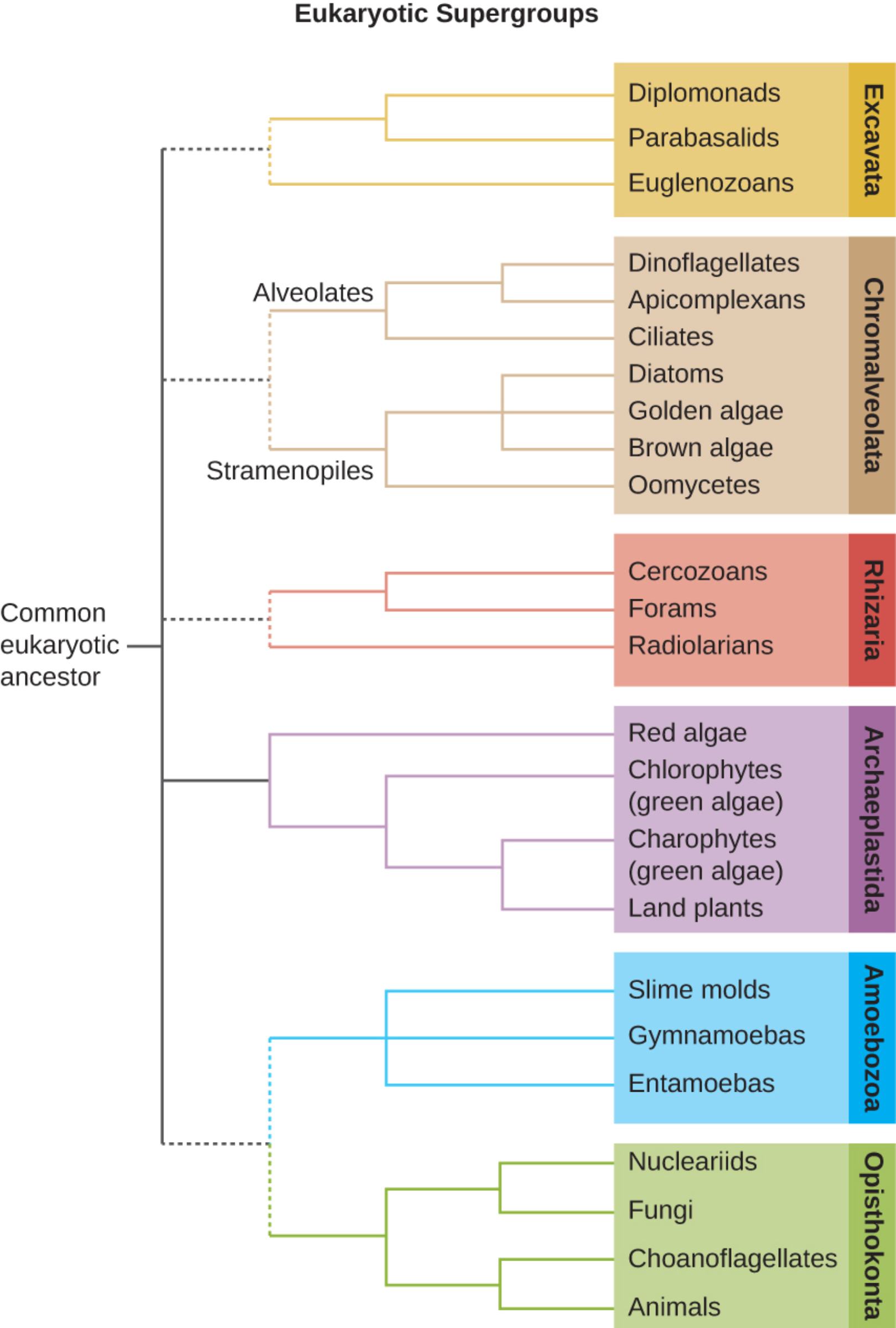
Common eukaryotic ancestor refers to the hypothetical last universal common ancestor of all eukaryotic organisms, from which all current supergroups diverged billions of years ago. This ancestor possessed key features like a nucleus, mitochondria, and endomembrane system that define eukaryotes today. Understanding this root helps trace the origins of cellular complexity and disease-causing mechanisms.
Excavata is a supergroup characterized by organisms often featuring an excavated feeding groove on one side of the cell. Many members are flagellated protists, including important human parasites. This group highlights how ancient cytoskeletal modifications led to diverse motility and feeding strategies still relevant in medical microbiology.
Diplomonads are anaerobic flagellates with two nuclei and multiple flagella, exemplified by Giardia species that cause giardiasis. They lack typical mitochondria but possess mitosomes, making them resistant to certain oxygen-dependent treatments and important in studies of anaerobic metabolism.
Parabasalids include trichomonads like Trichomonas vaginalis, a common sexually transmitted parasite. They possess a parabasal apparatus and hydrogenosomes instead of mitochondria, illustrating unique energy production pathways that influence drug development for urogenital infections.
Euglenozoans encompass diverse organisms such as euglenids and kinetoplastids, including the causative agents of sleeping sickness and Chagas disease. Their unique mitochondrial DNA organization (kinetoplast) and flagellar apparatus make them critical models for understanding parasitic adaptation and mitochondrial evolution.
Chromalveolata is a large supergroup combining alveolates and stramenopiles, unified by secondary endosymbiosis involving red algae. Many members are photosynthetic or heterotrophic and include significant algal blooms as well as devastating plant and animal pathogens.
Alveolates feature cortical alveoli beneath the plasma membrane, supporting diverse morphologies. This clade includes dinoflagellates responsible for red tides, apicomplexan parasites like Plasmodium and Toxoplasma, and ciliates used in genetic research.
Dinoflagellates are mostly marine or freshwater protists with two flagella and often armored plates. Some produce toxins causing paralytic shellfish poisoning, while others form symbiotic relationships with corals, demonstrating ecological and medical importance.
Apicomplexans are obligate intracellular parasites with a unique apical complex for host cell invasion. This group includes Plasmodium species causing malaria, Cryptosporidium, and Toxoplasma gondii, making them central to global health challenges and antiparasitic drug research.
Ciliates are characterized by numerous cilia for movement and feeding, with nuclear dimorphism separating somatic and germline functions. Paramecium and Tetrahymena serve as key model organisms for studying cellular processes applicable to human cell biology.
Stramenopiles are defined by flagella with tripartite tubular hairs and include photosynthetic algae as well as heterotrophic forms. This diverse group plays roles in aquatic food webs and contains pathogens affecting agriculture and aquaculture.
Diatoms are unicellular algae with intricate silica cell walls, contributing massively to global oxygen production and carbon fixation. Their frustules are used in nanotechnology and forensic science, while some species serve as sources of biofuels.
Golden algae possess chlorophylls a and c along with fucoxanthin, giving them a golden-brown color. They are important primary producers in freshwater and marine environments and can form harmful blooms under certain conditions.
Brown algae include large multicellular seaweeds like kelp, forming underwater forests that support marine biodiversity. They are sources of alginates used in food and medical industries, showcasing the commercial value of stramenopiles.
Oomycetes are fungus-like organisms causing diseases such as potato late blight. Despite their name, they are more closely related to brown algae than true fungi and possess cellulose cell walls rather than chitin.
Rhizaria comprises amoeboid organisms with thread-like pseudopodia, often featuring mineralized tests or skeletons. Many are marine plankton crucial to oceanic ecosystems and paleontological records.
Cercozoans are a diverse group of amoeboid and flagellated protists, including soil-dwelling forms that influence nutrient cycling. Some are parasites of plants or animals, bridging ecological and pathological roles.
Forams (Foraminiferans) are marine protists with calcium carbonate tests, widely used as indicators in paleoclimatology and oil exploration due to their fossil record. Their pseudopodia form intricate networks for feeding and movement.
Radiolarians produce intricate silica skeletons and inhabit open oceans as part of plankton communities. Their fossils help reconstruct ancient marine environments, and living forms contribute to silica cycling in the sea.
Archaeplastida includes organisms with primary plastids derived directly from cyanobacteria, encompassing red algae, green algae, and land plants. This supergroup is fundamental to understanding the evolution of photosynthesis in complex life.
Red algae are primarily marine multicellular organisms with phycoerythrin pigments, allowing photosynthesis in deep water. They are sources of agar and carrageenan used in microbiology media and food products.
Chlorophytes (green algae) share chlorophyll a and b with land plants and exhibit diverse body plans from unicellular to colonial. They serve as models for studying cell division and photosynthesis mechanisms relevant to plant biology.
Charophytes (green algae) are the closest relatives to land plants, sharing traits like phragmoplast-mediated cell division. They provide insights into the transition from aquatic to terrestrial life.
Land plants evolved from charophyte ancestors and dominate terrestrial ecosystems, providing oxygen, food, and medicine. Their study connects eukaryotic evolution directly to human agriculture and pharmacology.
Amoebozoa consists of amoeboid organisms using broad pseudopodia for movement and feeding. This supergroup includes free-living and pathogenic forms, with some serving as hosts for bacteria or models for cytoskeletal dynamics.
Slime molds exhibit complex life cycles alternating between unicellular and multicellular stages, with plasmodial or cellular forms. They are studied for cellular cooperation and developmental biology principles.
Gymnamoebas are naked amoebae without tests, commonly found in soil and water. Some species can cause rare but severe infections like primary amoebic meningoencephalitis.
Entamoebas include Entamoeba histolytica, the causative agent of amoebic dysentery. They demonstrate how anaerobic adaptations allow survival in the human gut and invasion of tissues.
Opisthokonta unites animals, fungi, and their closest protist relatives, characterized by a single posterior flagellum in motile cells. This supergroup contains the majority of macroscopic eukaryotic diversity relevant to medicine and biotechnology.
Nuclearids are amoeboid protists closely related to fungi, providing evolutionary links between unicellular and multicellular opisthokonts. They help researchers understand the origins of fungal hyphal growth.
Fungi are heterotrophic organisms with chitinous cell walls and absorptive nutrition, playing essential roles in decomposition, symbiosis, and pathogenesis. Medically important fungi cause infections ranging from athlete’s foot to systemic mycoses.
Choanoflagellates are colonial or unicellular protists with a collar of microvilli surrounding a flagellum, resembling sponge choanocytes. They represent the closest living relatives to animals and inform the evolution of multicellularity.
Animals are multicellular heterotrophs with nervous and muscle tissues in most groups, evolving from choanoflagellate-like ancestors. This kingdom includes humans and all metazoans, central to medical science and comparative biology.
What Are Eukaryotic Supergroups?
Eukaryotic supergroups organize the immense diversity of eukaryotic life into major clades based on shared ancestry rather than superficial similarities. This modern classification replaces older systems like the five-kingdom model, incorporating genomic and ultrastructural evidence for more accurate evolutionary trees. In medicine, recognizing these relationships aids in predicting drug susceptibilities and understanding pathogen emergence.
Medical Relevance of Eukaryotic Diversity
Many eukaryotic supergroups contain organisms that directly impact human health. Parasites from Excavata and Rhizaria cause millions of cases of disease annually, while apicomplexans in Chromalveolata remain leading causes of mortality in tropical regions. Studying supergroup relationships helps develop broad-spectrum antiparasitic strategies targeting conserved cellular features across related lineages.
Evolutionary Insights from the Phylogenetic Tree
The diagram illustrates how all eukaryotes trace back to a single common ancestor that acquired mitochondria through endosymbiosis. Subsequent divergences led to supergroups acquiring plastids independently or through secondary endosymbiosis. These events explain the distribution of photosynthetic capabilities and inform research into organelle-targeted therapies.
Applications in Research and Biotechnology
Model organisms from various supergroups, such as yeast in Opisthokonta or Chlamydomonas in Archaeplastida, drive discoveries in genetics, cell signaling, and bioengineering. Diatoms and algae from Stramenopiles and Archaeplastida offer sustainable sources for biofuels, pharmaceuticals, and nanomaterials, bridging basic evolutionary biology with practical innovations.
Challenges in Eukaryotic Classification
Ongoing debates exist regarding the exact branching order and monophyly of certain supergroups as new genomic data emerges. Some proposed clades like Chromalveolata have been revised, highlighting the dynamic nature of phylogenetic science. Continued research using single-cell genomics and environmental sequencing refines our understanding of eukaryotic tree of life.
Conclusion: The Importance of Eukaryotic Supergroups in Modern Science
Grasping eukaryotic supergroups provides a unified framework for studying life’s diversity, from microscopic pathogens to towering trees and complex animals. This knowledge enhances medical education, supports targeted therapies against eukaryotic infections, and inspires biotechnological advances. As research progresses, the phylogenetic map continues to guide discoveries that benefit human health and environmental stewardship worldwide.


