
The thyroid gland plays a pivotal role in maintaining metabolic balance through the production of hormones T3 and T4, regulated by a sophisticated negative feedback mechanism. This article explores the classic negative feedback loop that controls thyroid hormone levels, detailing the interplay between the hypothalamus, pituitary gland, and thyroid follicle cells.
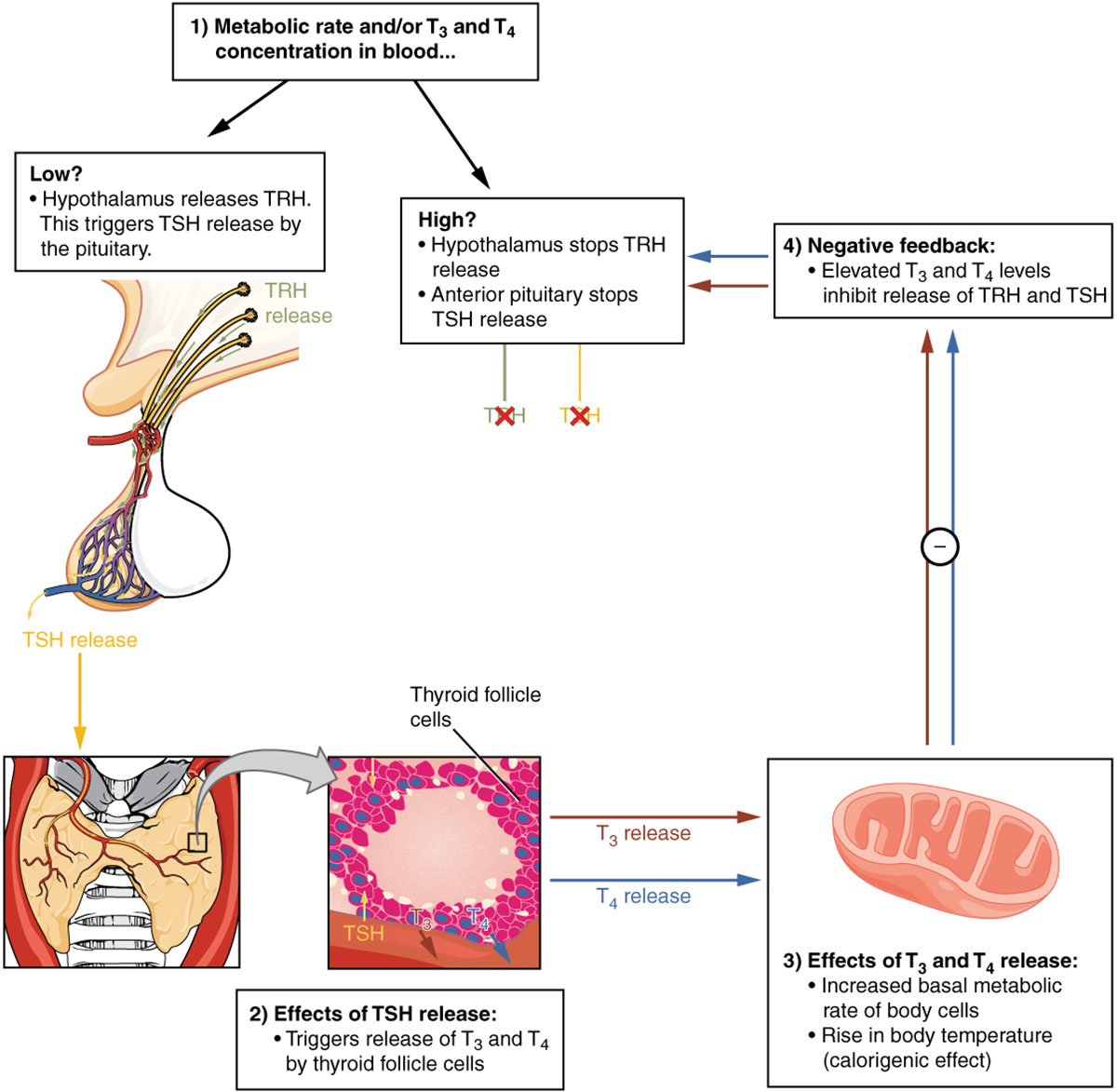
Metabolic rate and/or T3 and T4 concentration in blood… This factor represents the body’s metabolic demand and circulating levels of thyroid hormones T3 and T4. Changes in these levels trigger the feedback loop to maintain homeostasis.
Low? A low metabolic rate or reduced T3 and T4 levels prompt the hypothalamus to release TRH. This triggers TSH release by the pituitary, initiating hormone production to restore balance.
Hypothalamus releases TRH The hypothalamus releases thyrotropin-releasing hormone (TRH) in response to low thyroid hormone levels. This action stimulates the anterior pituitary to secrete TSH, kickstarting the thyroid hormone production cycle.
TRH release TRH release is the signal from the hypothalamus to the pituitary gland via the bloodstream. It is a critical step in activating the thyroid axis when hormone levels are insufficient.
High? High T3 and T4 levels signal the hypothalamus to stop TRH release and the anterior pituitary to halt TSH production. This cessation prevents overproduction of thyroid hormones.
TSH release TSH release from the anterior pituitary is triggered by TRH and stimulates the thyroid follicle cells. It regulates the synthesis and release of T3 and T4 to meet metabolic needs.
Thyroid follicle cells Thyroid follicle cells produce and store T3 and T4 within follicles, releasing them into the bloodstream. These cells respond to TSH to adjust hormone output based on demand.
T3 release T3 release involves the secretion of triiodothyronine, which enhances cellular metabolism. This hormone is more potent and acts directly on target cells to increase energy use.
T4 release T4 release refers to the secretion of thyroxine, a prohormone that converts to T3 in peripheral tissues. It provides a longer-lasting effect on metabolic regulation.
Effects of TSH release The effects of TSH release include triggering T3 and T4 production by thyroid follicle cells. This process ensures the body maintains adequate hormone levels for metabolic function.
Effects of T3 and T4 release The effects of T3 and T4 release include increased basal metabolic rate and a rise in body temperature. This calorigenic effect supports energy production and thermoregulation.
Negative feedback Negative feedback involves elevated T3 and T4 levels inhibiting TRH and TSH release to prevent excess hormone production. This self-regulating mechanism maintains thyroid hormone balance.
Overview of the Thyroid Feedback Mechanism
The negative feedback loop is a cornerstone of thyroid hormone regulation. This system ensures the body adapts to changing metabolic demands.
- The hypothalamus monitors T3 and T4 levels, releasing TRH when concentrations are low.
- TRH stimulates the pituitary to secrete TSH, activating thyroid follicle cells.
- Thyroid follicle cells release T3 and T4, addressing metabolic needs.
- High hormone levels trigger negative feedback, halting TRH and TSH production.
- This dynamic balance prevents hyperthyroidism or hypothyroidism.
Role of the Hypothalamus and Pituitary
The hypothalamus and pituitary gland orchestrate thyroid hormone production. Their coordination is essential for effective feedback regulation.
- The hypothalamus releases TRH in response to low metabolic rate or T3/T4 levels.
- TRH travel to the anterior pituitary, prompting TSH release.
- High T3 and T4 levels signal the hypothalamus to stop TRH secretion.
- The pituitary ceases TSH release, preventing overstimulation of the thyroid.
- This interplay maintains precise hormonal control.
Function of Thyroid Follicle Cells
Thyroid follicle cells are the primary site of T3 and T4 synthesis. Their activity is tightly regulated by TSH.
- TSH stimulates follicle cells to produce and release T3 and T4.
- T3, being more active, directly boosts cellular metabolism.
- T4 serves as a reservoir, converting to T3 as needed.
- The cells store hormones in follicles, releasing them into circulation.
- This process supports the body’s energy and growth requirements.
Clinical Implications of the Feedback Loop
Understanding the negative feedback loop aids in diagnosing thyroid disorders. Disruptions can lead to significant health issues.
- Low TRH or TSH release may indicate secondary hypothyroidism.
- Excessive T3 and T4 can cause hyperthyroidism, disrupting feedback.
- Thyroid follicle cell dysfunction may impair hormone synthesis.
- Imaging and blood tests assess TRH, TSH, T3, and T4 levels.
- Treatments adjust hormone levels to restore feedback balance.
The thyroid’s negative feedback loop is a finely tuned system that maintains metabolic homeostasis through T3 and T4 regulation. By integrating signals from the hypothalamus, pituitary, and thyroid follicle cells, this mechanism ensures the body adapts to its needs while preventing hormonal excess or deficiency. This knowledge provides a foundation for exploring thyroid health and related interventions.


