
At the most fundamental level, every living organism depends on the precise movement of molecules into and out of its cells. This process, known as cellular transport, ensures that nutrients are acquired, waste products are removed, and internal conditions remain stable despite external fluctuations. One of the most essential mechanisms driving this movement is simple diffusion. Unlike active transport, which requires energy in the form of ATP, simple diffusion is a passive process powered entirely by the kinetic energy of the molecules themselves. By understanding how molecules traverse the cellular barrier through this method, we gain deep insights into everything from how our lungs exchange gases to how certain medications enter our bloodstream. It is a concept that bridges the gap between basic physics and complex human physiology.
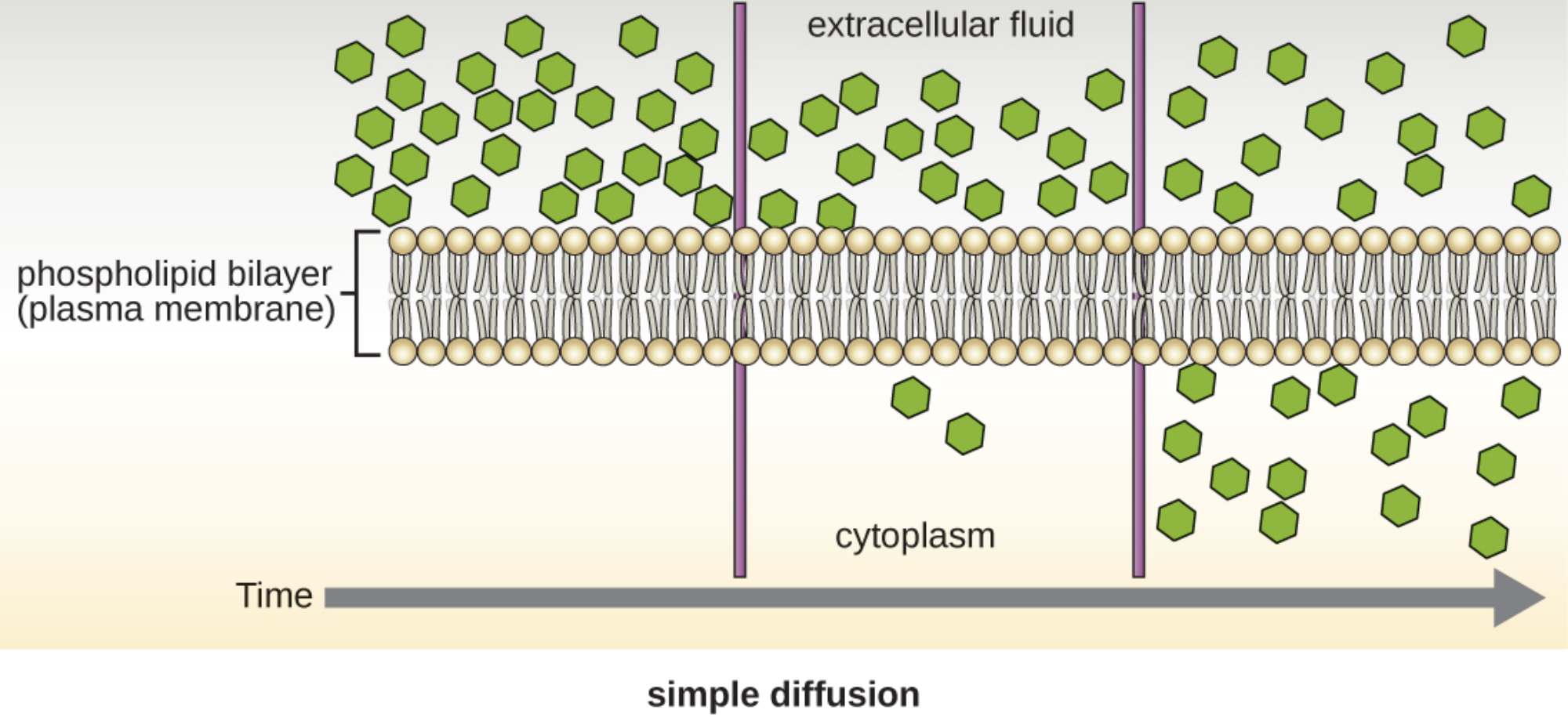
extracellular fluid: This term refers to the aqueous environment surrounding the outside of the cell, which contains various solutes, ions, and nutrients. In the context of the diagram, it serves as the initial area of high concentration for the green solute molecules.
cytoplasm: This is the jelly-like substance inside the cell membrane that contains the cell’s organelles and serves as the site for many metabolic reactions. The diagram shows molecules moving into the cytoplasm from the exterior to achieve a balance of concentration.
phospholipid bilayer (plasma membrane): This is the fundamental structural component of the cell membrane, consisting of two layers of lipids with hydrophobic tails and hydrophilic heads. It acts as a semi-permeable barrier that regulates which substances can pass directly through via simple diffusion.
Time: The arrow indicates the temporal progression of the diffusion process from left to right. It highlights how the random movement of molecules leads to a gradual transition from a state of high concentration gradient to a state of dynamic equilibrium.
simple diffusion: This label identifies the specific type of passive transport illustrated, where small or nonpolar molecules move directly through the lipid bilayer. The process continues until the concentration of the solute is uniform on both sides of the membrane.
The Physics Behind Passive Molecular Movement
To understand simple diffusion, one must look at the behavior of matter at the molecular level. Molecules are in a constant state of random motion due to their thermal energy. When a high concentration of molecules exists in one area, such as the extracellular fluid shown in the diagram, their random collisions eventually result in a net movement toward areas where they are less crowded. This movement occurs down a concentration gradient, which is the difference in the amount of a substance across a distance or a membrane.
This process is entirely spontaneous and does not stop once the concentration is equal on both sides. Instead, the system reaches a state called dynamic equilibrium. At this point, molecules continue to cross the membrane in both directions, but the rate of entry equals the rate of exit, resulting in no further net change in concentration. This principle of physics is the primary reason why oxygen naturally flows from the air-rich environment of our lungs into the oxygen-depleted blood within our pulmonary capillaries.
Properties of the Phospholipid Bilayer
The plasma membrane is not a solid wall; rather, it is a fluid, dynamic structure described by the fluid mosaic model. The phospholipid bilayer is the core of this structure, and its unique chemical properties dictate what can pass through it using simple diffusion. Each phospholipid molecule has a polar, water-loving head and a nonpolar, water-fearing tail. Because the tails face each other in the center of the membrane, they create a hydrophobic core that is highly resistant to the passage of large or charged particles.
Consequently, simple diffusion is limited to a specific subset of molecules. Small, nonpolar molecules like oxygen (O2) and carbon dioxide (CO2) can slip between the lipid molecules with ease. Similarly, lipid-soluble substances, such as steroid hormones and certain vitamins (A, D, E, and K), can dissolve through the membrane core. On the other hand, polar molecules like water or glucose, and charged ions like sodium (Na+), find the hydrophobic core impassable without the help of specialized transport proteins, a process known as facilitated diffusion.
Factors Influencing the Rate of Diffusion
The speed at which simple diffusion occurs is not constant; it is influenced by several physical and environmental factors. Understanding these variables is critical in medical contexts, such as when treating respiratory distress or managing edema. Key factors include:
- Steepness of the Gradient: The greater the difference in concentration between the outside and inside of the cell, the faster the molecules will move. As equilibrium is approached, the rate of diffusion naturally slows down.
- Temperature: Higher temperatures increase the kinetic energy of molecules, causing them to move and collide more frequently, which accelerates the diffusion process.
- Surface Area: Cells involved in heavy transport often have folded membranes (like microvilli) to increase the surface area available for diffusion, allowing more molecules to pass through at once.
- Membrane Thickness: The thinner the membrane, the faster molecules can cross it. This is why the membranes in the alveoli of the lungs are extremely thin to facilitate rapid gas exchange.
- Molecular Size: Generally, smaller molecules diffuse faster than larger ones because they can move more easily between the gaps in the phospholipid bilayer.
Biological and Medical Significance
Simple diffusion is a cornerstone of homeostasis, the process by which the body maintains a stable internal environment. One of the most vital examples is the exchange of gases in the respiratory system. In the lungs, oxygen concentration is higher than in the blood, so oxygen diffuses into the bloodstream. Conversely, carbon dioxide concentration is higher in the blood than in the lungs, so it diffuses out to be exhaled. This continuous exchange happens entirely through simple diffusion across the thin membranes of the alveoli and capillaries.
In the world of pharmacology, the concept of simple diffusion is fundamental to drug design. For a medication taken orally to reach its target, it must often cross various plasma membrane barriers. Drugs that are small and nonpolar (lipophilic) are absorbed much more readily because they can use simple diffusion to enter cells directly. Pharmacologists must carefully calculate the lipid solubility of a drug to ensure it can effectively bypass the cellular “gatekeepers” and exert its therapeutic effect within the body.
Comparing Simple Diffusion to Other Transport Methods
While simple diffusion is powerful, it is just one part of the cellular transport spectrum. It is often compared to facilitated diffusion and active transport to illustrate the complexity of cellular physiology. Facilitated diffusion also moves substances down a concentration gradient but requires a carrier or channel protein for molecules that are too large or polar to cross the lipids directly. Active transport, conversely, moves substances against their gradient, requiring energy input to maintain specific ion balances necessary for nerve impulses and muscle contractions.
The beauty of simple diffusion lies in its efficiency. By relying on the laws of physics rather than cellular energy, the body can perform massive amounts of molecular exchange for “free.” From the absorption of essential fatty acids in the intestines to the removal of metabolic waste from tissues, simple diffusion provides a silent, constant service that keeps the machinery of life running smoothly. Without this elegant passive process, the energy demands of basic survival would be vastly higher, likely making complex life as we know it impossible.
Clinical Pathophysiology and Diffusion Failure
When the conditions for simple diffusion are compromised, severe medical issues can arise. For example, in patients with pulmonary edema, fluid accumulates in the lungs, increasing the distance that oxygen must travel (membrane thickness) to reach the blood. This slows down the rate of diffusion, leading to hypoxia, where the body’s tissues are deprived of adequate oxygen. Similarly, in certain skin disorders, the lipid barrier of the epidermis becomes compromised, leading to excessive water loss through diffusion, resulting in severe dehydration and irritation.
Healthcare professionals often utilize the principles of diffusion in treatments. Hemodialysis for kidney failure is a prime example. In a dialysis machine, a patient’s blood is passed through a semi-permeable membrane separated from a dialysis fluid. Waste products like urea, which are at high concentration in the blood, diffuse across the membrane into the fluid where their concentration is low. By mimicking the natural process of simple diffusion, medical technology can sustain life for those whose biological systems have failed, demonstrating the profound importance of this physical phenomenon in both health and disease.


