
Eukaryote supergroups represent the current understanding of evolutionary relationships among eukaryotic organisms, providing critical context for medical microbiology and infectious disease management. While many people associate eukaryotes primarily with animals, plants, and fungi, the majority of eukaryotic diversity lies in protists that include numerous human pathogens and organisms of clinical importance. This comprehensive overview continues the exploration of supergroups, highlighting Rhizaria, Archaeplastida, Amoebozoa, and Opisthokonta with their distinguishing features and medical relevance.
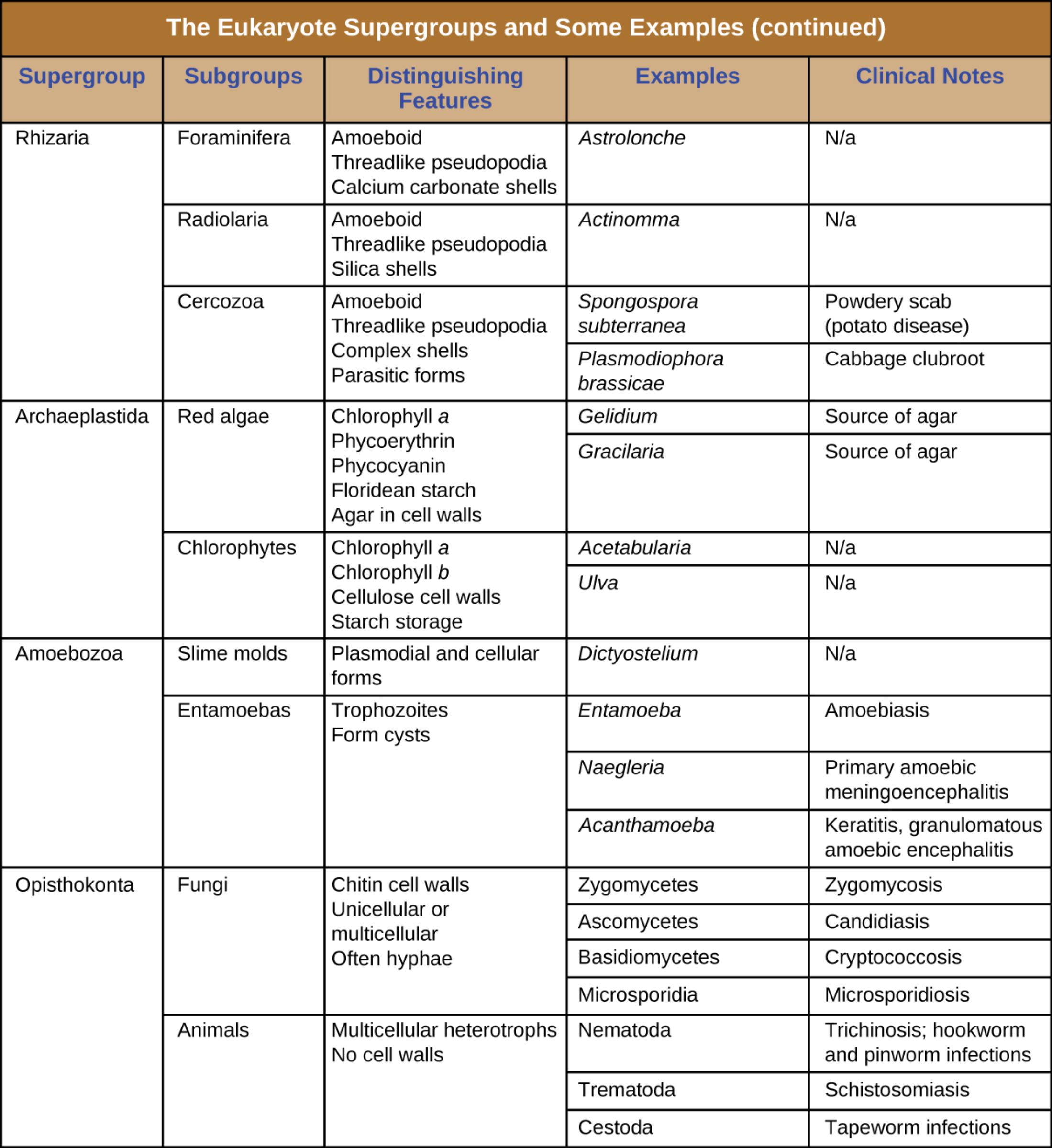
Rhizaria is a supergroup of primarily amoeboid organisms characterized by threadlike pseudopodia used for movement and feeding. Many members produce elaborate mineralized shells or tests, contributing significantly to marine sediments and paleontological records. Although few cause direct human disease, some rhizarians impact agriculture through plant parasitism.
Foraminifera within Rhizaria are amoeboid protists with threadlike pseudopodia and calcium carbonate shells. They are predominantly marine and serve as important indicators in geological and environmental studies.
Astrolonche is an example of a foraminiferan, illustrating the intricate shell structures typical of this subgroup, though it has no direct clinical significance.
Radiolaria are also amoeboid with threadlike pseudopodia but possess silica shells instead of calcium carbonate. These planktonic organisms play roles in oceanic silica cycling and fossil formation.
Actinomma represents a radiolarian species, known for its beautiful geometric silica skeleton visible under microscopy.
Cercozoa includes amoeboid organisms with threadlike pseudopodia, often featuring complex shells or parasitic lifestyles. Several members cause economically important plant diseases.
Spongospora subterranea causes powdery scab in potatoes, a significant agricultural disease affecting crop quality and marketability.
Plasmodiophora brassicae is responsible for clubroot disease in cabbage and related crops, leading to root galls and reduced yields in brassica vegetables.
Archaeplastida encompasses organisms with primary plastids derived from ancient cyanobacterial endosymbiosis. This supergroup includes red algae, green algae, and land plants, forming the basis of many photosynthetic lineages and providing valuable natural products.
Red algae contain chlorophyll a along with accessory pigments phycoerythrin and phycocyanin, store floridean starch, and often have agar in their cell walls. They are predominantly marine and serve as sources of commercially important polysaccharides.
Gelidium and Gracilaria are red algae widely used as sources of agar, a gelling agent essential for microbiological culture media and various food and pharmaceutical applications.
Chlorophytes are green algae possessing chlorophyll a and b, cellulose cell walls, and starch as the primary storage product. They exhibit diverse morphologies and are closely related to land plants.
Acetabularia and Ulva are well-known chlorophytes used in laboratory studies of cell biology and development, though they lack direct medical importance.
Amoebozoa consists of amoeboid protists that move and feed using broad, lobe-shaped pseudopodia. This supergroup includes both free-living and parasitic forms, with some causing serious human infections of the central nervous system and intestines.
Slime molds display plasmodial or cellular forms during their life cycles, demonstrating remarkable cooperative behaviors and developmental plasticity. They are primarily studied for basic biological processes rather than disease.
Dictyostelium is a cellular slime mold extensively used as a model organism for studying cell signaling, chemotaxis, and multicellular development.
Entamoebas are amoebae that exist as trophozoites and form resistant cysts, enabling survival outside hosts and transmission through contaminated food or water.
Entamoeba causes amoebiasis, an intestinal infection ranging from asymptomatic carriage to severe dysentery and liver abscesses.
Naegleria is a free-living amoeba that can cause primary amoebic meningoencephalitis, a rare but almost always fatal brain infection acquired from warm freshwater.
Acanthamoeba causes keratitis in contact lens users and granulomatous amoebic encephalitis in immunocompromised individuals, highlighting different tissue tropisms.
Opisthokonta is the supergroup uniting animals, fungi, and their closest unicellular relatives, characterized by a single posterior flagellum in motile cells. It includes the majority of macroscopic eukaryotic life and many clinically significant pathogens.
Fungi possess chitin cell walls, may be unicellular or multicellular with hyphae, and obtain nutrients through absorption. They play essential roles in decomposition and include numerous opportunistic and pathogenic species.
Zygomycetes cause zygomycosis, an aggressive infection often seen in diabetic or immunocompromised patients involving blood vessels and tissues.
Ascomycetes include species responsible for candidiasis, a common mucosal and systemic fungal infection.
Basidiomycetes encompass pathogens causing cryptococcosis, particularly affecting the lungs and central nervous system in immunocompromised hosts.
Microsporidia are obligate intracellular parasites now classified within fungi, causing microsporidiosis primarily in AIDS patients and other immunosuppressed individuals.
Animals are multicellular heterotrophs lacking cell walls, encompassing diverse phyla with medical importance as both hosts and parasites.
Nematoda includes roundworms causing trichinosis, hookworm, and pinworm infections, which affect millions globally through soil-transmitted or foodborne routes.
Trematoda are flukes responsible for schistosomiasis, a major tropical disease involving chronic inflammation and organ damage from parasitic worms.
Cestoda include tapeworms that cause intestinal infections and, in some cases, cysticercosis with serious neurological consequences.
Integrating Eukaryote Supergroups in Medical Education
Understanding the full spectrum of eukaryote supergroups helps clinicians and researchers appreciate the evolutionary context of human pathogens. While Excavata and Chromalveolata dominate many parasitic diseases, Amoebozoa and Opisthokonta contribute significant opportunistic and systemic infections, especially in vulnerable populations.
Pathogenic Amoebae in Amoebozoa
Amoebozoa contains free-living and parasitic amoebae capable of causing devastating infections. Naegleria fowleri and Acanthamoeba species enter through the nasal mucosa or cornea, respectively, exploiting host defenses in unique ways. Entamoeba histolytica remains a leading cause of parasitic dysentery in developing regions.
- Primary amoebic meningoencephalitis progresses rapidly with high mortality despite aggressive treatment.
- Amoebic keratitis requires prompt diagnosis to prevent vision loss in contact lens wearers.
These infections underscore the importance of proper water hygiene and contact lens care practices.
Fungal Pathogens within Opisthokonta
Fungi in Opisthokonta represent a major group of eukaryotic pathogens, particularly in hospital settings. Their chitinous cell walls and eukaryotic nature make them inherently resistant to many antibacterial agents, necessitating specific antifungal therapies. Opportunistic infections have increased with the rise in immunocompromised patients.
- Candidiasis ranges from superficial thrush to life-threatening bloodstream infections.
- Cryptococcosis often presents as meningitis in patients with advanced HIV.
Emerging resistance to azoles and echinocandins poses growing therapeutic challenges.
Helminth Parasites and Animal Diversity
Although animals themselves are not typically pathogens, many parasitic worms within animal phyla cause significant human disease. Nematodes, trematodes, and cestodes employ complex life cycles involving intermediate hosts, making control dependent on interrupting transmission cycles. These infections contribute heavily to the global burden of neglected tropical diseases.
Diagnostic and Therapeutic Considerations Across Supergroups
Laboratory diagnosis varies widely: microscopy for amoebae and helminths, culture or antigen tests for fungi, and molecular methods for precise identification. Treatment must account for the eukaryotic nature of these organisms, often targeting unique features such as ergosterol in fungal membranes or microtubule dynamics in parasites. Prevention strategies range from sanitation improvements to vector control and vaccination where available.
Future Perspectives in Eukaryotic Pathogen Research
Genomic sequencing continues to refine supergroup classifications and reveal novel drug targets shared across related organisms. Climate change and human encroachment may alter distributions of both free-living protists and their associated diseases. Interdisciplinary approaches combining phylogenetics, ecology, and clinical medicine will be essential for managing emerging threats from these diverse eukaryotic lineages.
Conclusion: A Unified View of Eukaryotic Diversity in Medicine
From Rhizaria’s plant pathogens to Amoebozoa’s brain-eating amoebae and Opisthokonta’s fungi and helminths, eukaryote supergroups encompass an extraordinary range of organisms impacting human health. Mastering this classification enhances diagnostic accuracy, informs treatment choices, and supports broader public health initiatives. As medical science advances, the evolutionary framework of supergroups will continue guiding innovations against eukaryotic threats.


