
The study of parasitology reveals a diverse world of organisms that have adapted to survive at the expense of their hosts. Among the most specialized are the members of the Class Monogenea, a group of flatworms within the Phylum Platyhelminthes. Unlike their counterparts in the classes Trematoda and Cestoda, monogeneans are primarily ectoparasites, meaning they live on the external surfaces of their hosts, such as the skin, fins, and especially the gills of fish. These organisms are of significant interest not only to evolutionary biologists but also to the aquaculture industry, where they can cause devastating outbreaks. One of the most frequently encountered genera is Dactylogyrus, commonly known as gill flukes. These microscopic parasites possess intricate attachment organs and a direct life cycle that allows them to proliferate rapidly in high-density aquatic environments. Understanding the biological nuances of these parasites is essential for maintaining aquatic health and managing the economic impact of parasitic infections in fisheries.
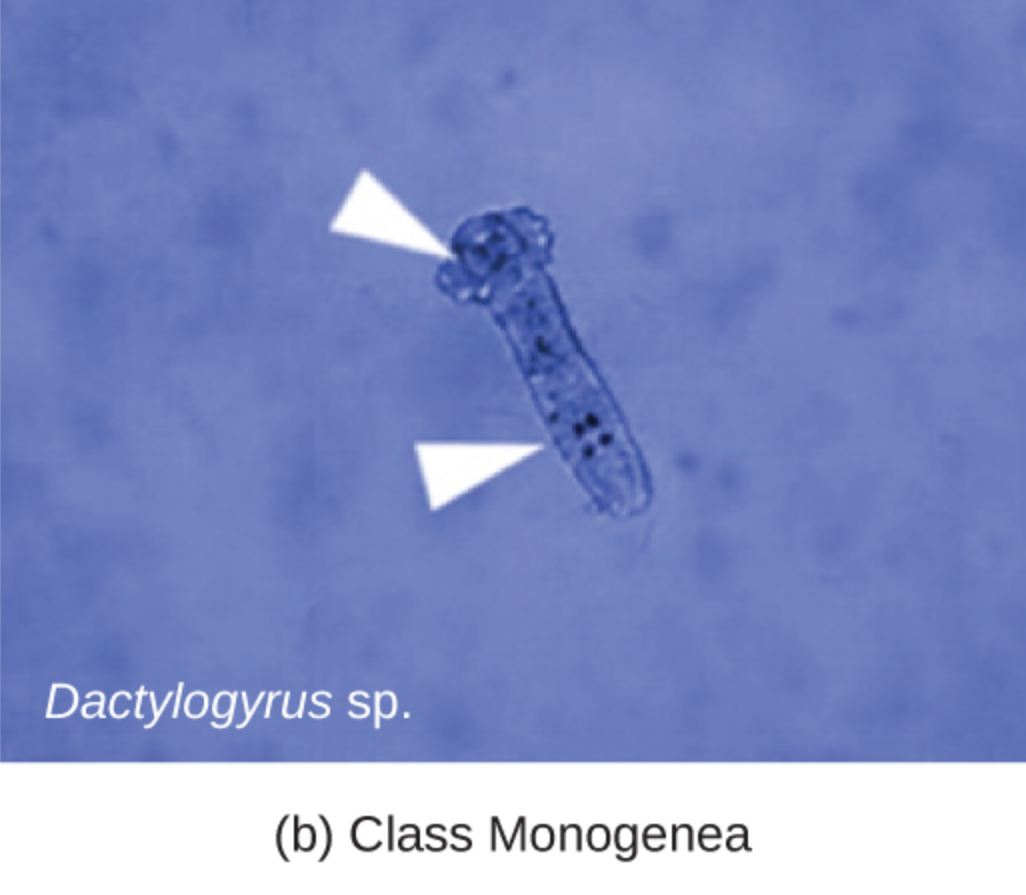
Dactylogyrus sp.: This label identifies a specific genus of monogenean flatworms that are characterized by the presence of four eyespots and a specialized attachment organ. They are notorious gill parasites, particularly affecting cyprinid fish like carp and goldfish, where they feed on epithelial cells and blood.
Class Monogenea: This classification refers to a group of parasitic flatworms that complete their entire life cycle on a single host without the need for an intermediate host. They are distinguished from other flukes by their posterior attachment organ, the haptor, and their primarily ectoparasitic lifestyle on aquatic vertebrates.
Upper Arrowhead: This arrow points toward the anterior end of the parasite, known as the prohaptor, which contains adhesive glands and sensory structures. In the genus Dactylogyrus, this region typically features four distinct, dark-pigmented eyespots that are sensitive to light, aiding the parasite during its free-swimming larval stage.
Lower Arrowhead: This arrow indicates the posterior end of the organism, which houses the haptor, the primary organ for attachment. The haptor of Dactylogyrus is armed with a pair of large central anchors and several smaller marginal hooks that provide a secure grip on the host’s delicate gill filaments.
The Evolutionary Context of Phylum Platyhelminthes
To understand the Class Monogenea, one must first look at the broader group to which it belongs: the Phylum Platyhelminthes. These are the flatworms, a group of bilaterally symmetrical, acoelomate invertebrates. Evolutionarily, they represent some of the simplest animals to possess three germ layers (triploblastic) and true organs. While the free-living turbellarians exhibit a wide range of ecological niches, the parasitic classes—Monogenea, Trematoda, and Cestoda—have undergone extreme morphological and physiological specializations to facilitate a parasitic existence.
Monogeneans are often considered the most primitive of the parasitic flatworms because of their direct life cycle and ectoparasitic nature. Unlike the Digenean trematodes, which require multiple hosts (often involving a snail and a vertebrate), monogeneans represent a specialized lineage that refined the art of host-specificity. They have evolved highly complex attachment mechanisms to resist being washed away by the constant flow of water across a fish\’s gills or the movement of a fish through its environment. This evolutionary arms race between the parasite\’s attachment and the host\’s immune response has led to a high degree of niche specialization, where many species of Monogenea are found only on a single species of fish.
Morphological Features and Anatomy of Dactylogyrus
The morphology of Dactylogyrus species is a masterclass in parasitic adaptation. Being dorsoventrally flattened, they present a low profile to water currents. The most striking feature of their anatomy is the presence of two distinct attachment regions. At the anterior end, the prohaptor serves for temporary attachment and movement, much like an inchworm. This area is equipped with adhesive sacs and cephalic glands that secrete a sticky substance, allowing the fluke to “walk” across the gill surface to find optimal feeding or mating sites.
The posterior attachment organ, or haptor, is the primary reason for their success as ectoparasites. In the genus Dactylogyrus, the haptor is a well-defined disc-like structure. It features two large, curved hooks called anchors (or hamuli) that are supported by a transverse bar. These anchors act like surgical needles, piercing the gill tissue. Surrounding these central anchors are smaller marginal hooklets, which provide additional points of contact. This mechanical grip is so strong that it often causes localized trauma and hyperplasia (cell proliferation) in the host\’s tissue.
Internally, Dactylogyrus possesses a simple digestive system consisting of a mouth, a muscular pharynx, and a branched intestine (ceca). Because they lack a circulatory system, nutrients are distributed via the branched gut and simple diffusion through the parenchyma. Their nervous system is ladder-like, and as shown in the microscopic image, they possess sensitive eyespots that detect light, a crucial feature for the larval stage that must find a new host after hatching.
The Direct Life Cycle: From Egg to Adult
One of the defining characteristics of the Class Monogenea is their monoxenous (direct) life cycle. For Dactylogyrus, the process begins when the adult parasite, which is hermaphroditic, releases eggs into the water. These eggs are often equipped with small filaments or stalks that allow them to entangle in the vegetation or substrate, preventing them from being swept too far from potential hosts. The rate of development is highly temperature-dependent; in warmer tropical waters, the eggs can hatch in just a few days.
The larval stage that emerges from the egg is called an oncomiracidium. This tiny, ciliated larva is the free-swimming dispersive stage. It is equipped with eyespots to seek out light and shadows, which may indicate the presence of a host fish. Once it locates a suitable host, the oncomiracidium attaches to the skin or gills and begins its transformation into an adult. It sheds its cilia, develops its permanent haptor, and starts feeding on the host\’s mucus and epithelial cells. Because there is no intermediate host involved, populations of Dactylogyrus can explode in closed systems like aquariums or commercial fish ponds, leading to heavy parasite loads that can kill the host.
Pathophysiology and Impact on Aquaculture
In the wild, monogeneans usually exist in low numbers and rarely cause significant harm to their hosts. However, in aquaculture, the story is very different. High stocking densities provide the perfect environment for the oncomiracidium larvae to find new hosts quickly. When a fish is infested with hundreds or thousands of Dactylogyrus flukes, the cumulative damage is severe. The physical attachment of the haptor hooks causes deep lesions in the gill lamellae, leading to hemorrhaging and the destruction of the delicate respiratory surface.
Clinical signs of an infestation include “flashing” (the fish rubbing its body against objects to relieve irritation), increased mucus production, and respiratory distress, often seen as gasping at the water surface. The damage to the gills not only impairs oxygen exchange but also disrupts the fish\’s osmoregulation, as the gills are the primary site for ion exchange. Furthermore, the lesions created by the fluke’s anchors serve as portals for secondary bacterial and fungal infections. If left untreated, a heavy Dactylogyrus infestation can lead to mass mortality within a fish population, resulting in significant economic losses for fish farmers.
Diagnosis and Management Strategies
Diagnosing a Dactylogyrus infestation requires microscopic examination, as the parasites are generally too small to be seen with the naked eye. Veterinarians and fish health professionals typically perform a “gill snip” or a mucus scrape. A small piece of gill tissue is placed on a slide with a drop of water and viewed under a light microscope. The characteristic movement of the flukes and the presence of the four eyespots at the anterior end make Dactylogyrus relatively easy to identify. The large anchors on the posterior haptor are also a key diagnostic feature used to distinguish them from other genera like Gyrodactylus (which lacks eyespots and is viviparous).
Managing these parasites involves a combination of chemical treatments and environmental control. Common treatments include salt baths, formalin, or organophosphates, though the latter are increasingly restricted due to environmental concerns. Because the eggs are often resistant to chemical treatments, multiple applications are usually required to kill the larvae as they hatch. In modern aquaculture, emphasis is placed on biosecurity and water quality. Maintaining optimal dissolved oxygen levels and minimizing organic waste can reduce the stress on the fish, making them more resilient to low-level parasitic challenges. Research is also ongoing into developing vaccines and breeding fish strains with natural resistance to monogenean attachment.
Conclusion: The Biological Persistence of Monogeneans
The Class Monogenea, exemplified by the genus Dactylogyrus, represents a highly successful and specialized branch of animal life. Their ability to thrive on the exterior of a moving host, their rapid reproductive rate, and their precise mechanical adaptations for attachment underscore the complexity of parasitic evolution. While they pose a significant threat to global aquaculture and ornamental fish keeping, they also serve as important models for studying host-parasite interactions and the evolution of life cycles. By continuing to study these remarkable flatworms, we gain not only the tools to protect aquatic biodiversity and food resources but also a deeper appreciation for the intricate web of life that exists within our planet’s waters.


