
Deinococcus radiodurans, famously nicknamed “Conan the Bacterium” for its extraordinary resilience reminiscent of the fictional barbarian warrior, stands as one of the most radiation-resistant organisms known on Earth. This Gram-positive coccus can withstand extreme doses of ionizing radiation, desiccation, oxidative stress, and other harsh conditions that would rapidly kill most other life forms. The provided image, captured via electron microscopy, reveals the distinctive cellular morphology of this remarkable microbe, offering a window into its structural adaptations that contribute to its unparalleled survival capabilities and making it a key model organism in microbiology, astrobiology, and biotechnology research.
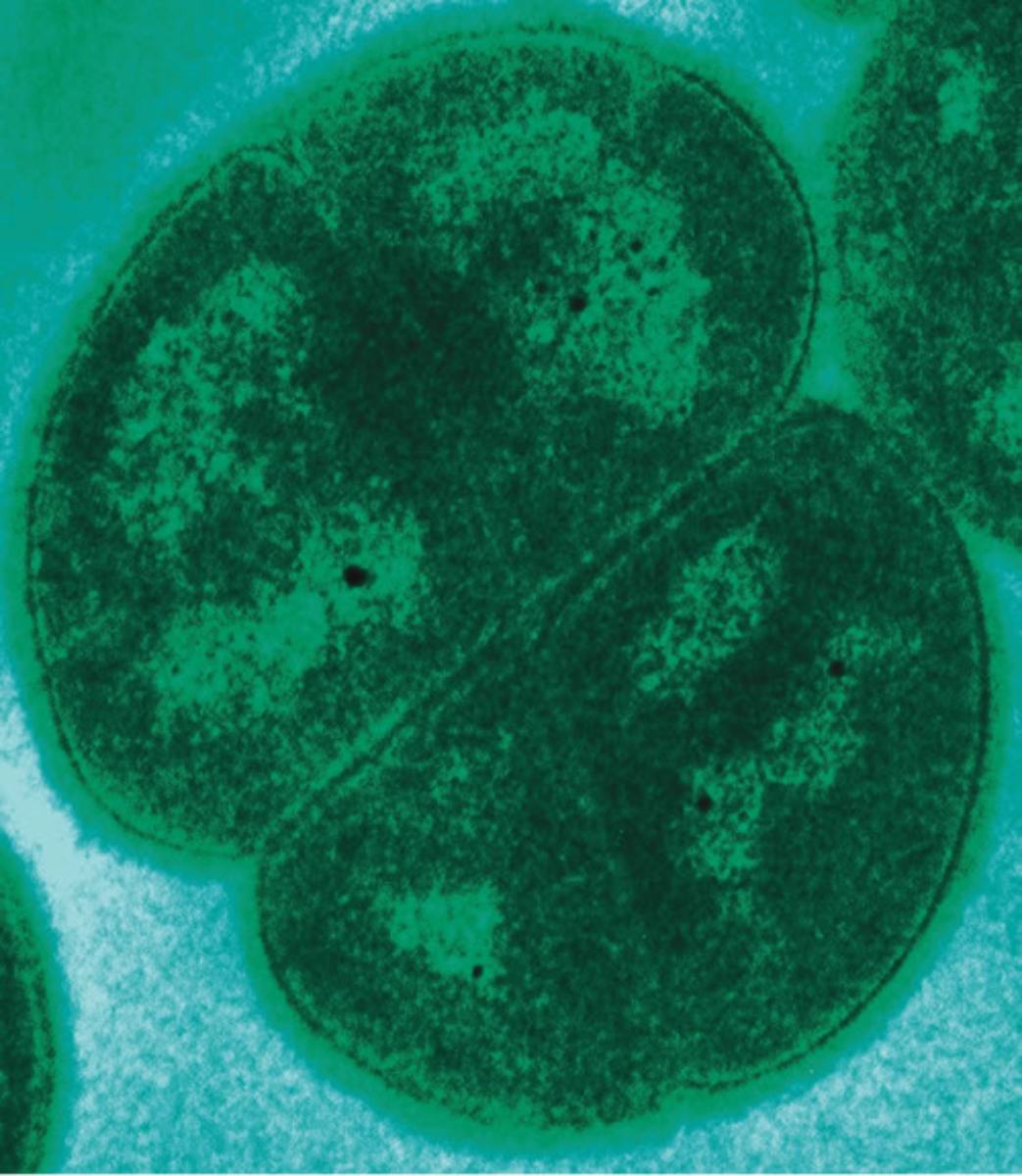
Spherical cells of Deinococcus radiodurans appear as large, rounded structures with a diameter typically ranging from 1.5 to 3.5 micrometers. These cocci often occur in pairs (diads) or tetrads due to division in alternating perpendicular planes, as visible in the clustered arrangement within the image. The robust, textured appearance of the cell surface reflects a complex multilayered cell envelope that includes a thick peptidoglycan layer, an outer membrane-like structure, and a paracrystalline S-layer, all of which enhance structural integrity under stress.
Cell envelope in the micrograph shows the dense, irregular surface texture characteristic of D. radiodurans. This multilayered architecture provides mechanical strength and protection against environmental insults. The envelope includes a highly ordered S-layer composed of proteins that form a protective coat, contributing to resistance against desiccation and radiation-induced damage while maintaining cellular integrity during recovery from extreme conditions.
Dividing cells are evident in the image through the characteristic pairing and tetrad formation. D. radiodurans divides sequentially in two perpendicular planes, resulting in clusters of two or four cells that remain attached. This morphology is clearly illustrated by the adjacent spherical bodies sharing a common plane of division, a feature that aids in the efficient packaging of multiple genome copies and supports rapid DNA repair following damage.
Discovery and Unique Characteristics of Deinococcus radiodurans
Deinococcus radiodurans was first isolated in the 1950s from irradiated canned meat that had spoiled despite sterilization doses of radiation. Initially classified as Micrococcus radiodurans, it was later reassigned to its own genus based on its distinct phylogenetic position and remarkable traits. The bacterium is non-pathogenic, aerobic, and typically forms pink to red colonies due to the carotenoid pigment deinoxanthin, a potent antioxidant that helps neutralize reactive oxygen species generated by radiation.
Its nickname “Conan the Bacterium” aptly captures its ability to survive conditions lethal to other organisms. It tolerates acute gamma radiation doses up to 15,000 Gy—thousands of times higher than the lethal dose for humans—and can endure prolonged desiccation, vacuum, and extreme temperatures. These properties make D. radiodurans an ideal subject for studying survival mechanisms relevant to space exploration, nuclear decontamination, and cancer radiotherapy side effects.
- Cells contain multiple genome copies (usually 4–10), providing redundant genetic material for repair.
- The nucleoid is highly condensed, helping to keep DNA fragments in close proximity after double-strand breaks.
- Colonies on agar are smooth, convex, and pigmented, facilitating easy laboratory cultivation.
Mechanisms of Extreme Radiation Resistance
The extraordinary radioresistance of Deinococcus radiodurans stems from a sophisticated combination of passive protection and active repair systems. Ionizing radiation generates reactive oxygen species (ROS) and hundreds of DNA double-strand breaks, yet the bacterium efficiently reassembles its genome within hours. Key to this is a highly efficient homologous recombination system, including RecA-mediated repair, and specialized proteins such as DdrA through DdrP and PprA that facilitate DNA end protection and repair.
Protein protection is equally critical. Unlike many organisms where DNA is the primary target, D. radiodurans prioritizes proteome integrity. It accumulates high intracellular manganese (Mn²⁺) levels in complexes with small metabolites that act as antioxidants, preventing iron-dependent ROS formation that would otherwise damage proteins. This Mn/Fe ratio strategy, combined with powerful enzymatic antioxidants like catalases and superoxide dismutases, allows repair enzymes to remain functional during recovery.
- Multiple antioxidant systems, including carotenoids like deinoxanthin, scavenge ROS effectively.
- Condensed nucleoids and ring-like genome structures keep broken DNA ends aligned for accurate repair.
- Extended synthesis-dependent strand annealing (ESDSA) and other recombination pathways enable rapid genome reconstitution.
Cell Structure and Morphological Adaptations
The electron micrograph highlights the robust spherical morphology and tetrad arrangement typical of D. radiodurans. Cells divide in alternating planes, forming stable clusters that may enhance resistance by providing shared protection or efficient resource distribution. The complex cell envelope, with its thick peptidoglycan and S-layer, acts as a physical barrier against environmental stressors while supporting the cell during extreme dehydration or radiation exposure.
Internal organization includes highly dynamic nucleoids that adopt various configurations during the cell cycle, from toroidal to elongated shapes. This plasticity coordinates with division and supports the maintenance of multiple genome copies. The image’s textured cell surface underscores the structural reinforcements that contribute to mechanical stability under stress.
- Division in perpendicular planes results in characteristic diads and tetrads.
- The S-layer forms a regular lattice of proteins providing additional surface protection.
- Multilayered envelope architecture distinguishes it from typical Gram-positive bacteria.
Biotechnological and Medical Applications
Deinococcus radiodurans has significant potential beyond basic research. Engineered strains expressing metal-reducing or organic-degrading genes are explored for bioremediation of radioactive waste sites and heavy metal pollution. Its radiation tolerance allows survival and function in environments lethal to conventional microbes, making it a promising chassis for synthetic biology applications in harsh conditions.
In medicine, insights from its antioxidant and DNA repair systems inspire new strategies for radioprotection during cancer therapy or space travel. Extracts or proteins from D. radiodurans may protect human cells from radiation-induced damage. Additionally, its non-pathogenic nature and robust growth support its use in industrial enzyme production and astrobiology studies on panspermia or life on other planets.
Ongoing research into its genome, proteome, and metabolome continues to uncover novel genes and pathways. The bacterium’s ability to survive desiccation and radiation parallels challenges faced by organisms in extreme terrestrial or extraterrestrial environments, broadening its relevance across scientific disciplines.
The image of Deinococcus radiodurans serves as a vivid reminder of life’s resilience. By studying this “Conan the Bacterium,” scientists gain valuable knowledge applicable to radiation biology, environmental cleanup, and protective therapies, highlighting how understanding microbial extremes can advance human health and technology.


