
Explore the critical contributions of the accessory digestive organs—the liver, pancreas, and gallbladder—whose functions are indispensable for efficient digestion despite not being part of the alimentary canal. This article details their anatomical structures, including the lobes of the liver and the intricate duct systems, and explains their profound impact on nutrient breakdown and absorption, highlighting their vital role in maintaining overall digestive health.
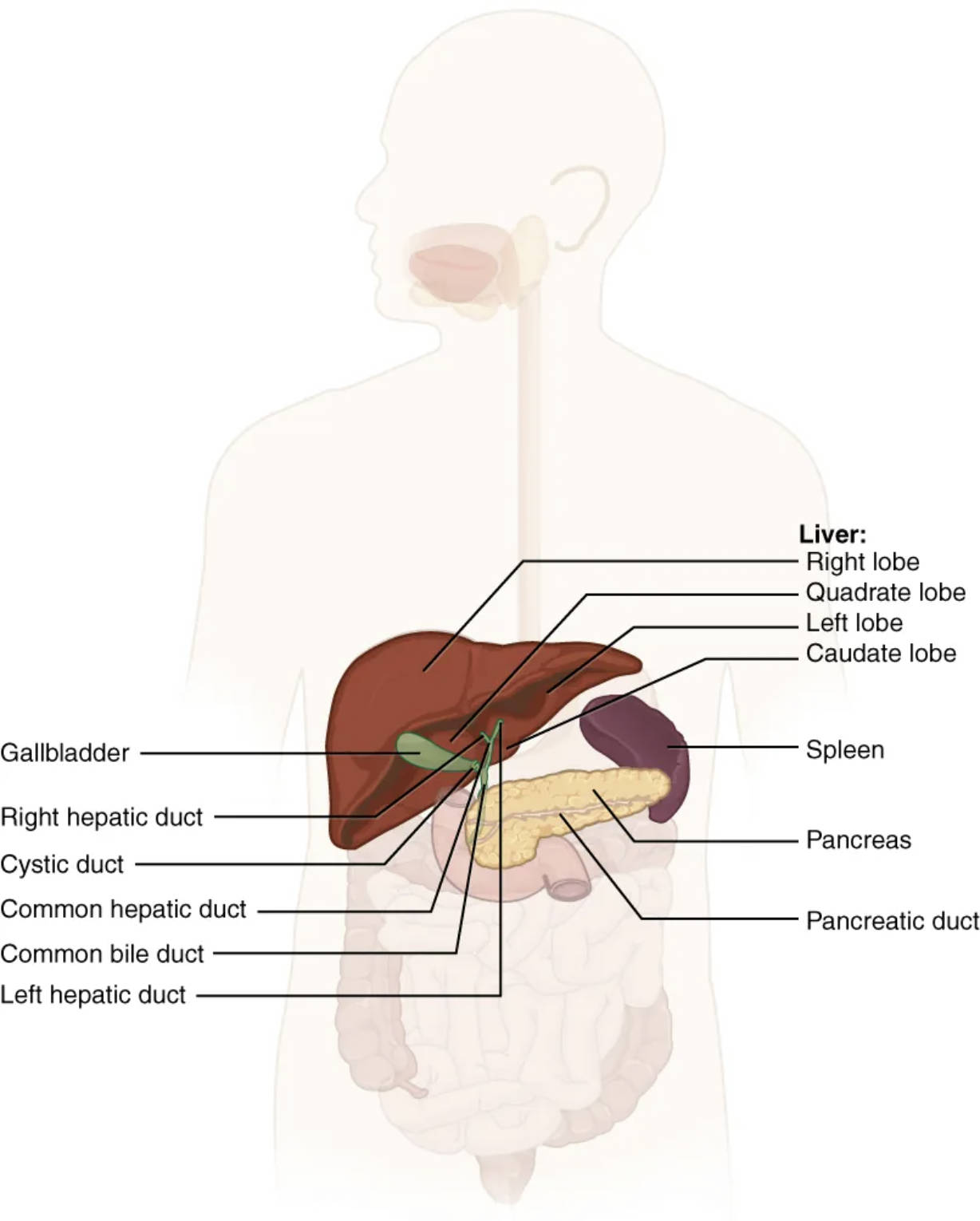
Liver: The largest internal organ, located in the upper right quadrant of the abdomen, performing over 500 vital functions. Its digestive roles include producing bile for fat emulsification, metabolizing nutrients, and detoxifying harmful substances.
Right lobe: This is the largest lobe of the liver, situated on the right side of the body. It forms a significant portion of the liver’s mass and is primarily involved in metabolic processes and bile production.
Quadrate lobe: This is a smaller lobe of the liver located on the inferior surface of the right lobe, anterior to the porta hepatis. It is anatomically part of the right lobe but functionally associated with the left hepatic duct system.
Left lobe: Situated to the left of the falciform ligament, this is the smaller of the two main anatomical lobes of the liver. It performs similar metabolic and digestive functions as the right lobe, including bile synthesis.
Caudate lobe: This is a small, posterior lobe of the liver, located inferior to the diaphragm and anterior to the inferior vena cava. Anatomically considered part of the right lobe, it often receives blood supply from both the right and left hepatic arteries.
Gallbladder: A small, pear-shaped organ located beneath the liver. Its primary function is to store and concentrate bile produced by the liver, releasing it into the duodenum when needed for fat digestion.
Right hepatic duct: This duct collects bile from the right lobe of the liver. It merges with the left hepatic duct to form the common hepatic duct, initiating the pathway for bile transport.
Cystic duct: This duct connects the gallbladder to the common hepatic duct. It allows bile to flow into and out of the gallbladder for storage and release.
Common hepatic duct: Formed by the junction of the right and left hepatic ducts, this duct carries bile from the liver. It then joins with the cystic duct to form the common bile duct.
Common bile duct: This duct is formed by the union of the common hepatic duct and the cystic duct. It transports bile from the liver and gallbladder to the duodenum, where it aids in fat emulsification.
Left hepatic duct: This duct collects bile specifically from the left lobe (and often the quadrate and caudate lobes) of the liver. It merges with the right hepatic duct to form the common hepatic duct.
Spleen: While located in proximity to the digestive organs, the spleen is not an accessory digestive organ. Its primary functions are related to the lymphatic and immune systems, filtering blood and destroying old blood cells.
Pancreas: An elongated, glandular organ located posterior to the stomach, performing both exocrine and endocrine functions. Its exocrine role involves producing digestive enzymes and bicarbonate, essential for neutralizing chyme and breaking down macronutrients.
Pancreatic duct: Also known as the duct of Wirsung, this main duct runs through the length of the pancreas. It collects pancreatic juices (enzymes and bicarbonate) and delivers them to the duodenum, usually via the ampulla of Vater.
The digestive system comprises not only the alimentary canal (gastrointestinal tract) but also a crucial set of accessory digestive organs. These organs, although food does not directly pass through them, play indispensable roles in secreting enzymes, bile, and hormones that are vital for the chemical breakdown of food and the efficient absorption of nutrients. The liver, pancreas, and gallbladder stand out as the primary accessory organs, each contributing unique and complex functions that are essential for the overall digestive process.
Without the coordinated efforts of these organs, the intricate process of digestion would be severely hampered. The liver, a metabolic powerhouse, produces bile necessary for fat digestion. The gallbladder serves as a storage reservoir for this bile, releasing it on demand. Meanwhile, the pancreas, a versatile gland, secretes a rich cocktail of digestive enzymes that break down carbohydrates, proteins, and fats, alongside bicarbonate to neutralize stomach acid.
The anatomical proximity and functional interdependence of the liver, pancreas, and gallbladder highlight their collaborative nature in orchestrating effective digestion. Understanding the specific contributions of each organ, including their internal structures and their intricate duct systems, is fundamental to comprehending how our bodies process food and extract the necessary energy and building blocks for life. The diagram above provides a clear overview of these vital accessory organs and their connections.
The Liver: A Multifunctional Digestive Gland
The liver, the largest gland in the body, is an organ of immense metabolic and digestive importance. Anatomically, it is divided into four lobes:
- Right lobe: The largest lobe, making up the bulk of the liver.
- Left lobe: Smaller than the right, positioned to the left of the falciform ligament.
- Quadrate lobe: Located on the inferior surface of the right lobe, anterior to the porta hepatis.
- Caudate lobe: A smaller lobe on the posterior-superior surface of the liver, posterior to the porta hepatis.
From a digestive perspective, the liver’s most crucial role is the production of bile. Bile is a complex fluid containing bile salts, bilirubin, cholesterol, and phospholipids. Bile salts are amphipathic molecules that are essential for the emulsification of fats in the small intestine, breaking large fat globules into smaller ones, thereby increasing the surface area for enzymatic digestion by lipase. Bile is collected by the right hepatic duct and left hepatic duct, which merge to form the common hepatic duct.
The Gallbladder: Bile Storage and Concentration
The gallbladder is a small, pear-shaped muscular sac nestled beneath the right lobe of the liver. Its primary function is to store and concentrate bile produced by the liver. When fatty chyme enters the duodenum, the hormone cholecystokinin (CCK) stimulates the gallbladder to contract, expelling concentrated bile into the small intestine. The cystic duct connects the gallbladder to the common hepatic duct, forming the common bile duct, through which bile flows into the duodenum.
The Pancreas: Dual Role in Digestion and Metabolism
The pancreas is a long, slender gland situated posterior to the stomach, playing a critical dual role as both an exocrine and an endocrine organ.
- Exocrine Function: Its exocrine function is directly related to digestion. The pancreas produces pancreatic juice, a mixture rich in digestive enzymes and bicarbonate.
- The enzymes include pancreatic amylase (for carbohydrates), pancreatic lipase (for fats), and various proteases like trypsin and chymotrypsin (for proteins).
- The bicarbonate is crucial for neutralizing the acidic chyme entering the duodenum from the stomach, creating an optimal pH environment for the pancreatic enzymes to function effectively.
- This pancreatic juice is transported through the pancreatic duct (duct of Wirsung) which usually joins the common bile duct at the ampulla of Vater, before emptying into the duodenum.
- Endocrine Function: The pancreas also has an endocrine role, secreting hormones like insulin and glucagon, which are vital for blood glucose regulation, though this is not directly part of digestion.
In conclusion, the liver, gallbladder, and pancreas are far more than mere “accessory” organs; they are indispensable powerhouses of the digestive system. The liver’s bile production and metabolic prowess, the gallbladder’s efficient bile storage, and the pancreas’s comprehensive enzymatic and buffering secretions are all critical for the complete breakdown and absorption of nutrients. Their intricate anatomical connections and coordinated physiological responses are fundamental to maintaining a healthy and efficient digestive process, underscoring their profound importance to overall human health.


