
The human body is a marvel of complexity, organized into distinct levels that work together seamlessly to sustain life. From the tiniest chemical building blocks to the complete organism, the structural organization of the body can be broken down into six key levels of increasing complexity. This article explores these levels through a detailed medical image, offering insights into how each level contributes to the overall functioning of the body. Whether you’re looking to deepen your understanding of human anatomy or explore the interconnected systems that keep us alive, this guide provides a clear and comprehensive overview.
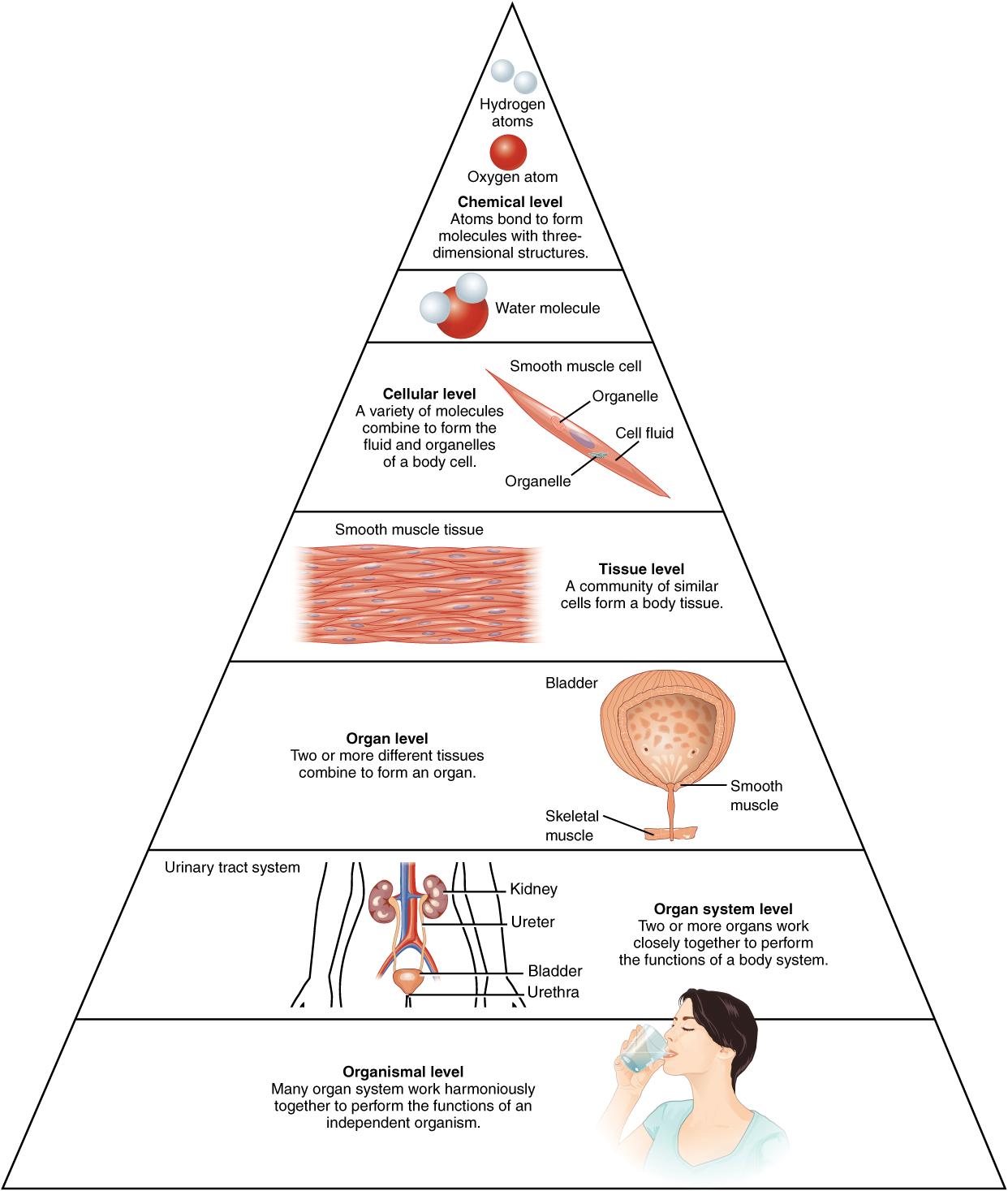
Introduction to the Levels of Structural Organization
Hydrogen atoms
Hydrogen atoms are fundamental building blocks at the chemical level of organization. They combine with other atoms, such as oxygen, to form essential molecules like water, which are critical for life processes.
Oxygen atom
The oxygen atom plays a vital role in forming molecules necessary for cellular respiration and energy production. It bonds with hydrogen to create water and is a key component in many organic molecules within the body.
Water molecule
A water molecule, composed of two hydrogen atoms and one oxygen atom, is essential for maintaining cellular hydration and facilitating biochemical reactions. It serves as a solvent, enabling the transport of nutrients and waste within cells.
Smooth muscle cell
The smooth muscle cell is a specialized cell found in various organs, such as the digestive tract and blood vessels. These cells are responsible for involuntary movements, like the contraction of the stomach during digestion.
Organelle
An organelle, such as the nucleusπει:Cell fluid
Cell fluid, also known as cytoplasm, is the gel-like substance within a cell that surrounds the organelles. It provides a medium for chemical reactions and helps maintain the cell’s structure and shape.
Smooth muscle tissue
Smooth muscle tissue consists of tightly packed smooth muscle cells that work together to perform involuntary functions. This tissue is found in the walls of internal organs, such as the bladder, and aids in processes like urination.
Bladder
The bladder is an organ in the urinary system that stores urine before it is excreted. It is composed of smooth muscle tissue, known as the detrusor muscle, which contracts to expel urine through the urethra.
Skeletal muscle
Skeletal muscle is attached to bones and enables voluntary movements, such as walking or lifting. Unlike smooth muscle, it is striated and under conscious control, working in coordination with the nervous system.
Kidney
The kidney is a vital organ in the urinary system, responsible for filtering blood and removing waste products through urine production. It also regulates water and electrolyte balance, maintaining overall homeostasis.
Ureter
The ureter is a tube that transports urine from the kidney to the bladder. It uses peristaltic contractions of smooth muscle to ensure a unidirectional flow of urine, preventing backflow and infection.
Urethra
The urethra is the final passageway for urine to exit the body from the bladder. In males, it also serves as a conduit for semen during ejaculation, while in females, it is solely part of the urinary system.
Urinary tract system
The urinary tract system includes the kidneys, ureters, bladder, and urethra, working together to eliminate waste and regulate fluid balance. This system is crucial for maintaining the body’s internal environment and preventing toxin buildup.
Exploring the Chemical Level: The Foundation of Life
The chemical level forms the foundation of the human body’s structural organization. This level includes atoms and molecules that are the building blocks of life.
- Atoms like hydrogen and oxygen are the smallest units of elements that combine to form molecules. These interactions are governed by chemical bonds, such as covalent bonds in water molecules.
- Molecules at this level, including water, are essential for biochemical processes. Water, for instance, makes up about 60% of the human body and is critical for temperature regulation and nutrient transport.
- The chemical level sets the stage for higher levels of organization. Without these basic units, the formation of cells and tissues would be impossible.
The Cellular Level: Building Blocks of the Body
At the cellular level, molecules combine to form cells, the basic functional units of life. This level is where life processes begin to emerge.
- Cells like smooth muscle cells are specialized to perform specific functions. For example, smooth muscle cells contract without conscious control to facilitate organ functions.
- Organelles within cells, such as mitochondria, are responsible for energy production, while the cell fluid provides a medium for these activities. This internal organization ensures cells can perform their roles effectively.
- The diversity of cells at this level allows for specialization. This specialization is key to forming tissues and, eventually, organs.
Tissue Level: Collaboration of Cells
The tissue level involves groups of similar cells working together to perform a specific function. Tissues are the next step in the body’s structural hierarchy.
- Smooth muscle tissue is an example of how cells collaborate to enable organ function. In the bladder, this tissue contracts to expel urine, ensuring proper waste elimination.
- Tissues vary widely in structure and function, including epithelial, connective, and nervous tissues. Each type contributes uniquely to the body’s overall operation.
- The organization of cells into tissues allows for greater efficiency. This collaboration is essential for the formation of organs with complex functions.
Organ Level: Integrated Systems
At the organ level, different tissues combine to form organs, each with a specific role in the body. This level showcases the integration of tissues for specialized functions.
- The bladder, for instance, combines smooth muscle tissue with epithelial tissue to store and release urine. This coordination ensures the body can efficiently remove waste.
- Skeletal muscle works with connective tissue to attach to bones, enabling movement. This partnership highlights how tissues collaborate to achieve organ-level functions.
- Organs are highly specialized and interdependent. Their roles are critical for the body’s survival and interaction with the environment.
Organ System Level: Coordinated Functions
The organ system level involves multiple organs working together to perform a unified function. The urinary tract system is a prime example of this coordination.
- The urinary tract system includes the kidneys, ureters, bladder, and urethra, all collaborating to filter and excrete waste. The kidneys filter blood, while the ureters and bladder ensure proper urine transport and storage.
- This system also regulates blood pressure and pH balance. The kidneys release hormones like renin, which helps control blood pressure, and they maintain acid-base balance by excreting hydrogen ions.
- Organ systems are essential for maintaining homeostasis. Their coordinated efforts ensure the body operates as a cohesive unit.
Organismal Level: The Complete Human Body
The organismal level represents the culmination of all previous levels, forming a complete human being capable of independent function.
- At this level, all organ systems work harmoniously to sustain life. For example, the urinary tract system collaborates with the cardiovascular system to regulate blood volume and pressure.
- The human body at this level can adapt to environmental changes, reproduce, and grow. This complexity allows humans to thrive in diverse conditions.
- The organismal level reflects the intricate interplay of all systems. It is the ultimate expression of structural organization, enabling survival and interaction with the world.
Importance of Structural Organization in Health
Understanding the levels of structural organization is crucial for maintaining health and diagnosing issues. Each level plays a role in overall well-being.
- Disruptions at the chemical level, such as imbalances in electrolytes, can affect cellular function. For example, low potassium levels can impair muscle contraction, including in smooth muscle tissues.
- At the organ system level, issues like kidney failure can disrupt the urinary tract system’s ability to filter waste. This can lead to toxin buildup, affecting the entire organism.
- A comprehensive understanding of these levels aids in medical interventions. Treatments often target specific levels, such as dialysis for kidney failure, to restore balance.
Conclusion
The structural organization of the human body, from the chemical to the organismal level, reveals the remarkable complexity that sustains life. Each level, from hydrogen atoms to the urinary tract system, plays an indispensable role in ensuring the body functions as a cohesive whole. By understanding these levels, we gain insight into how our bodies operate and how to maintain health at every stage. This knowledge not only deepens our appreciation for human anatomy but also empowers us to make informed decisions about our well-being.


