
Plasmodial slime molds, also known as myxomycetes, represent one of nature’s most remarkable examples of eukaryotic adaptability, featuring a giant multinucleate plasmodium capable of impressive growth and sophisticated behaviors without a nervous system. These organisms belong to the Amoebozoa supergroup and exhibit a complex life cycle alternating between haploid and diploid phases, involving amoeboid cells, flagellated gametes, and a massive syncytial plasmodium. Their study provides valuable insights into cell motility, cytoplasmic streaming, cell cycle regulation, and even unconventional computing, while highlighting evolutionary strategies for survival in diverse terrestrial environments.
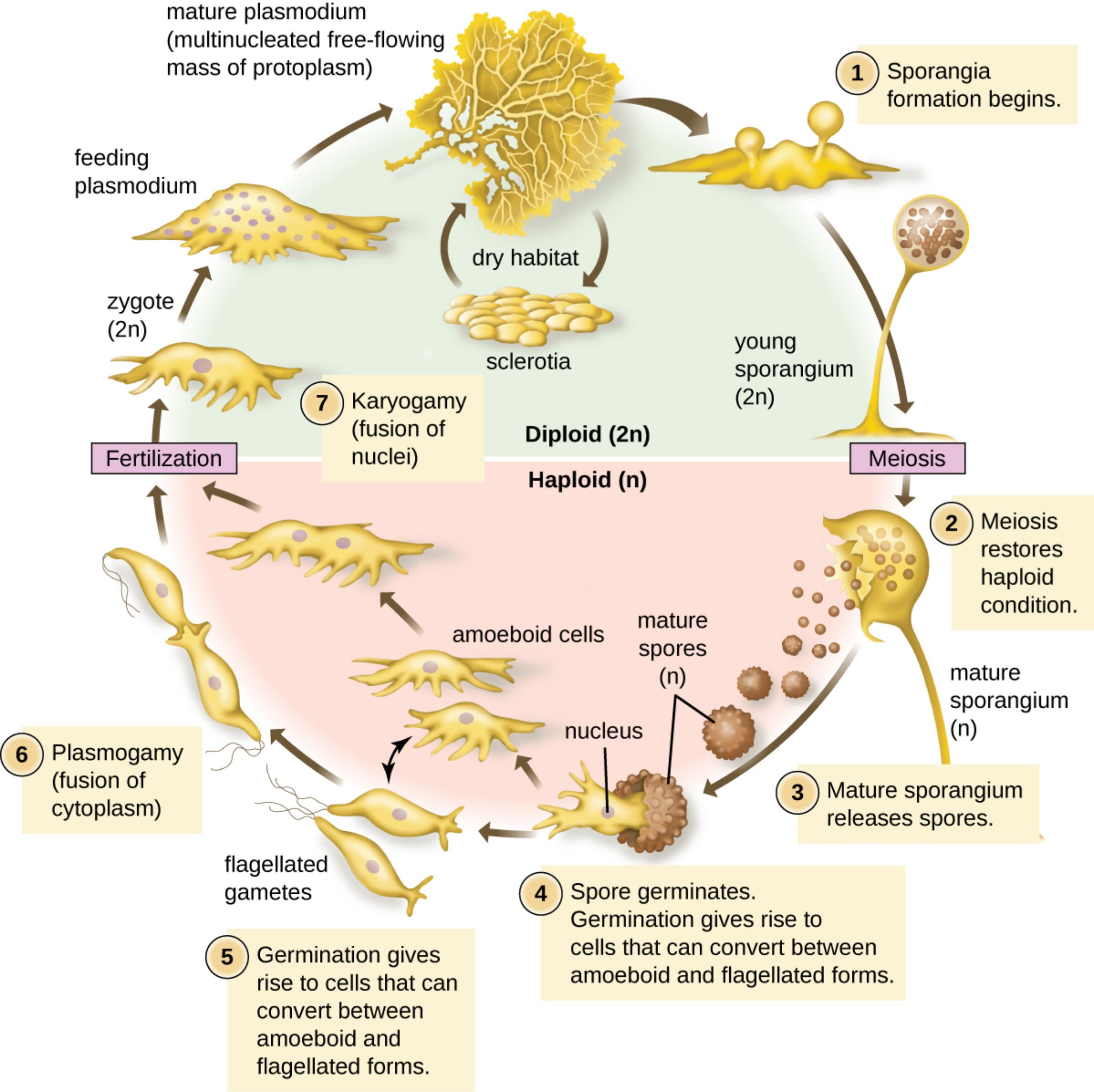
Mature plasmodium is the large, multinucleated free-flowing mass of protoplasm that forms the primary feeding and vegetative stage of plasmodial slime molds. This acellular structure can grow to several square meters in some species and moves via cytoplasmic streaming, allowing efficient nutrient transport and exploration of the environment.
Feeding plasmodium refers to the active, motile plasmodial stage that engulfs bacteria, yeast, and organic debris through phagocytosis. It displays network-like vein structures that optimize resource distribution and can solve complex problems such as finding the shortest path in mazes.
Zygote (2n) is the diploid cell formed after fertilization, which grows and undergoes nuclear divisions without cytokinesis to develop into the plasmodium. This stage marks the transition to the diploid phase of the life cycle.
Sclerotia are hardened, dormant resting structures formed by the plasmodium under dry or unfavorable conditions. They allow survival during stress and can rapidly revive into a feeding plasmodium when moisture and nutrients return.
Karyogamy (fusion of nuclei) occurs within the developing plasmodium, where nuclei from fused gametes combine, establishing the diploid state. This nuclear fusion is a key step in completing the sexual cycle.
Fertilization involves the fusion of compatible gametes, leading to zygote formation. In plasmodial slime molds, this process initiates the diploid plasmodial phase.
Plasmogamy (fusion of cytoplasm) is the initial fusion of cytoplasm between compatible haploid cells, often flagellated gametes, preceding nuclear fusion. This step creates a heterokaryotic or diploid cell that develops further.
Flagellated gametes are haploid motile cells produced after spore germination under wet conditions. They swim using flagella to locate compatible mating types for sexual reproduction.
Amoeboid cells are haploid cells that emerge from germinating spores and can switch between amoeboid and flagellated forms depending on environmental moisture. They feed on microorganisms and can fuse during sexual reproduction.
Mature spores (n) are haploid resistant structures released from sporangia. They ensure dispersal and survival, germinating into amoeboid or flagellated cells when conditions improve.
Sporangia formation begins when the mature plasmodium converts into fruiting bodies under starvation or specific cues like light exposure. Sporangia are the spore-producing structures elevated for better dispersal.
Young sporangium (2n) represents the early diploid stage of fruiting body development following meiosis initiation in the plasmodium.
Meiosis restores haploid condition occurs during sporangium maturation, reducing the chromosome number to produce haploid spores. This restores the haploid phase for the next generation.
Mature sporangium (n) is the fully developed fruiting body containing haploid spores ready for release. It often has distinctive shapes and colors characteristic of different myxomycete species.
Mature sporangium releases spores completes the cycle as spores are dispersed by wind, water, or animals to colonize new areas.
Spore germinates when environmental conditions are favorable, releasing cells capable of amoeboid or flagellated movement. Germination links the dormant spore stage back to active growth.
Understanding the Life Cycle of Plasmodial Slime Molds
The diagram illustrates the diplontic life cycle of plasmodial slime molds, where the prominent vegetative phase is diploid. Haploid spores germinate into amoeboid or flagellated cells that feed and eventually undergo plasmogamy and karyogamy to form a zygote. The zygote develops into the massive multinucleate plasmodium through repeated nuclear divisions without cell division. Under stress, the plasmodium forms sclerotia for dormancy or differentiates into sporangia, where meiosis produces new haploid spores.
Biological Significance of the Plasmodium Stage
The mature plasmodium is a syncytium containing thousands to millions of nuclei sharing a common cytoplasm. This unique structure enables rapid cytoplasmic streaming, nutrient transport over large distances, and coordinated responses to environmental stimuli. Species like Physarum polycephalum have been extensively studied for their ability to form optimized vein networks that efficiently connect food sources, demonstrating emergent intelligence without neurons.
- Plasmodia can solve mazes and optimize transport networks in laboratory experiments.
- Cytoplasmic streaming facilitates fast distribution of nutrients and signals.
- The stage allows massive growth, with some plasmodia covering several square meters.
These properties make plasmodial slime molds excellent models for studying self-organization and adaptive behavior in non-neural systems.
Reproductive Strategies and Survival Adaptations
Plasmodial slime molds combine sexual and asexual capabilities. The sexual cycle involves fusion of gametes leading to a diploid plasmodium, while sclerotia provide a dormant survival strategy. Sporangia formation under starvation ensures spore production for dispersal. This flexibility allows colonization of decaying wood, leaf litter, and other moist habitats rich in microorganisms.
Applications as Biomedical and Research Models
Plasmodial slime molds, particularly Physarum polycephalum, serve as powerful model organisms for cell cycle regulation, motility, chemotaxis, and cellular differentiation. Their synchronous nuclear divisions in the plasmodium provide insights into mitotic control relevant to cancer research. The organism has been used in space biology experiments to study gravity effects on cytoplasmic streaming and migration. Additionally, researchers explore their potential in unconventional computing, where the plasmodium acts as a living substrate for solving optimization problems.
Potential in Biotechnology and Medicine
Extracts from plasmodial slime molds show promising biological activities, including antimicrobial and antioxidant properties from extracellular polysaccharides. Some compounds exhibit activity against cancer cell lines, suggesting potential for drug discovery. The slime tracks and plasmodial secretions are studied for bioactive molecules that could contribute to new therapeutic agents or industrial applications like biofuels.
Ecological Role and Distribution
As heterotrophic protists, plasmodial slime molds play important roles in terrestrial ecosystems by consuming bacteria, fungi, and decaying organic matter. They contribute to nutrient cycling in forest floors and are found worldwide in moist environments. Their fruiting bodies add to microbial biodiversity and serve as food for small invertebrates.
Comparison with Cellular Slime Molds
Unlike cellular slime molds such as Dictyostelium discoideum, which aggregate from individual amoebae, plasmodial slime molds form a true syncytium through cell fusion. This fundamental difference highlights diverse evolutionary solutions to multicellularity within the Amoebozoa supergroup. Both groups offer complementary models for studying cooperation, differentiation, and development.
Future Research Directions
Ongoing studies focus on the molecular basis of network optimization, memory-like behaviors in the plasmodium, and genomic analyses of myxomycetes. Advances in imaging and genetic tools will further elucidate how these acellular organisms achieve complex behaviors. Their potential in bio-computing and natural product chemistry continues to expand, bridging basic biology with applied sciences.
Conclusion: Nature’s Syncytial Wonders
The life cycle of plasmodial slime molds showcases extraordinary eukaryotic versatility, from solitary haploid cells to vast multinucleate plasmodia and intricate fruiting bodies. As research models, they illuminate fundamental cellular processes and inspire innovations in computing, biotechnology, and medicine. Continued exploration of these fascinating organisms will deepen our understanding of life’s diversity and adaptability.


