
The phylogenetic tree of life represents one of the most profound achievements in biology, illustrating the evolutionary relationships among all living organisms and tracing their origins back to a single common ancestor. This branching diagram organizes life into three primary domains based on genetic, biochemical, and structural evidence, revealing deep connections and divergences that shape our understanding of biodiversity, microbiology, and human health. The image provides a clear visual summary of these relationships, highlighting major groups within each domain and marking the position of the last universal common ancestor from which all cellular life descended.
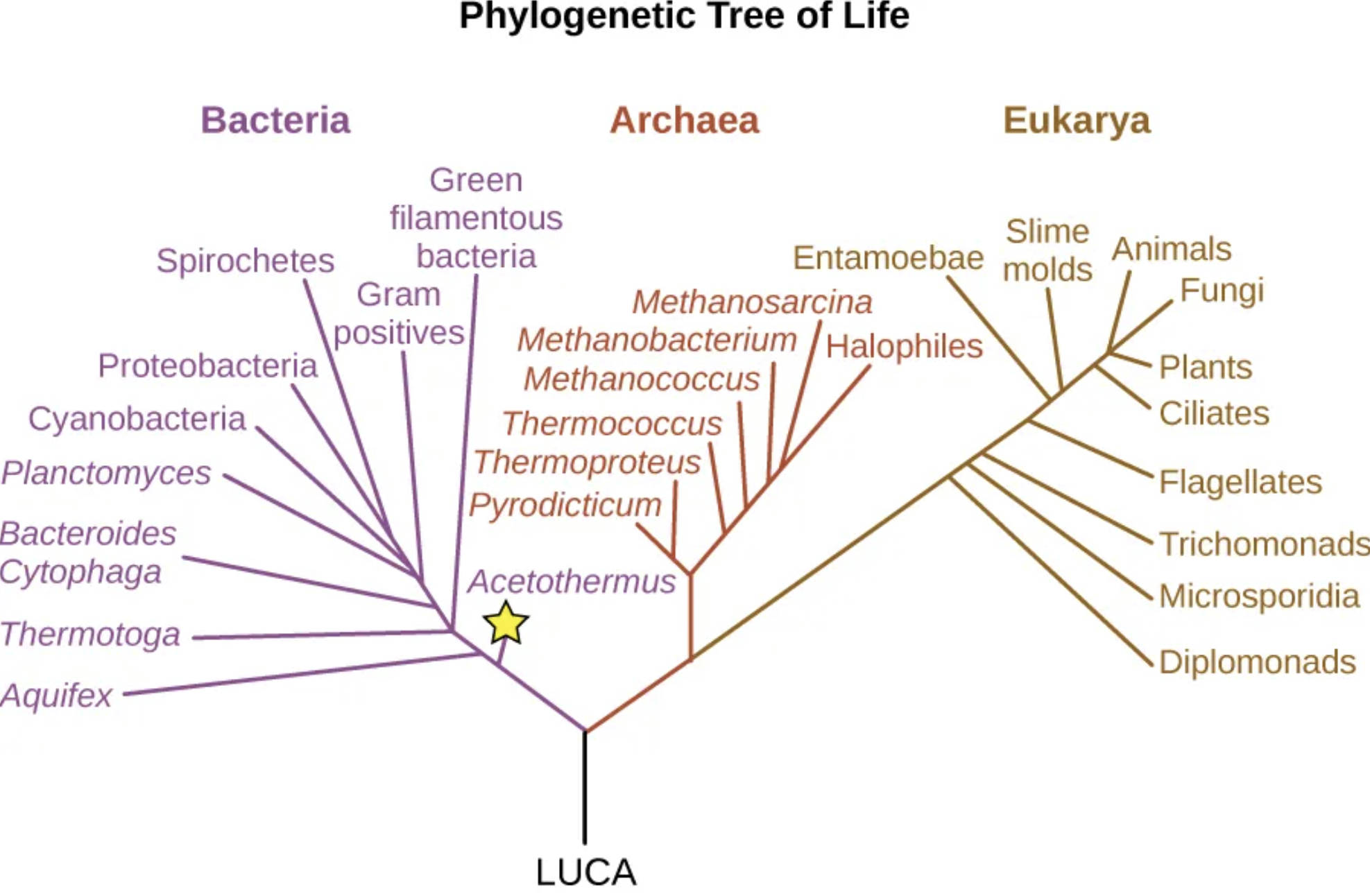
Bacteria form one of the three primary domains of life, encompassing a vast array of prokaryotic organisms with diverse metabolic capabilities and ecological roles. This domain includes many medically significant pathogens as well as beneficial microbes involved in nutrient cycling and human microbiota. In the tree, Bacteria branch separately from Archaea and Eukarya, with subgroups such as Proteobacteria, Cyanobacteria, and Gram positives radiating outward, reflecting their ancient divergence and rapid evolutionary adaptations.
Archaea constitute the second domain, consisting of prokaryotes often adapted to extreme environments but also found in diverse habitats including the human body. Archaea share some molecular features with Eukarya, such as RNA polymerase structure, yet differ from Bacteria in cell membrane lipids and cell wall composition. The diagram shows major archaeal groups like Methanobacterium, Thermococcus, and Halophiles emerging from a common branch, underscoring their unique evolutionary lineage.
Eukarya is the domain that includes all organisms with complex cells containing a nucleus and membrane-bound organelles. This domain encompasses animals, plants, fungi, and protists, many of which interact with microbes in symbiotic or pathogenic relationships relevant to medicine. The tree depicts Eukarya branching into lineages such as Animals, Fungi, Plants, and various protist groups like Ciliates and Flagellates, illustrating the diversification of multicellular and unicellular eukaryotes.
LUCA stands for the Last Universal Common Ancestor, the hypothetical primordial organism from which all current domains of life evolved billions of years ago. Represented at the base of the tree with a connecting line, LUCA is inferred from shared genetic and biochemical features across Bacteria, Archaea, and Eukarya. Its position emphasizes that all cellular life shares a common origin, providing a foundational concept for evolutionary biology and microbial genomics.
Acetothermus is marked with a yellow star near the base of the Bacterial branch, indicating its status as a deeply branching lineage considered among the earliest diverging bacterial groups. This thermophilic organism exemplifies primitive traits retained from near the time of LUCA. Its placement highlights how certain bacteria represent ancient evolutionary branches, offering insights into early life forms and the transition from primordial conditions to modern microbial diversity.
Understanding the Three-Domain System
The three-domain classification system, proposed by Carl Woese and colleagues in 1990, revolutionized biology by using ribosomal RNA sequences to reveal that life is divided into Bacteria, Archaea, and Eukarya rather than the traditional five-kingdom model. This framework recognizes that Archaea are as distinct from Bacteria as they are from Eukarya, despite superficial similarities in prokaryotic cell structure. The phylogenetic tree visualizes these relationships through branching patterns derived from molecular data, providing a more accurate picture of evolutionary history.
In medical contexts, the tree helps explain why certain microbes behave differently and respond variably to antibiotics. Bacterial pathogens often belong to groups like Proteobacteria or Gram positives, while archaea are rarely pathogenic but influence human gut microbiota. Eukaryotic pathogens such as fungi and protozoa fall within the Eukarya domain, requiring different therapeutic approaches due to their closer cellular similarities to human cells.
- Ribosomal RNA genes serve as universal markers because they evolve slowly and are present in all cellular life.
- The system integrates genomic, biochemical, and ultrastructural evidence for robust classification.
- Modern phylogenomics sometimes refines the tree, with ongoing debates about the exact placement of Eukarya within or as a sister group to Archaea.
Major Groups Within the Bacteria Domain
The Bacteria domain displays tremendous diversity, with branches including Proteobacteria (containing many Gram-negative pathogens), Gram positives (such as Staphylococcus and Streptococcus), Cyanobacteria (oxygen-producing photosynthesizers), and deeply branching groups like Aquifex and Thermotoga. These organisms play critical roles in human health as both commensals and pathogens. The tree shows how groups like Spirochetes, Bacteroides, and Green filamentous bacteria radiate from the main bacterial stem, reflecting adaptations to varied niches.
Medical microbiology heavily relies on this classification to understand disease mechanisms, antibiotic resistance patterns, and vaccine development. For instance, Gram-positive bacteria have thick peptidoglycan walls targeted by beta-lactam antibiotics, while Gram-negatives possess outer membranes that confer additional resistance. Deeply branching bacteria like those near Acetothermus provide clues about early metabolic pathways that may have influenced the evolution of oxygenic photosynthesis and respiration.
- Proteobacteria include important genera such as Escherichia, Salmonella, and Helicobacter.
- Gram positives encompass clinically relevant organisms like Clostridium and Bacillus.
- Cyanobacteria contributed to Earth’s oxygenation through ancient endosymbiotic events leading to chloroplasts.
Key Features of the Archaea Domain
Archaea are renowned for extremophiles thriving in high-temperature, high-salinity, or acidic conditions, yet many mesophilic species exist in oceans, soils, and the human microbiome. Groups like methanogens (Methanobacterium, Methanococcus) produce methane, influencing global carbon cycles and potentially human gut health. The tree illustrates archaeal diversity through lineages such as Thermoproteus, Pyrodicticum, and Halophiles, demonstrating adaptations distinct from bacterial counterparts.
Although archaea are not major human pathogens, their biochemistry informs biotechnology and astrobiology. Unique membrane lipids with ether linkages and isoprenoid chains distinguish them from bacteria. Research into archaeal viruses and horizontal gene transfer continues to reshape our view of early evolution and the possible archaeal ancestry of eukaryotic cells.
- Methanogens are strict anaerobes crucial in anaerobic digestion and wastewater treatment.
- Thermophiles and hyperthermophiles provide enzymes stable at high temperatures used in PCR and industrial processes.
- Halophiles maintain osmotic balance in saturated salt environments through compatible solutes or high internal salt concentrations.
Diversity and Medical Relevance of the Eukarya Domain
The Eukarya domain includes multicellular kingdoms—Animals, Plants, and Fungi—as well as diverse protists such as Ciliates, Flagellates, Trichomonads, and slime molds. Many eukaryotic microbes interact with humans as symbionts, commensals, or pathogens causing diseases like malaria, candidiasis, or giardiasis. The tree shows these groups diverging from a common eukaryotic stem, highlighting endosymbiotic origins of mitochondria and chloroplasts.
In clinical practice, distinguishing eukaryotic pathogens from prokaryotic ones is essential because treatments differ dramatically. Antifungal and antiprotozoal drugs target structures like ergosterol in fungal membranes or unique metabolic pathways absent in human cells. The phylogenetic position of Eukarya explains why some antibiotics have limited effects on these organisms while posing toxicity risks to the host.
- Fungi include both beneficial decomposers and pathogens such as Candida and Aspergillus.
- Protists encompass causative agents of sleeping sickness, amoebic dysentery, and toxoplasmosis.
- Animals and Plants represent the visible macroscopic diversity arising from eukaryotic cellular complexity.
Implications for Medicine and Evolutionary Biology
The phylogenetic tree of life provides a unifying framework for understanding microbial evolution, horizontal gene transfer, and the origins of eukaryotic complexity through endosymbiosis. In medicine, it guides comparative genomics to identify conserved targets for broad-spectrum therapies or to predict resistance mechanisms. Knowledge of deep branches near LUCA and Acetothermus informs studies on the origins of life and potential extraterrestrial biology.
Advances in metagenomics and single-cell sequencing continue to refine the tree, revealing new candidate phyla and challenging traditional boundaries. The diagram emphasizes that humans and their microbiomes are part of a vast evolutionary continuum, where bacterial and archaeal genes have shaped eukaryotic genomes. This perspective encourages holistic approaches to health that consider microbial ecology alongside host biology.
Overall, the phylogenetic tree of life not only organizes biodiversity but also illuminates fundamental principles relevant to infectious disease, biotechnology, and conservation. By visualizing relationships from LUCA to modern domains, it inspires curiosity about life’s origins and resilience across billions of years of evolution.


