
Bacterial chemotaxis is a sophisticated sensory and motor process that allows single-celled organisms to find optimal environments for survival. By alternating between straight-line “runs” and random “tumbles,” bacteria can effectively migrate toward higher concentrations of beneficial substances, such as nutrients or oxygen. This targeted movement is powered by a complex molecular motor that responds instantaneously to environmental stimuli detected by specialized surface receptors.
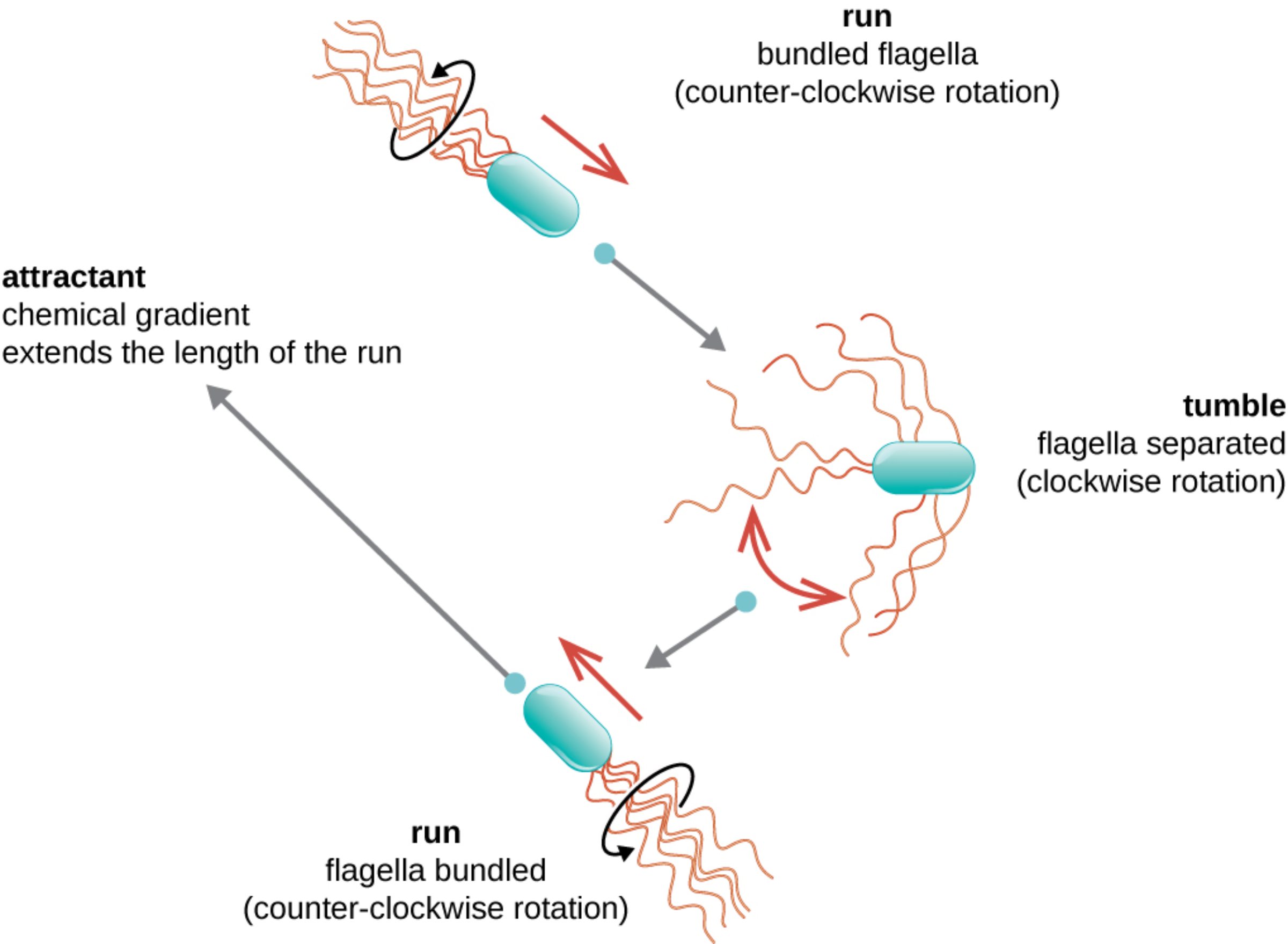
run bundled flagella (counter-clockwise rotation): This phase occurs when the individual flagella rotate in a counter-clockwise direction, causing them to wrap together into a single, cohesive tail. The coordinated thrust produced by this bundle propels the bacterium forward in a straight or slightly curved trajectory known as a run.
tumble flagella separated (clockwise rotation): When the flagellar motor switches to a clockwise rotation, the torque causes the bundle to fly apart and the flagella to point in different directions. This lack of coordination results in the bacterium spinning randomly in place, effectively “tumbling” to reset its orientation before the next move.
run flagella bundled (counter-clockwise rotation): After a tumble, the cell resumes a counter-clockwise rotation to re-bundle the appendages and start a new run. Because the tumble reorients the cell randomly, this new run will likely head in a different direction than the previous one.
attractant chemical gradient extends the length of the run: In the presence of a favorable chemical stimulus, the bacterium alters its movement frequency to favor progress toward the source. The cell senses an increase in attractant concentration and suppresses the signal to tumble, thereby lengthening the duration of its runs in the desired direction.
The Physiology of Microbial Locomotion
At the microscopic level, movement is not a matter of simple swimming but a highly regulated response to external cues. Most motile bacteria, particularly those with a peritrichous arrangement of flagella, utilize a strategy called the “biased random walk.” In a neutral environment with no chemical gradient, the lengths of runs and tumbles are relatively equal, resulting in no net displacement. However, once a gradient is detected, the internal signaling of the cell shifts to favor productive movement toward favorable conditions.
The decision-making process in a bacterium is governed by a complex signal transduction pathway involving Methyl-accepting Chemotaxis Proteins (MCPs). These receptors scan the extracellular environment for specific molecules, such as glucose or amino acids. When an attractant binds to these receptors, it triggers a cascade of phosphorylation events inside the cell that ultimately communicates with the flagellar motor.
Bacteria navigate their surroundings by sensing various types of environmental stimuli:
- Chemotaxis: Movement in response to chemical gradients like nutrients or toxins.
- Phototaxis: Directional movement toward or away from light sources.
- Aerotaxis: The ability to migrate toward optimal concentrations of oxygen.
- Magnetotaxis: Alignment and movement along magnetic field lines.
The Mechanics of the Flagellar Motor
The actual movement is driven by the flagellar motor, a remarkable piece of biological engineering located within the cell envelope. Unlike eukaryotic muscles that rely on ATP hydrolysis, the bacterial motor is powered by the proton motive force. This energy is derived from an electrochemical gradient of hydrogen ions across the plasma membrane. As protons flow through the motor proteins (MotA and MotB), they generate the torque necessary to spin the flagellum at speeds of up to several hundred revolutions per second.
The transition between running and tumbling is nearly instantaneous, controlled by a switch protein called FliM. When a specific signaling protein, CheY-P, binds to the motor, it induces a conformational change that flips the rotation from counter-clockwise to clockwise. If the bacterium senses it is moving up an attractant gradient, the levels of CheY-P drop, the motor stays in the counter-clockwise “run” state longer, and the organism makes steady progress toward its goal. This microscopic navigation is essential for pathogens to locate host tissues and establish successful infections.
The ability of bacteria to sense and respond to their environment through chemotaxis is a testament to the complexity of life at the cellular level. By mastering the mechanics of the flagellar motor and the nuances of chemical signaling, these organisms can thrive in diverse and often hostile habitats. Understanding these physiological processes is not only fundamental to microbiology but also critical for medical research aimed at disrupting bacterial colonization and virulence.


