
The larynx, often referred to as the voice box, is a vital structure bridging the laryngopharynx and trachea, playing a central role in respiration and phonation. Extending from the hyoid bone downward, this cartilaginous framework protects the airway, houses the vocal cords, and facilitates sound production through intricate muscular coordination. Detailed views of its anatomy, as depicted in anterior and lateral perspectives, provide a deeper understanding of its functional significance and structural complexity.
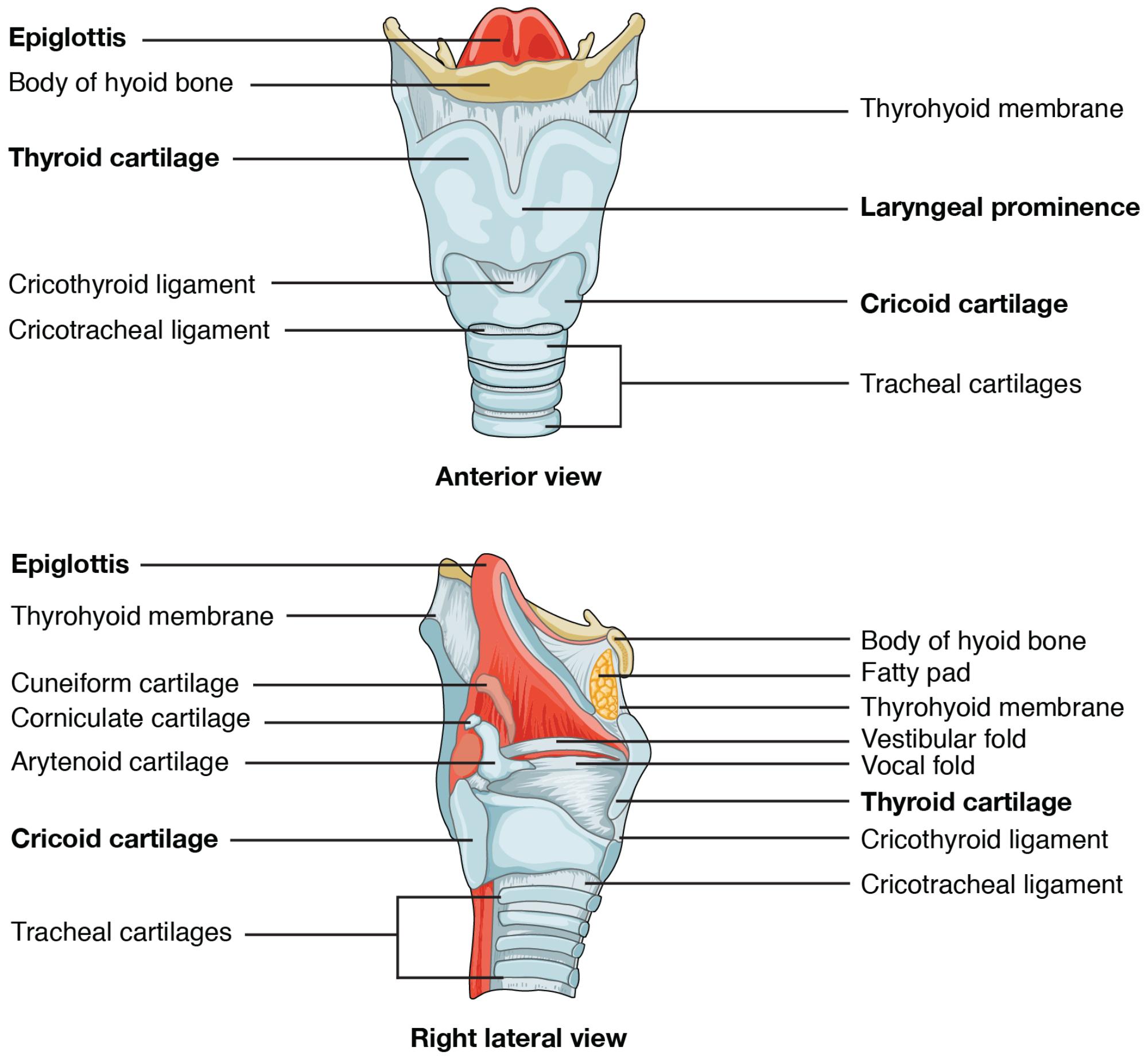
Key Anatomical Labels in the Diagram
This section highlights each labeled component, offering insight into their locations and contributions to laryngeal function.
Epiglottis: The epiglottis is a leaf-shaped cartilage that covers the larynx during swallowing, preventing food from entering the airway. It flips upward during breathing to allow air passage into the trachea.
Body of hyoid bone: The body of the hyoid bone is a U-shaped structure above the larynx, providing attachment for tongue and laryngeal muscles. It remains suspended without direct skeletal connection, aiding in swallowing and speech.
Thyroid cartilage: The thyroid cartilage forms the laryngeal prominence or Adam’s apple, protecting the vocal cords within. It supports the vocal apparatus and is connected to the hyoid bone via the thyrohyoid membrane.
Cricothyroid ligament: The cricothyroid ligament connects the thyroid cartilage to the cricoid cartilage, allowing vocal pitch adjustment through muscle tension. It serves as a potential site for emergency airway access.
Cricotracheal ligament: The cricotracheal ligament links the cricoid cartilage to the trachea, ensuring a stable transition between these structures. It maintains airway continuity and flexibility.
Thyrohyoid membrane: The thyrohyoid membrane stretches between the thyroid cartilage and hyoid bone, supporting laryngeal elevation during swallowing. It contains the internal laryngeal nerve, aiding sensory function.
Laryngeal prominence: The laryngeal prominence, or Adam’s apple, is the outward projection of the thyroid cartilage, more pronounced in males. It shields the vocal cords and varies in size due to hormonal influences.
Cricoid cartilage: The cricoid cartilage forms a complete ring below the thyroid cartilage, providing a stable base for the larynx. It supports the airway and anchors the esophagus posteriorly.
Tracheal cartilages: The tracheal cartilages are C-shaped rings extending from the cricoid cartilage, maintaining tracheal patency. They prevent collapse during respiration and extend into the bronchial tree.
Cuneiform cartilage: The cuneiform cartilage is a small, paired structure within the aryepiglottic fold, supporting the epiglottis. It contributes to the shape and stability of the laryngeal inlet.
Corniculate cartilage: The corniculate cartilage sits atop the arytenoid cartilages, aiding in the closure of the laryngeal inlet during swallowing. It enhances the epiglottis’s protective function.
Arytenoid cartilage: The arytenoid cartilage is a paired structure on the cricoid cartilage, controlling vocal cord movement via muscles. It rotates to adjust pitch and facilitate breathing or phonation.
Corniculate ligament: The corniculate ligament connects the corniculate cartilage to surrounding structures, stabilizing the laryngeal inlet. It supports the epiglottis’s dynamic movements.
Fatty pad: The fatty pad lies within the thyrohyoid membrane, cushioning the larynx against external pressure. It also contributes to the smooth contour of the neck.
Vestibular fold: The vestibular fold, or false vocal cord, lies above the true vocal cord, protecting the airway during swallowing. It plays a minor role in sound production but aids in closure.
Vocal fold: The vocal fold, or true vocal cord, vibrates to produce sound as air passes, modulated by the recurrent laryngeal nerve. It is essential for speech and cough reflex initiation.
Cartilaginous Framework of the Larynx
The larynx’s cartilaginous structure provides both rigidity and flexibility. This balance supports its dual roles in respiration and phonation.
- The thyroid cartilage shields the vocal cords, with its prominence varying by gender.
- Cricoid cartilage forms a complete ring, unique among laryngeal cartilages.
- Arytenoid cartilages rotate to open or close the glottis, controlling airflow.
- Epiglottis and cuneiform cartilages protect the airway during swallowing.
- Tracheal cartilages ensure an open passage to the lungs.
Ligaments and Membranes in Laryngeal Support
Ligaments and membranes enhance the larynx’s stability and mobility. They connect key structures, allowing coordinated function.
- The cricothyroid ligament adjusts vocal pitch through muscle action.
- Thyrohyoid membrane elevates the larynx, aiding swallowing coordination.
- Cricotracheal ligament maintains tracheal-laryngeal continuity.
- Corniculate ligament stabilizes the inlet, supporting epiglottis movement.
- These structures adapt to pressure changes during respiration.
Functional Roles in Respiration and Phonation
The larynx serves as a multifunctional organ, critical for breathing and voice. Its anatomy supports a range of physiological processes.
- The epiglottis directs food away from the trachea, ensuring safe swallowing.
- Vocal folds vibrate to produce sound, modulated by arytenoid movement.
- The laryngeal prominence protects the delicate vocal apparatus.
- Tracheal cartilages maintain airway patency under varying pressures.
- The hyoid bone anchors muscles, facilitating speech and swallowing.
Clinical Relevance and Anatomical Variations
Knowledge of laryngeal anatomy is key to diagnosing and treating related conditions. Variations can influence clinical approaches.
- Laryngeal cancer may affect the vocal folds, altering voice quality.
- Epiglottitis, an inflammation, can obstruct the airway, requiring urgent care.
- Thyroid cartilage fractures from trauma may impair phonation.
- Vocal fold paralysis, due to recurrent nerve damage, affects speech.
- Imaging like laryngoscopy assesses structural abnormalities.
The larynx’s intricate design, from the epiglottis to the tracheal cartilages, underscores its importance in respiration, phonation, and airway protection. By examining its anatomy through anterior and lateral views, one gains a profound appreciation for its role in human physiology, highlighting the elegance of this vital structure.


