
The classification of eukaryotes into supergroups provides a modern evolutionary framework that is essential for understanding the biology of medically important organisms. From intestinal parasites causing widespread diarrheal diseases to vector-borne pathogens responsible for millions of deaths annually, these supergroups encompass many organisms that directly affect human health. This article explores the key eukaryote supergroups highlighted in clinical microbiology, focusing on their distinguishing features, representative examples, and clinical implications for diagnosis, treatment, and prevention.
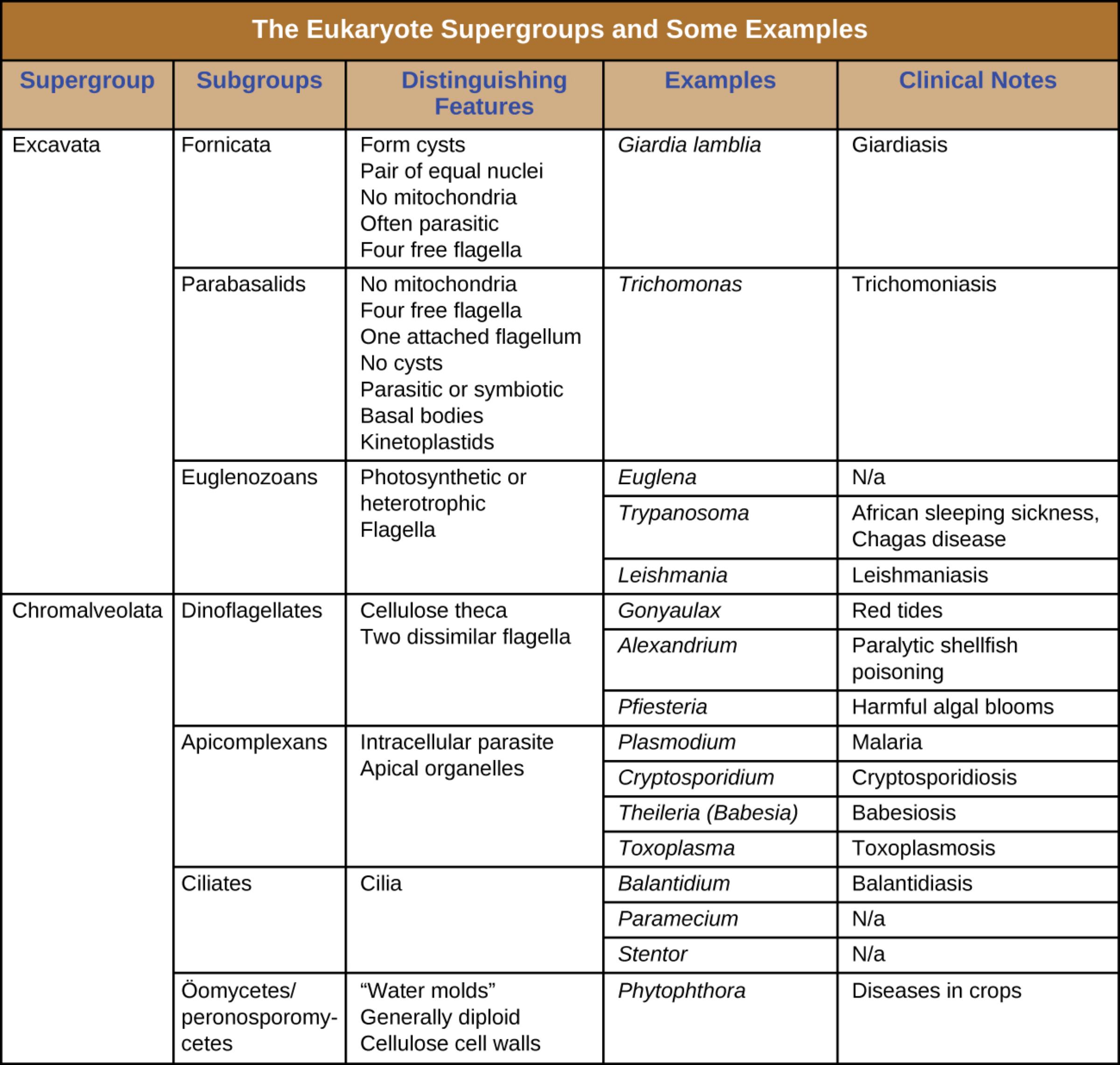
Excavata is a supergroup of often asymmetrical protists characterized by a distinctive feeding groove or “excavated” ventral side in many members. Many excavates are flagellated and include both free-living and parasitic species that lack typical mitochondria or have highly modified organelles. This supergroup is particularly relevant in medicine due to several important human parasites.
Fornicata within Excavata includes organisms that often form resistant cysts and possess a pair of equal nuclei. They frequently lack standard mitochondria and are often parasitic, moving with four free flagella. These features allow survival in harsh environments and efficient transmission via contaminated water.
Giardia lamblia is a classic example from Fornicata causing giardiasis, a common waterborne diarrheal illness. Its ability to form cysts makes it resistant to chlorine treatment in water supplies, leading to outbreaks in travelers and communities with poor sanitation.
Parabasalids are another subgroup of Excavata lacking typical mitochondria and featuring four free flagella along with one attached flagellum. They possess basal bodies and kinetoplastids in some relatives and are often parasitic or symbiotic without forming cysts. These adaptations support anaerobic lifestyles in host tissues.
Trichomonas is a key parabasalid causing trichomoniasis, a prevalent sexually transmitted infection. It thrives in the urogenital tract, leading to inflammation, discharge, and increased risk of other infections if untreated.
Euglenozoans within Excavata include organisms that may be photosynthetic or heterotrophic and typically possess flagella. Some members have unique mitochondrial structures like kinetoplasts, enabling diverse ecological roles from free-living to parasitic.
Euglena is a photosynthetic euglenozoan often used as a model organism, though not directly pathogenic. It demonstrates the mixotrophic capabilities seen in this subgroup.
Trypanosoma causes African sleeping sickness and Chagas disease, serious vector-borne illnesses transmitted by tsetse flies and triatomine bugs respectively. These kinetoplastid parasites evade the immune system through antigenic variation, complicating vaccine development.
Leishmania leads to leishmaniasis, ranging from cutaneous skin ulcers to life-threatening visceral forms. Sandfly vectors transmit these parasites, which survive inside macrophages using sophisticated immune evasion strategies.
Chromalveolata (also known as Chromalveolates) unites groups with secondary plastids of red algal origin in many photosynthetic members. It includes alveolates and stramenopiles, encompassing both harmful algal bloom producers and major intracellular parasites of medical importance.
Dinoflagellates are characterized by a cellulose theca and two dissimilar flagella, often causing red tides and paralytic shellfish poisoning through toxin production. Some species like Pfiesteria are linked to harmful algal blooms affecting aquatic life and human health indirectly.
Gonyaulax and Alexandrium are dinoflagellates responsible for red tides and paralytic shellfish poisoning, respectively. Toxins accumulate in shellfish, posing risks to consumers and causing neurological symptoms.
Pfiesteria is associated with harmful algal blooms and fish kills, with potential impacts on human health through toxin exposure in affected waters.
Apicomplexans are intracellular parasites featuring an apical complex of organelles for host cell invasion. They have complex life cycles often involving multiple hosts and represent some of the most significant eukaryotic pathogens globally.
Plasmodium causes malaria, a mosquito-borne disease responsible for hundreds of thousands of deaths yearly, primarily in tropical regions. Different species produce varying severities, with drug resistance posing ongoing challenges.
Cryptosporidium leads to cryptosporidiosis, a waterborne diarrheal disease particularly severe in immunocompromised individuals. Its oocysts are highly resistant to disinfectants, making it a major concern in drinking water safety.
Theileria (Babesia) causes babesiosis, a tick-borne illness resembling malaria that infects red blood cells and can be life-threatening in certain populations.
Toxoplasma is responsible for toxoplasmosis, which can cause congenital infections or severe disease in immunocompromised patients, often linked to cat feces or undercooked meat.
Ciliates are distinguished by the presence of cilia used for motility and feeding. While many are free-living, some like Balantidium can infect humans.
Balantidium causes balantidiasis, an intestinal infection acquired from pigs or contaminated water, leading to dysentery-like symptoms in rare human cases.
Paramecium and Stentor are common non-pathogenic ciliates used extensively in laboratory research for studying cellular processes.
Oomycetes/peronosporomycetes are fungus-like organisms often called “water molds.” They are generally diploid with cellulose cell walls and include important plant pathogens.
Phytophthora causes diseases in crops, famously linked to the Irish potato famine, demonstrating the agricultural and economic impact of this group beyond direct human infection.
Understanding Eukaryote Supergroups in Clinical Context
Eukaryote supergroups organize the diversity of eukaryotic microorganisms based on molecular phylogenetics rather than traditional morphology alone. This approach reveals unexpected relationships and helps predict shared vulnerabilities to drugs or environmental stresses. In clinical practice, recognizing these groupings aids in differential diagnosis of parasitic infections and guides the selection of antiparasitic therapies.
Excavata: Flagellated Parasites and Anaerobic Adaptations
Members of Excavata often lack conventional mitochondria, relying instead on hydrogenosomes or mitosomes for energy production in anaerobic environments. This metabolic uniqueness influences their susceptibility to certain drugs like metronidazole, which targets anaerobic pathways. Key pathogens include Giardia lamblia and Trichomonas, which cause high-burden infections worldwide through fecal-oral or sexual transmission.
- Giardiasis presents with foul-smelling diarrhea, bloating, and malabsorption, often self-limiting but prolonged in some cases.
- Trichomoniasis is frequently asymptomatic but can increase HIV transmission risk and cause reproductive complications.
Trypanosoma and Leishmania species within Euglenozoans add complexity with their kinetoplast DNA and ability to undergo antigenic variation, allowing chronic infections and immune evasion.
Chromalveolata: From Algal Toxins to Intracellular Parasites
The supergroup Chromalveolata includes organisms with diverse lifestyles, from photosynthetic dinoflagellates producing potent neurotoxins to apicomplexans that invade host cells using specialized apical machinery. Apicomplexans like Plasmodium and Cryptosporidium have intricate life cycles involving sexual and asexual stages, complicating control efforts.
- Malaria control relies on vector management, antimalarial drugs, and emerging vaccines, yet resistance remains a global threat.
- Cryptosporidiosis outbreaks highlight the need for advanced water treatment beyond standard chlorination.
Ciliates and oomycetes further expand the clinical relevance, with Balantidium representing a rare zoonotic ciliate infection and Phytophthora underscoring broader ecological impacts on food security.
Diagnostic Approaches for Eukaryotic Pathogens
Diagnosis of infections from these supergroups typically involves microscopic examination of stool, blood smears, or tissue samples, often supplemented by antigen tests, PCR, or serology. For instance, Giardia cysts are identified in stool, while Plasmodium requires careful blood film analysis to distinguish species. Molecular methods increasingly allow rapid, sensitive detection even in low-parasite-load cases.
Treatment and Prevention Strategies
Treatment varies by supergroup and specific pathogen. Nitroimidazoles like metronidazole are effective against many Excavata parasites, while artemisinin-based combinations target Plasmodium. Prevention emphasizes sanitation, safe water, vector control, and education on food safety. In immunocompromised patients, infections from Cryptosporidium or Toxoplasma can be particularly challenging, requiring prolonged or prophylactic therapy.
Emerging Challenges and Research Directions
Drug resistance, climate change affecting vector ranges, and globalization of travel increase the burden of eukaryotic infections. Ongoing genomic studies of supergroup representatives are revealing new drug targets and improving understanding of host-parasite interactions. Public health efforts focus on integrated control programs combining chemotherapy, vaccines where available, and environmental management.
Conclusion: The Value of Phylogenetic Classification in Medicine
Knowledge of eukaryote supergroups and their examples bridges basic evolutionary biology with practical clinical medicine. By understanding shared features within groups like Excavata or Chromalveolata, healthcare providers can better anticipate disease patterns, optimize diagnostics, and develop innovative interventions. Continued research into these diverse eukaryotes will remain vital for addressing current and future infectious disease challenges.


