
Stentor roeselii is a remarkable giant ciliate protist known for its distinctive trumpet or horn-like shape and impressive size among unicellular organisms, making it a fascinating subject for microscopic observation and behavioral studies. This free-living freshwater ciliate belongs to the supergroup Chromalveolata and exhibits sophisticated behaviors such as coordinated ciliary feeding, rapid contraction, and even hierarchical decision-making in response to stimuli, despite lacking a nervous system. The microscopic image highlights key morphological features that enable its unique lifestyle, offering valuable insights into ciliate biology, cellular decision processes, and the evolutionary complexity achievable in single-celled eukaryotes.
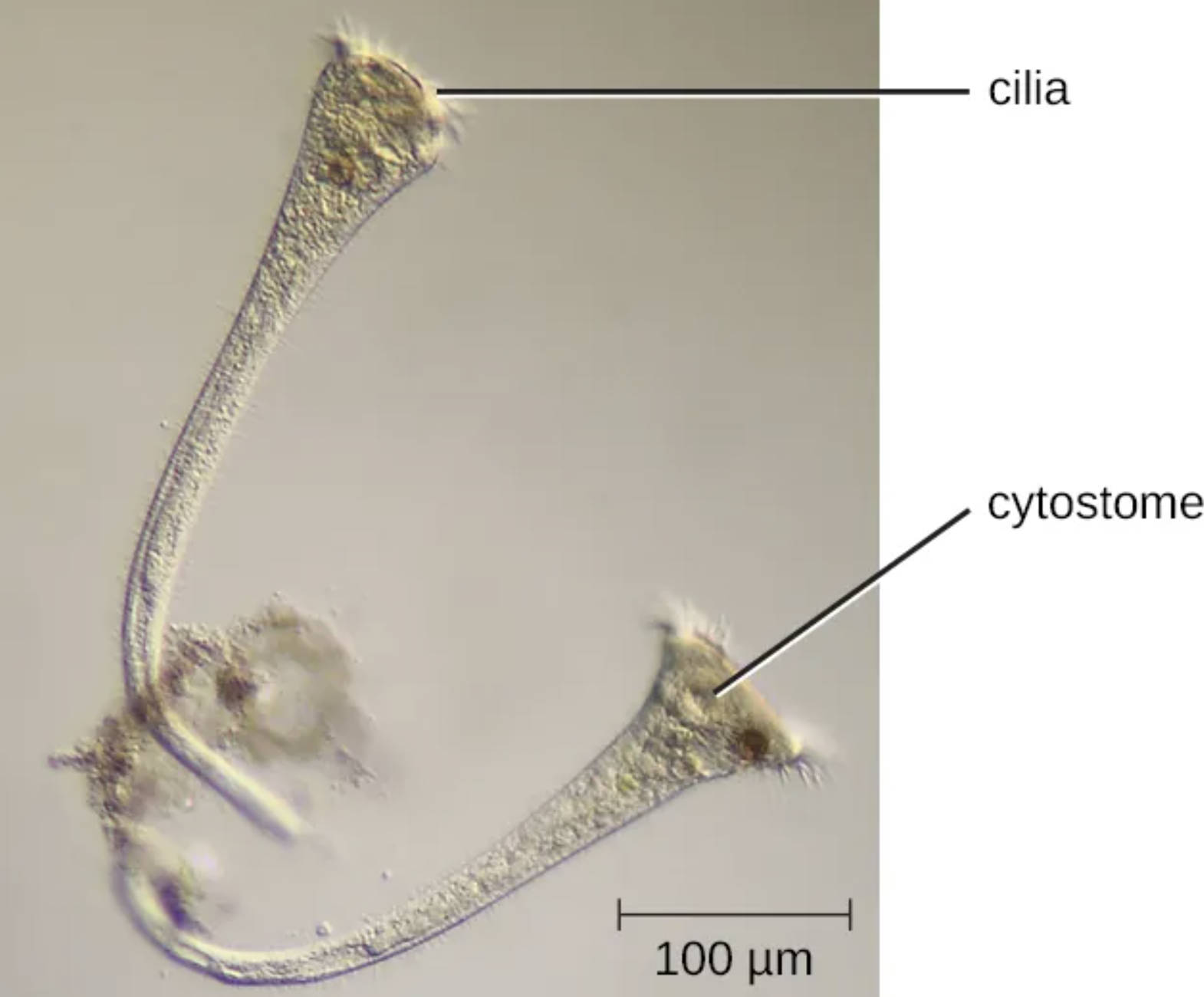
Cilia are the numerous fine, hair-like projections visible at the flared anterior end and along the body of Stentor roeselii. These motile organelles beat to generate water currents that draw food particles toward the feeding apparatus and also contribute to limited locomotion when the organism is detached from its substrate.
Cytostome is the cell mouth located at the center of the oral disc at the wide anterior end. It serves as the entry point where food particles concentrated by the surrounding membranelles are ingested into the cell for digestion, forming food vacuoles in the endoplasm.
100 μm scale bar provides critical size context, illustrating that Stentor roeselii can reach lengths of several hundred micrometers when extended, making it one of the larger known single-celled organisms visible even under low-power microscopy.
Morphology and Adaptive Shape of Stentor roeselii
Stentor roeselii displays a highly contractile body that can extend into a long trumpet shape when attached to a substrate or contract into a more spherical form when disturbed. The anterior end flares into a broad oral disc fringed with cilia and compound membranelles that create powerful feeding currents. The posterior end tapers and often attaches via a holdfast, allowing the organism to remain stationary while feeding. This polymorphic shape enables efficient resource capture in its freshwater habitat while providing protection through rapid contraction.
Ciliary Feeding Mechanism
The prominent cilia at the oral end work in concert with fused membranelles to form a vortex that sweeps bacteria, algae, and organic debris into the cytostome. This specialized feeding apparatus allows Stentor to efficiently capture and ingest prey, supporting its heterotrophic lifestyle as a predator of smaller microorganisms. The image clearly shows the concentration of cilia at the flared end, highlighting the structural adaptation for active filter feeding.
Behavioral Complexity in a Single Cell
Stentor roeselii has gained scientific attention for demonstrating hierarchical avoidance behaviors when exposed to irritating stimuli. It first bends away, then reverses ciliary beating to expel particles, and if irritation persists, it detaches and swims away. This sequence suggests a form of decision-making and habituation in a cell without a nervous system, raising intriguing questions about cellular intelligence and signaling pathways that may parallel processes in multicellular organisms, including immune responses and embryonic development.
- Initial response involves localized bending to avoid the stimulus.
- Persistent irritation triggers ciliary reversal for particle expulsion.
- Extreme conditions lead to full detachment and swimming escape.
These behaviors highlight how sophisticated responses can emerge from intracellular signaling networks.
Ecological Role and Habitat
Stentor species are common in freshwater ponds, lakes, and slow-moving streams, often attaching to aquatic vegetation or debris. They play an important role in microbial food webs by consuming bacteria and small protists, contributing to nutrient cycling. Their large size and conspicuous appearance make them noticeable components of freshwater microbial communities, serving as indicators of water quality in some ecosystems.
Research Significance as a Model Organism
Stentor roeselii and related species are valuable for studying cellular regeneration, morphogenesis, and behavior. The organism can regenerate lost parts after injury, and its large size facilitates micromanipulation and live imaging. Recent studies on its decision-making capabilities have renewed interest in single-cell cognition, potentially informing broader questions in systems biology and the evolution of complex behaviors.
Comparison with Other Ciliates
Unlike the more common Paramecium, which is oval and free-swimming, Stentor roeselii is trumpet-shaped and often sessile. Its giant size and prominent oral disc with membranelles distinguish it from smaller ciliates like Balantidium or Tetrahymena. These morphological differences reflect adaptations to different ecological niches, with Stentor optimized for stationary filter feeding rather than constant active hunting.
Educational Value of Microscopic Observation
Viewing Stentor under the microscope provides an engaging introduction to protist diversity and cellular complexity. Students can observe ciliary movement, feeding currents, and contraction responses in real time. The clear visibility of the cytostome and cilia in the image makes it an excellent teaching tool for discussing eukaryotic organelles, motility, and feeding strategies in single-celled organisms.
Conclusion: The Fascinating World of Giant Ciliates
The microscopic specimen of Stentor roeselii showcases the elegance and functional sophistication of a large unicellular organism. From the dense cilia powering feeding currents to the specialized cytostome facilitating ingestion, every visible feature supports an efficient predatory lifestyle. Beyond morphology, its demonstrated behavioral hierarchy underscores the remarkable capabilities of single cells, bridging basic protist biology with deeper questions in cellular decision-making and evolutionary biology. Continued observation and research on organisms like Stentor enrich our understanding of life’s diversity at the microscopic scale.


