
Paramecium species are fascinating examples of single-celled complexity, representing a genus of unicellular ciliated protozoa that are found abundantly in aquatic environments. Often described as having a slipper-like shape, these microorganisms are members of the phylum Ciliophora, a group characterized by the presence of hair-like organelles called cilia. Despite being comprised of only a single cell, a Paramecium possesses highly specialized internal structures that perform functions analogous to the organs found in multicellular animals, including digestion, excretion, and osmoregulation. Scientists have long utilized these organisms as model systems in biological and medical research to study everything from cellular behavior to genetic inheritance and environmental toxicology. By examining the intricate anatomy of the Paramecium, we gain a deeper appreciation for the sophisticated mechanisms that allow life to thrive at a microscopic scale.
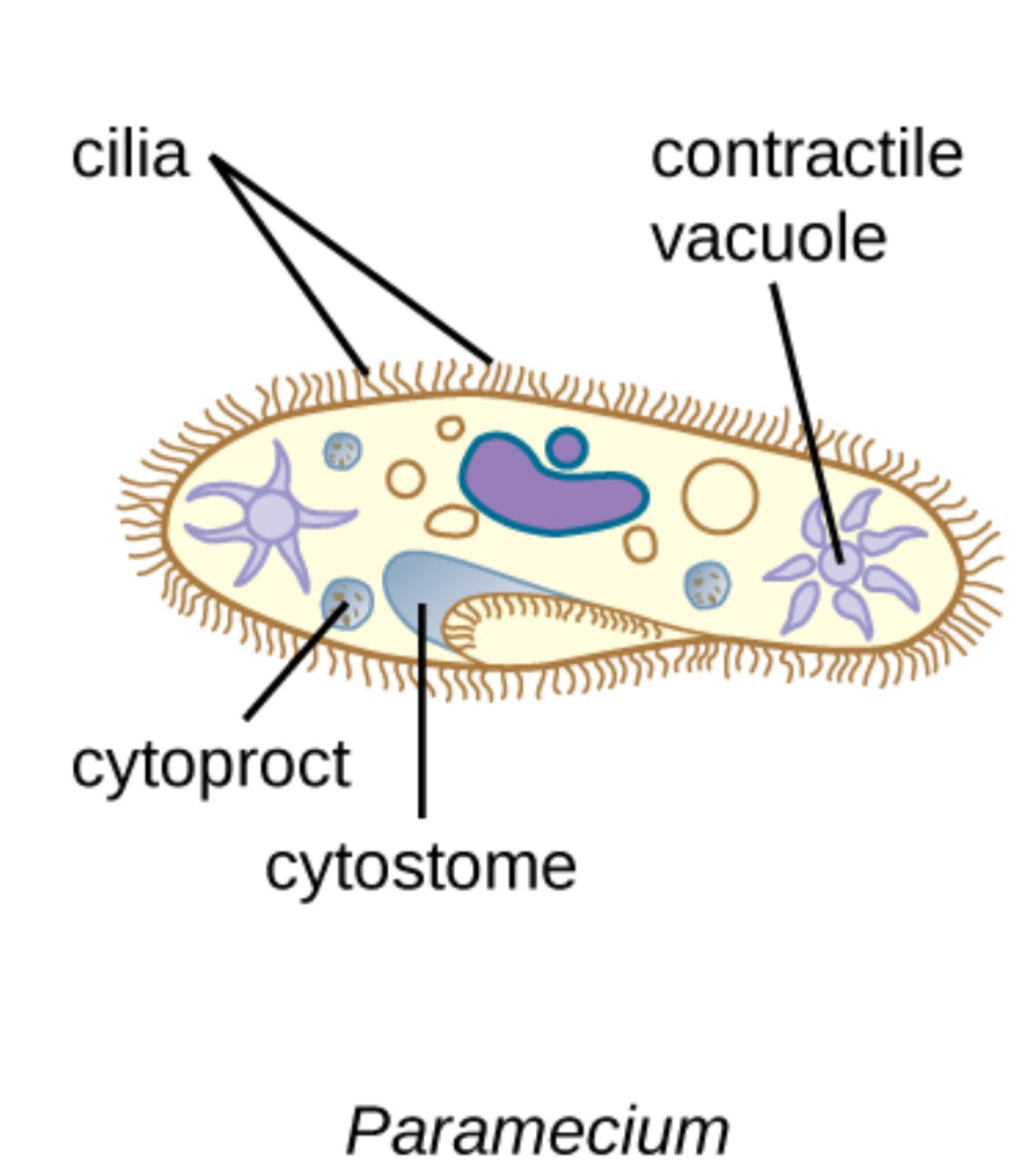
cilia: These are numerous, short, hair-like projections that cover the outer surface of the organism. They beat in a coordinated rhythm to facilitate movement through water and to sweep food into the oral groove.
contractile vacuole: This star-shaped organelle acts as an osmoregulatory pump by collecting and expelling excess water from the cytoplasm. It is essential for maintaining the cell’s internal pressure in freshwater environments.
cytoproct: Also known as the anal pore, this specialized region is responsible for the elimination of solid waste. It allows indigestible remains to be expelled from the cell after nutrients have been absorbed.
cytostome: This represents the cell mouth, situated at the base of the oral groove. It functions as the entry point where food particles are enclosed in vacuoles for intracellular digestion.
Classification and Evolutionary Context of Ciliary Protozoa
The ciliary protozoa occupy a unique niche in the evolutionary tree of life. As eukaryotes, they possess a membrane-bound nucleus and specialized organelles, but they have taken cellular specialization to an extreme level that is rarely seen in other unicellular groups. Within the genus Paramecium, various species such as P. caudatum and P. aurelia exhibit slight variations in size and nuclear arrangement, yet they all share the fundamental body plan that has made them globally successful. Their evolutionary success is largely attributed to their high motility and efficient feeding mechanisms, which allow them to compete effectively in diverse freshwater and brackish habitats.
From a taxonomical perspective, the arrangement of cilia and the structure of the oral apparatus are key features used to differentiate species. These organisms are not merely passive drifters; they are active hunters that consume bacteria, algae, and yeast. Their ability to sense and respond to chemical, thermal, and physical stimuli in their environment demonstrates a primitive form of “intelligence” at the cellular level, which continues to intrigue researchers studying the origins of sensory systems.
The Protective Barrier: The Pellicle and Trichocysts
The exterior of the Paramecium is defined by the pellicle, a complex living membrane that provides both protection and flexibility. The pellicle is not a simple wall like that found in plant cells; rather, it is a triple-membrane system that maintains the organism’s distinctive slipper shape while allowing it to squeeze through narrow spaces. Beneath the pellicle lie specialized organelles called trichocysts. When the organism is threatened by a predator or certain chemical stimuli, these trichocysts can be explosively discharged, shooting out long, thread-like filaments that may serve as a defensive mechanism or an anchoring tool.
This outer layer also serves as the anchor point for the thousands of cilia. Each cilium is rooted in a basal body, and these bodies are interconnected by a network of fibers that ensures coordinated movement. This coordination is essential for both locomotion and the creation of water currents that bring food particles toward the oral groove. The pellicle acts as a gatekeeper, allowing the selective passage of gases and small molecules while protecting the delicate internal cytoplasm from the external environment.
Mechanics of Movement and Locomotion
Locomotion in Paramecium is a marvel of microscopic engineering. The cilia beat in a pattern known as a metachronal wave, similar to the way wind blows across a field of wheat. This coordinated beating propels the organism through the water in a spiral motion, rotating along its long axis as it moves forward. This corkscrew movement is highly efficient and allows the Paramecium to navigate complex three-dimensional environments with ease.
- Effective Stroke: The cilium is held rigid and pushed back against the water to provide thrust.
- Recovery Stroke: The cilium bends and moves forward close to the body to minimize resistance.
- Ciliary Reversal: When the organism hits an obstacle, it can reverse the direction of the ciliary beat, swim backward, turn slightly, and move forward again—a behavior known as the avoiding reaction.
Osmoregulation: Managing the Influx of Water
Living in freshwater environments poses a constant threat of cellular rupture due to osmosis. Because the concentration of solutes inside the cell is higher than in the surrounding water, water is constantly diffusing into the Paramecium. To counteract this, the organism relies on osmoregulation managed by its contractile vacuoles. Usually located at the anterior and posterior ends of the cell, these vacuoles are surrounded by a network of radial canals that collect fluid from the cytoplasm.
Once the central reservoir of the vacuole is filled, it contracts (systole), forcing the water out through a temporary pore in the pellicle. The timing of these contractions is highly regulated; in water with higher salinity, the vacuoles pulse less frequently, whereas in pure freshwater, they must work harder to expel the constant influx. This active transport mechanism is energy-intensive, requiring a significant portion of the cell’s ATP to maintain homeostasis.
Nutrition and the Intracellular Digestive Pathway
The Paramecium is a heterotroph that employs a sophisticated digestive system. Food particles, primarily bacteria, are swept into the oral groove by the action of specialized oral cilia. At the base of the groove lies the cytostome, which leads into a funnel-like cytopharynx. When enough food has accumulated at the bottom of the cytopharynx, a food vacuole pinches off and enters the cytoplasm.
As the food vacuole moves through the cell in a predictable path—a process called cyclosis—enzymes are secreted into it to break down the contents. The pH inside the vacuole changes from acidic to alkaline to facilitate different stages of digestion. Nutrients are absorbed directly into the surrounding cytoplasm to fuel the cell’s metabolic activities. Once the digestion is complete, the vacuole moves toward the cytoproct, where the membrane of the vacuole fuses with the pellicle to expel indigestible waste into the environment.
Nuclear Dualism: The Macronucleus and Micronucleus
One of the most striking features of Ciliophora is nuclear dualism, the presence of two distinct types of nuclei within a single cell. The large, bean-shaped macronucleus is polyploid, containing many copies of the genome. It is responsible for day-to-day metabolic activities, including protein synthesis and the regulation of cellular growth. Without a functioning macronucleus, the Paramecium cannot survive for long as its essential life processes would fail.
In contrast, the much smaller micronucleus is diploid and serves as the carrier of the germline genetic material. It is primarily involved in the sexual process of conjugation. This separation of functions allows the organism to maintain a robust metabolic state while protecting its core genetic information for future generations. The interaction between these two nuclei is a complex dance of genetic regulation that ensures both survival and the potential for genetic diversity.
Reproductive Strategies: Asexual and Sexual Phases
Paramecium species can reproduce both asexually and through a sexual process called conjugation. Under favorable conditions, the organism undergoes binary fission, where the cell divides into two identical daughter cells. The macronucleus simply elongates and splits, while the micronucleus undergoes mitosis. This method allows for rapid population growth, enabling Paramecium to quickly colonize new environments.
When environmental conditions become stressful, or as a way to prevent genetic senescence, the organism may engage in conjugation. Two individuals of compatible mating types align side-by-side and exchange micronuclear material. This process does not immediately produce offspring, but it results in a genetic shuffling that produces two “rejuvenated” individuals with new combinations of DNA. This genetic recombination is vital for the long-term survival of the species, allowing it to adapt to changing environmental pressures and pathogen threats.
Ecological Significance and Biological Research
In their natural habitats, Paramecium species play a critical role in the food web. By consuming vast quantities of bacteria, they help regulate bacterial populations and facilitate the cycling of nutrients within aquatic ecosystems. In turn, they serve as a vital food source for larger microorganisms and small invertebrates. Their presence or absence can often serve as an indicator of water quality, as they are sensitive to various pollutants and changes in dissolved oxygen levels.
In the laboratory, Paramecium remains an indispensable tool. It was one of the first organisms used to demonstrate the principles of Mendelian genetics in protozoa and has contributed significantly to our understanding of ciliary function, which is directly relevant to human health. Defects in human cilia can lead to a range of conditions known as ciliopathies, affecting everything from respiratory health to fertility and embryonic development. By studying the simple cilia of the Paramecium, medical researchers continue to uncover the fundamental principles of cellular movement and signaling that are essential for human life.
In conclusion, the Paramecium is far more than a simple “slipper-shaped” animalcule. It is a highly integrated biological machine that performs the functions of life with remarkable efficiency. From the star-shaped contractile vacuoles that defy the laws of osmosis to the dual nuclei that manage both metabolism and inheritance, every structure in this single cell is a product of millions of years of evolutionary refinement. As we continue to probe the secrets of its anatomy and physiology, the Paramecium serves as a reminder that the smallest units of life are often among the most complex.
Keywords: paramecium, protozoa, cilia, contractile vacuole, cytoproct, cytostome, microbiology, cell anatomy, osmoregulation, ciliophora


