
Sulfolobus represents a fascinating genus of thermoacidophilic archaea that thrive in extreme environments characterized by high temperatures and low pH, playing crucial roles in sulfur cycling and geothermal ecosystems worldwide. These organisms belong to the phylum Crenarchaeota and are renowned for their ability to oxidize elemental sulfur or reduced sulfur compounds while producing sulfuric acid as a metabolic byproduct. The provided electron micrograph offers a detailed view of a single Sulfolobus cell, revealing its characteristic morphology and highlighting adaptations that enable survival under conditions lethal to most other forms of life, making it an important model for studying extremophile biology and microbial ecology.
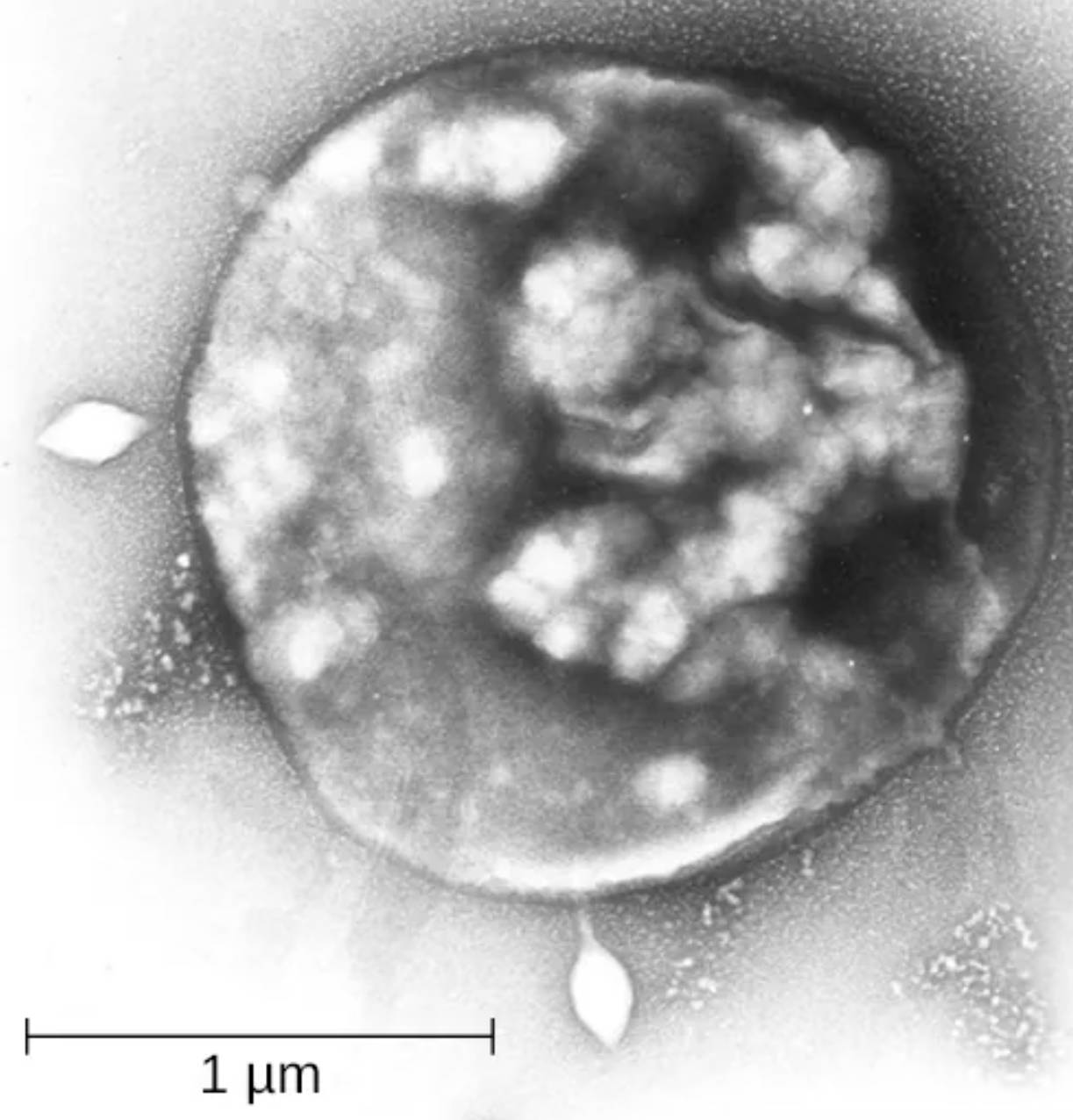
Spherical cell of Sulfolobus appears as a large, roughly circular structure in the center of the image, demonstrating the typical coccoid morphology of this archaeon. Cells are usually 0.5 to 2 micrometers in diameter and lack a rigid cell wall, instead possessing a flexible proteinaceous S-layer that provides structural support in acidic, high-temperature conditions. The image clearly shows the irregular, lobed surface contour and internal density variations typical of actively metabolizing Sulfolobus cells.
1 μm scale bar at the bottom of the micrograph provides essential size reference, confirming the cell diameter is approximately 1-2 micrometers. This scale emphasizes the relatively large size of Sulfolobus compared to many bacteria and allows accurate interpretation of ultrastructural features visible under transmission electron microscopy. Such scaling is critical for comparing cellular dimensions across different extremophiles and understanding their adaptations to extreme environments.
Internal granules are visible as lighter, irregularly shaped regions within the cell, corresponding to storage or metabolic compartments. Sulfolobus cells often accumulate elemental sulfur or polyphosphate granules during sulfur oxidation. These intracellular structures appear as electron-dense or lucent areas depending on preparation methods and reflect the organism’s specialized metabolism for energy generation through sulfur compound oxidation.
S-layer forms the outer boundary of the cell visible as a distinct, somewhat irregular edge surrounding the cytoplasmic content. This paracrystalline protein lattice replaces a traditional peptidoglycan cell wall in archaea and protects against the extreme acidity and heat of the organism’s natural habitat. The S-layer contributes to cell shape maintenance and resistance to environmental stresses while allowing selective exchange of molecules.
Biology and Habitat of Sulfolobus
Sulfolobus species are obligate aerobes that grow optimally at temperatures between 70°C and 85°C and pH values as low as 2-3. They are commonly found in acidic hot springs, solfataras, and geothermal soils where they contribute to the geochemical cycling of sulfur by oxidizing hydrogen sulfide, elemental sulfur, or thiosulfate to sulfuric acid. This metabolic activity lowers the local pH and influences mineral precipitation in volcanic environments.
The genus was first described from samples collected in Yellowstone National Park and has since been isolated from geothermal sites globally. Sulfolobus is non-motile or possesses limited motility and reproduces by binary fission. Its genome is relatively small and circular, encoding enzymes adapted to function under extreme conditions, including heat-stable proteins and acid-resistant membrane lipids unique to archaea.
- Cells are irregular cocci that may appear lobed or pleomorphic under stress.
- Optimal growth occurs with organic carbon sources or chemolithoautotrophically using sulfur compounds.
- Many strains can also oxidize ferrous iron, contributing to acid mine drainage processes.
Metabolic Pathways and Sulfur Oxidation
Sulfolobus derives energy primarily through the oxidation of reduced sulfur compounds, a process that generates sulfuric acid as an end product, hence the name of the genus. This chemolithotrophic metabolism involves a complex electron transport chain that couples sulfur oxidation to oxygen reduction, producing ATP via oxidative phosphorylation. The organism can also grow heterotrophically on various organic substrates, demonstrating metabolic versatility in nutrient-poor extreme habitats.
The production and storage of sulfuric acid or elemental sulfur granules, hinted at by internal structures in the image, allow Sulfolobus to manage toxic intermediates and maintain intracellular pH homeostasis. Its membrane lipids contain unique tetraether structures that remain stable in hot, acidic conditions, preventing leakage and maintaining proton gradients essential for energy production.
- Sulfur oxidation pathways involve enzymes such as sulfur oxygenase reductase and thiosulfate:quinone oxidoreductase.
- Acid production helps create and maintain the low-pH microenvironment preferred by the organism.
- Carbon fixation can occur via the 3-hydroxypropionate/4-hydroxybutyrate cycle in autotrophic growth.
Ultrastructure and Cellular Adaptations
The electron micrograph reveals the absence of a conventional peptidoglycan layer and the presence of a prominent S-layer, a hallmark of many archaea. This proteinaceous surface array provides mechanical protection and serves as a molecular sieve in harsh environments. Internal cytoplasmic density variations reflect active metabolic compartments and storage inclusions adapted for survival during fluctuating nutrient availability in geothermal settings.
Sulfolobus lacks typical bacterial flagella but may possess archaella in some related species for limited movement. The cell membrane is composed of glycerol dialkyl glycerol tetraethers (GDGTs), which form a stable monolayer that resists hydrolysis and maintains fluidity at high temperatures. These adaptations collectively enable Sulfolobus to thrive where most microorganisms cannot survive.
- The S-layer consists of repeating glycoprotein subunits forming a porous lattice.
- Internal granules often store elemental sulfur or polyphosphates for energy or phosphate reserves.
- DNA is organized in a nucleoid region without a nuclear membrane, typical of prokaryotes.
Scientific and Biotechnological Significance
Sulfolobus has become a valuable model organism for studying archaeal biology, thermoacidophily, and the evolution of sulfur metabolism. Its heat-stable enzymes, particularly DNA polymerases and proteases, have found applications in molecular biology techniques and industrial biocatalysis. Research on Sulfolobus also provides insights into the origins of life and the potential for microbial life in extraterrestrial acidic or volcanic environments.
In environmental science, Sulfolobus species contribute to natural acid generation in geothermal areas and can be harnessed for bioleaching of metals from ores. Their role in sulfur cycling influences global biogeochemical processes and local ecosystem dynamics. Ongoing genomic and proteomic studies continue to uncover novel genes and pathways with potential for biotechnology and astrobiology.
Although not a direct human pathogen, understanding Sulfolobus helps broaden knowledge of microbial diversity and extremophile adaptations that parallel challenges faced by pathogens in hostile host environments. The organism exemplifies how life can exploit extreme chemical and physical niches through specialized cellular structures and metabolic strategies.
The electron micrograph of Sulfolobus serves as an educational window into the world of archaea, demonstrating the remarkable structural and functional innovations that allow survival in conditions once thought incompatible with life. Continued study of this sulfur-oxidizing extremophile promises further discoveries relevant to microbiology, biotechnology, and our understanding of life’s limits on Earth and beyond.


